Zen and the Art of Sock Drawer Maintenance
Sheryl Garratt discovers that the path to enlightenment begins with tidying your room…
Shoukei Matsumoto has been a Zen Buddhist monk at the Komyo-ji temple in Tokyo since 2003. Every day, he says, the monks’ routine starts with cleaning: ‘We sweep dust to remove our worldly desires. We scrub dirt to free ourselves of attachments. The time we spend carefully cleaning every nook and cranny of the temple grounds is extremely fulfilling. We live simply and take time to contemplate the self, mindfully living each moment. It’s not just monks who need to live this way. Everyone in today’s busy world needs to do it.’
His charming little book, A Monk’s Guide to a Clean House and Mind, offers a seductive vision of a calmer, more simple life – particularly for those of us who also have a job to go to, a family to cook for, and all the other complications that make simplicity so damn difficult. The fact that it has been translated into English at all, let alone published by Penguin, is of course due to the massive, global success of another Japanese book, Marie Kondo’s unexpected bestseller The Life- Changing Magic of Tidying.
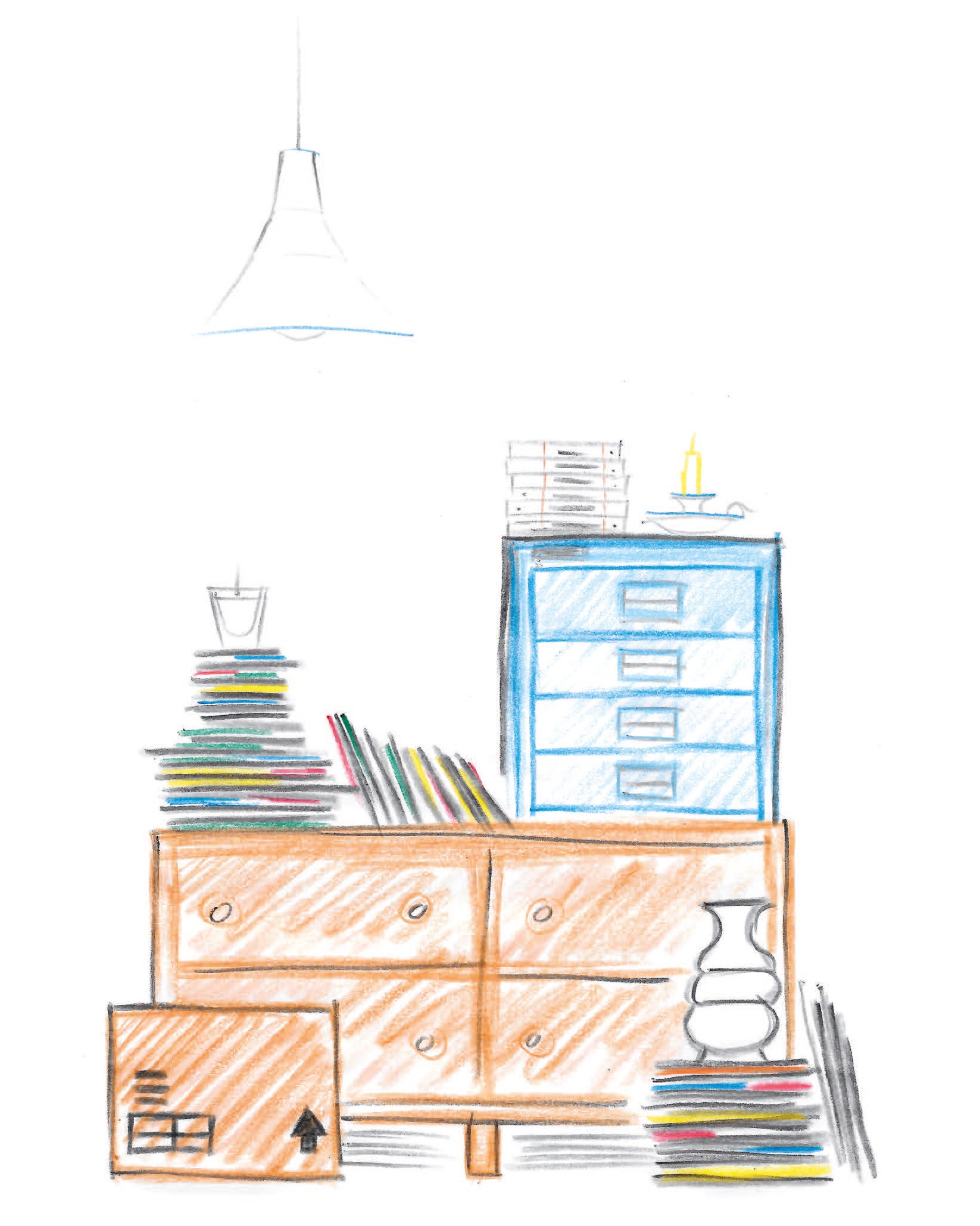
Illustration George Selwyn-Brace
But while Kondo’s book is full of actually quite sound advice about how to deal with accumulated clutter, Matsumo is perhaps a little too specific for a European audience, with tips on how to select and clean the samue robes and setta sandals worn by Zen monks, how to care for the family shrine, or re-paper shoji doors. Nonetheless, his central message is appealing: that a clean, uncluttered environment leads to a clean, uncluttered mind. Matsumoto advocates owning as little as possible, and quotes an old Zen saying: ‘Where there is nothing, there is everything.’ What you do have, he adds, should be high-quality and crafted with love so that it is pleasurable to use, and lasts for many years.
And I get that, I really do.
And yet, looking round my study now, I see a precarious tower of the London Review of Books, mostly unread and all no longer enticing – just another source of guilt, like the piles of weekend supplements stacked on shelves, each containing at least one thing I really will read… one day. There are boxes and files containing who knows what, two tall cabinets so full that I only ever open two of the drawers. There are recipes and notes that I really must get round to putting in Evernote, as well as all kinds of stuff it is hard to explain such as old watches, pedometers, chargers and cables, driftwood and stones from the beach, dusty candles and vintage vases that I’ve long since stopped noticing, let alone liking. And compared to many of my friends, who pay to keep their excess stuff in self-storage facilities, I’m positively minimal. The fact is, many of us now have an uneasy feeling about our accumulated belongings, a sense that our stuff has begun to own and control us, rather than the other way around.
A while back, I interviewed the British artist Michael Landy. He made his name with a piece called Break Down in 2001, in which he took over an empty shop front at one end of Oxford Street and after carefully cataloguing absolutely all of his possessions – 7,227 of them – he systematically destroyed them. His car, his clothes, his art collection, his credit cards, his clothes – everything he owned was reduced to dust over a two-week period, and at the end of it he owned nothing except a pet cat, and the boiler suit he’d worn for the installation. ‘My stuff wasn’t that different to anyone else’s stuff,’ he explained. ‘When people saw it, they then started to make a mental inventory of how much they possessed. And suddenly you start to think about how much stuff you own, and how you end up owning 7,227 things. It was about consumerism, but also about self-identity.’
In the developed world, we’ve all been trained to believe that our happiness depends on consuming, and we tend to measure our self-worth in terms of what we own. Yet on a deeper level, we also know the harm it is doing to our planet, our purses, our psyche. We’re full up. Stuffed to bursting point. Constantly decluttering, even while we’re compulsively bringing home more. So we subscribe to blogs like The Minimalist, we admire hipsters living in tiny houses and digital nomads travelling the world with all their belongings in a backpack or camper van. And we read Marie Kondo, hoping some of her life-changing magic will rub off.
It’s easy to mock Kondo’s method, with its odd way of folding clothes so they stand upright in drawers, and her insistence that you speak to your possessions, holding each one closely while you sort through them, to see if it sparks joy. If it doesn’t, she tells you to get rid of it. This works well with stained T-shirts and unwanted gifts, not so well with tax returns and tin openers, which rarely spark joy but are pretty useful when the inspector calls or you fancy beans on toast.
But you should see my sock drawer. Honestly, since being Kondoed, it’s a thing of quiet beauty. Gone are sweary mornings when I’d tip the lot out onto the floor, frantically scrabbling to find a matching pair. Now my socks, T-shirts and jumpers all stand to attention in neat, colour-coded rows in their separate drawers – and once set up, her system is surprisingly easy to maintain.
And yes, it brings me joy. Just not enough to tackle the rest of my stuff. Recently, a post on David Cain’s excellent blog Raptitude struck a chord with me. He talked about our compulsive search for novelty, for the new, new thing. He suggests that those of us who are established in our work and home lives, who have accumulated more than enough, take a year out of consuming to use and enjoy what we have, choosing to go deeper, not wider: ‘No new hobbies, equipment, games, or books. Instead, you find the value in what you already own or what you’ve already started. You consume media you’ve already stockpiled instead of acquiring more. You read your unread books, or even reread your favourites. You pick up the guitar again and get better at it, instead of taking up the harmonica.’
So I’m going to spring clean, then use what I have, from unfinished online courses to the watercolours I wanted to master. I’ll never be a Zen monk, but I’d like to try to make the rest of the house feel like that sock drawer. Then again, I’ve just noticed that Poundland has these neat new glass jars, which would be an ideal way of organising all the packets of pasta and dried foods cluttering up my kitchen cupboards. Wouldn’t they?
A Monk’s Guide to a Clean House and Mind by Shoukei Matsumoto (Penguin, £4.99) is out now