An Evening of Interconnection at the Barbican’s Our Time on Earth symposium
Words BEE EVELEIGH-EVANS
In July, as part of the Barbican’s ‘Our Time on Earth’, guest curators Caroline Till and Kate Franklin founders of futures research agency Franklin Till organised a diverse and eclectic showcase of art and design: a four-hour Symposium designed to look closer at the ideas of the exhibition and to speak in depth with many of its contributors.
The Symposium took place in the heart of the Barbican and like many others I arrived alone. The seating in the auditorium was so close-knit one ended up shoulder-to-shoulder with strangers. Throughout the evening the energy of the room was transformed. There was laughter, yes, but also a feeling of unity as each speaker built off the last, often returning to what had previously been said in an echo of agreement and connection; the medium of each speaker was different, the message much the same. As an English student on work experience with Hole & Corner, an evening like this was a welcome opportunity to discover more about the projects of the exhibition. Here are a few of the things I learned.
Letting Go
Before the symposium began Shanti Faiia, a breathwork and healing practitioner, was welcomed to the stage: not an epilogue to the Symposium but an introduction. In a series of meditation exercises we were encouraged to breathe together, feeling each other’s presence and reminded of our oneness. I became more conscious of my own breathing, my poor posture and partial focus. Faiia asked us to think of ourselves as an active community rather than a passive audience. It was from this vantage point that the rest of the evening progressed.
Bridging Worlds
Rather than viewing our analogue and digital environments as separate, the artists and makers of the symposium were concerned with bringing the outside world alive in the digital realm. Suddenly icecaps, rainforests and ecosystems are automated: characters in the digital studio DVTKs video game simulator are made interactive, and there is an opportunity for reflection in an installation by experiential art collective Marshmallow Laser Feast. The digital world offers a unique form of community able to bridge language and geographical barriers, allowing ‘radical collaboration’ and ‘relational economies’ to emerge.
View this post on Instagram
Lending An Ear
Dr Henrietta Moore, founder and director of the Institute for Global Prosperity, emphasised the necessity of communication for conservation and climate action, “language itself” our oldest and most versatile technology. The breathwork we practised in the first moments of the Symposium became relevant again; the discussion turned to the importance of pause, where listening became a more crucial skill than speaking. Often we came to a point of stillness, the audience waiting on the edge of a speaker’s sentence. The silence is as meaningful as the dialogue that follows it: the discussions are nuanced and charged with emotion; they cannot be rushed.
A Different Approach
Vinu Daniels, a proponent of camouflage and vagabond architecture, spoke powerfully about his design practice, Wallmakers, which makes constructive use of mud and waste. Wallmakers’ buildings are almost entirely recycled, the natural materials sourced from the site itself. The final products are a blend of earth tones and raw metals that feel almost otherworldly. Wallmakers utilises municipal and industrial waste in their construction, nothing is overlooked and nothing is discarded.
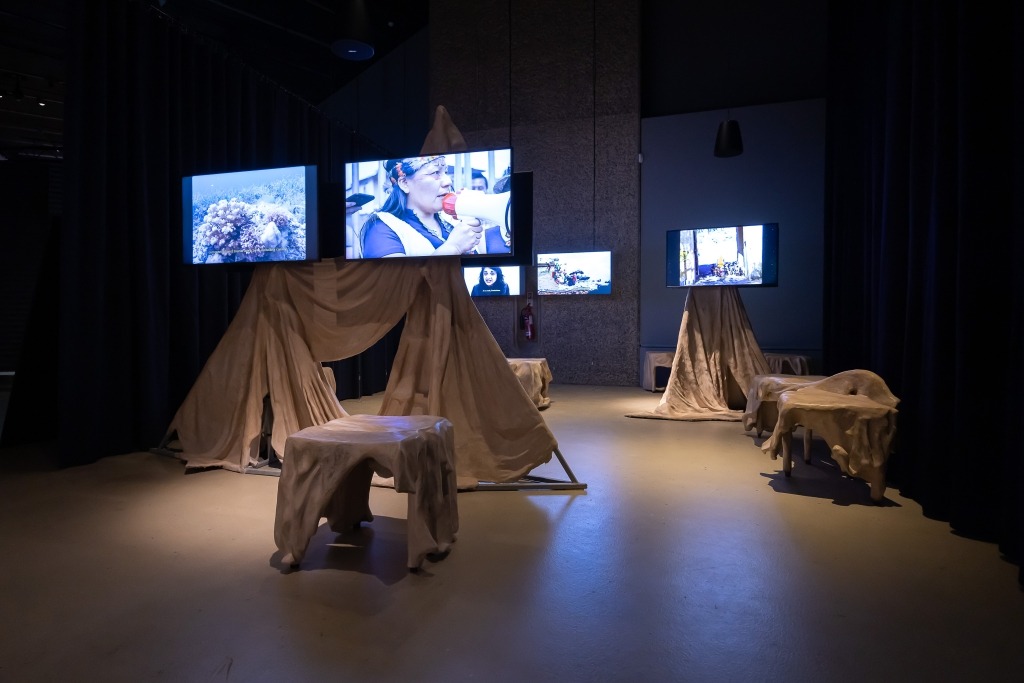
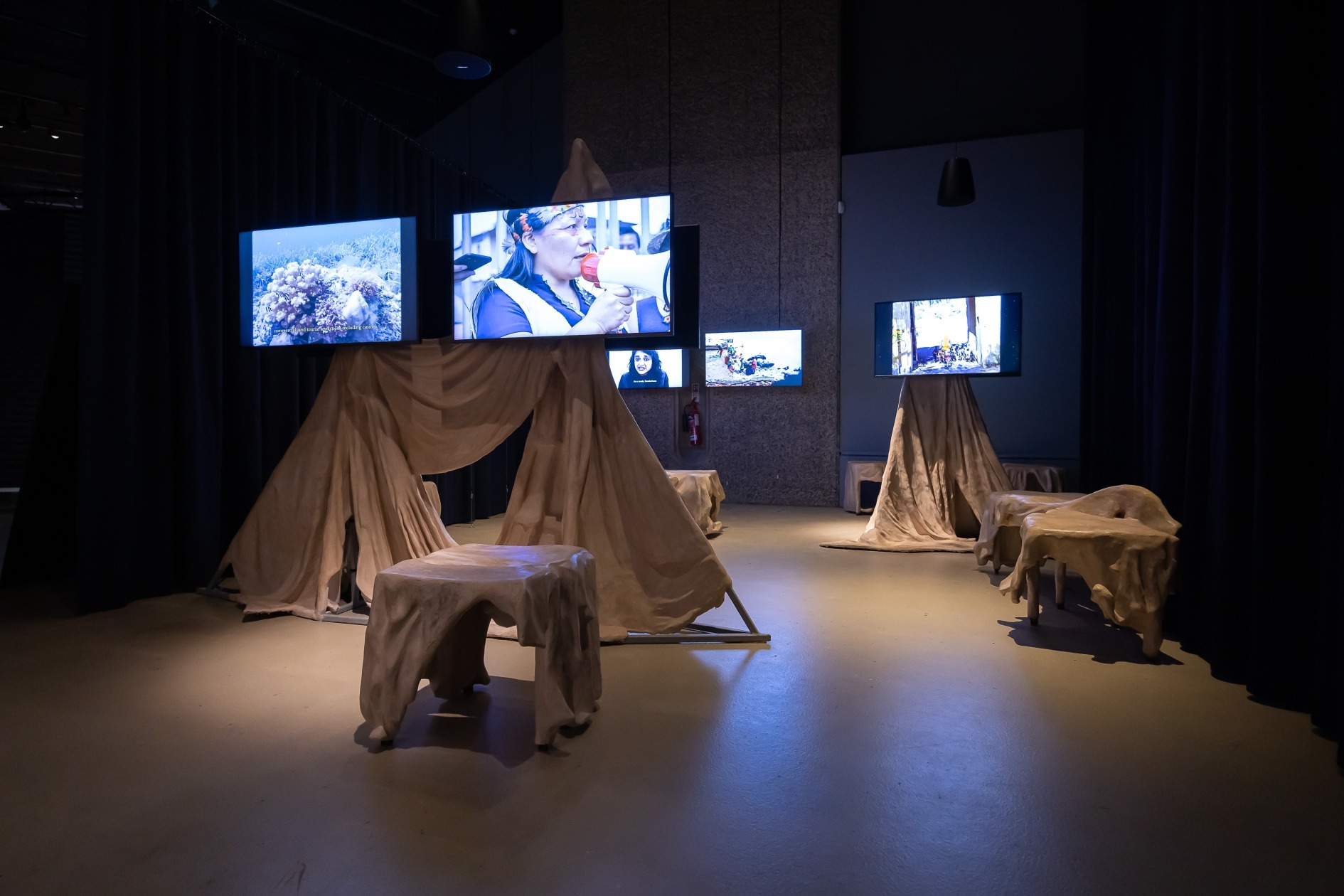
Wallmakers’ ‘Clothcrete’ installation and Stories of Change with The Earth Issue Tim Whitby/Getty Images
Southern India, where Daniels hails from, faces different environmental pressures to most of Western Europe. Wallmakers addresses the issues facing India specifically, and works with local communities to solve them. Daniels was commissioned to create a space for the exhibition at the Barbican and used fabric that had been damaged in the 2018 Kerala floods that affected Chendamagalam in India to create ‘Clothcrete’ – draped as reminders of the effects of climate change, demonstrating not only global solutions but local ones, both modern and ancestral.
Indigenous Voices
The key ideas around preservation and connection centred around indigenous voices. The evening ended with a powerful discussion between Patternity co-founder Anna Murray, filmmaker Marc Silver and indigenous activist Nina Gualinga. Questions of extractivism, appropriation, and conservation delved deep into the moral and cultural facets of environmental conservation. The talk ran over, neither the speakers nor the audience wanting it to end: there was so much left to be said.
We were each given a letter written by indigenous leaders Sonia Guajajara and Celia Xakriaba titled ‘We are the Earth’ inviting us to ‘join forces in this collective task’, making a commitment to heal the land.
The message was bigger than the Symposium, bigger than the Barbican or the exhibition itself. Walking home at the end of it all, the feeling of breathing together, first introduced over five hours before, returned to me. What the Symposium offered, and what ‘Our Time on Earth’ continues to offer is a change of perspective. The opportunity to leave together, even if one arrived alone.
‘Our Time on Earth’ is at the Barbican, London until August 29, after which it will depart on a five-year world tour.