I Colori Della Vita
Words Mark Hooper
Photographs Pete Drinkell
Uncovering secrets among the mist and silhouette of the River Po: through a ‘moral duty to respect the old ways’, the people of Soragna combine ‘know-how, meat of a good pig, salt and fog’ to produce an ancient delicacy…
I’m so full it hurts. It’s a sort of delirious, punch drunk sense of fullness: death by a thousand, wafer-thin cuts of pork. This has been one of those meals that creeps up on you; a slow, steady drip of exquisite courses. I may be ready to lay down my cutlery, but chef Marco Dallabona, who won a Michelin star for his food here at the Stella d’Oro, Soragna, isn’t taking no for an answer yet. His philosophy to food is simple: it is ‘a vice to which we must give in’.
Dallabona is every inch the epicurean. In fact, despite being Greek, Epicurus would find his natural home here in Soragna, a small town on the Bassa Paremense – the misty flatlands that form the floodplains of the River Po, sandwiched between the cities of Parma in the east and Fidenza in the west. Born in 341BC, Epicurus dismissed politics as a needless cause of stress and anxiety, instead preaching the virtues of pleasure – not in a hedonistic, orgiastic way, but through a modest dedication to the simple life.
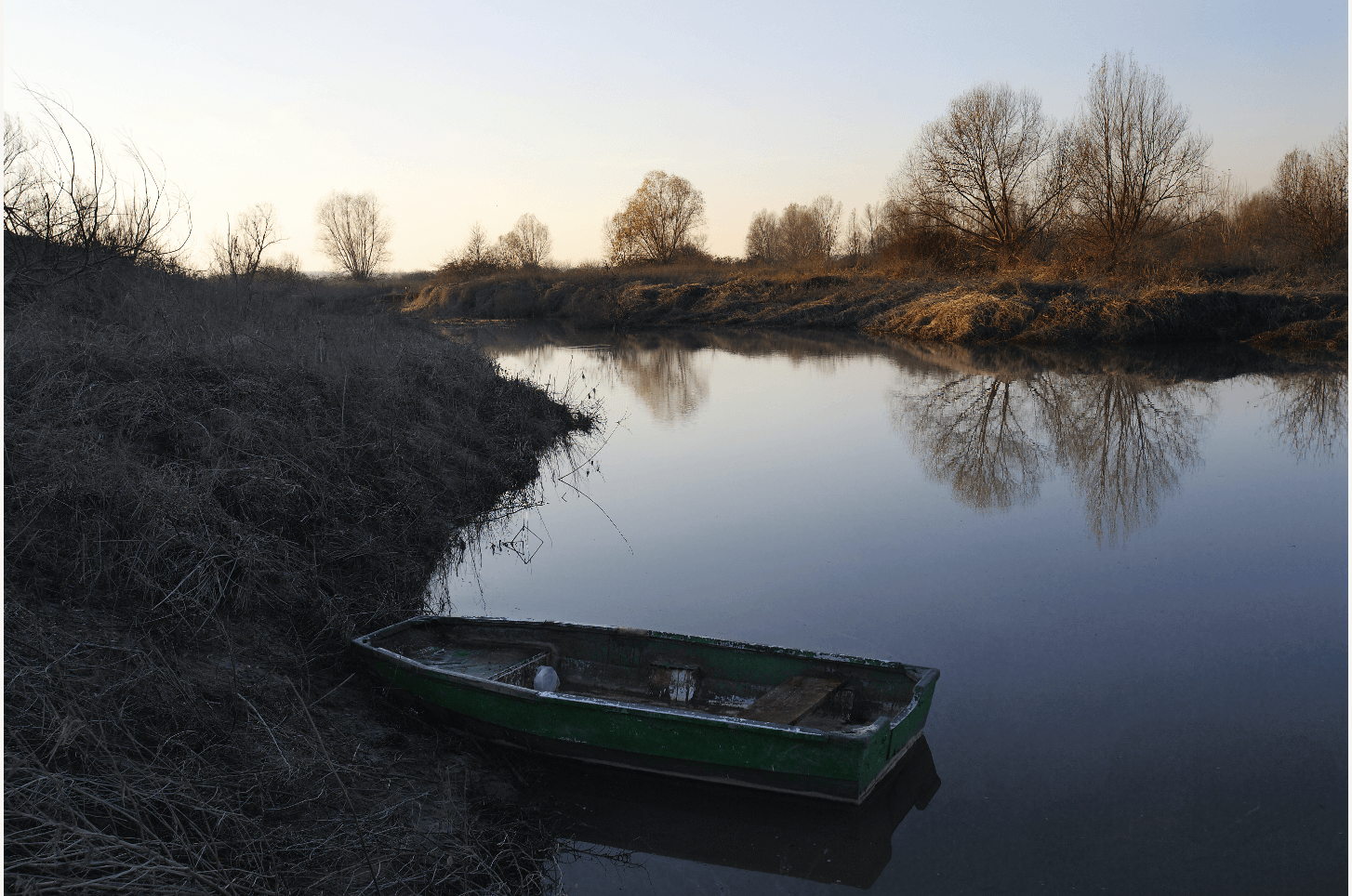
The microclimate around the River Po is responsible for the ‘noble mould’ vital in the making of culatello
They certainly like things slow and simple here. Like Dellabona’s food, Soragna itself creeps up slowly on you and gets under your skin until you have no option but to submit. Beyond the town, clouds of mist hug the landscape, enveloping everything save the occasional farm building that rises above the plains. Film buffs may recognise the atmospheric scenery as the setting of Bernardo Bertolucci’s 1976 epic 1900 (or Novecento) starring Robert de Niroand Gérard Depardieu. The great romantic composer Giuseppe Verdi – who championed ‘natural certainty’ over ‘fashion… innovation and an alleged scientific spirit’ – was born a few miles down the road in Le Roncole. This may all be grabbing at tenuous straws, seeing mystical links with nature where there are none, but one thing is clear: the local mist is partly responsible for Soragna’s – and Stella d’Oro’s – greatest delicacy. That’s the reason why we’re here.
Culatello is a bulbous, dry-cured ham from the prosciutto family. For those who are used to seeing their cold cuts pre-sliced and vacuum-packed on supermarket shelves, this may not sound particularly special. But we’re not talking about people who merely eat to live here. When I tell our host, Umberto Angeloni, MD of the menswear label Caruso, that I want to ensure we book some time to interview him about his philosophy, he offers up a brilliantly Latin shrug. ‘You want to understand my philosophy?’ he asks. ‘First you have to eat more. Then you’ll understand.’
The ham is cured for anything from eight to 40 months
Softly spoken, with the quiet satisfaction of a life lived well – of elegance over extravagance – Mr Angeloni is the embodiment of sprezzatura – a term first coined by Baldassare Castiglione in his The Book of the Courtier (1528) and meaning effortless style, or ‘an ease bordering on nonchalance’. It’s notable that, as well as their own designs, I had spotted the labels of a number of international fashion brands – Italian and further afield – during our earlier tour of the Caruso factory. I’m later asked not to mention the other marques that Caruso provides white-label designs for. Style here, it seems, is so effortless that they quietly lend it to their rivals to crow about.
An age-old sense of charm and poise seems to suit this region of mist and silhouette, its fertile flood plains so distinctive that they say you can taste where an individual pig has grazed. In fact, the reputation the Po basin has for its ham is as fiercely protected as the vineyards of Champagne in France or the sherry producing land around Jerez in Spain.
We are here for ‘November Porc’, an annual celebration of the month in which the local ham is cured. It’s an opportunity to celebrate and taste the local specialities, to mingle with its makers, a handful of connoisseurs and even the local prince. At least that was the theory. In reality, the festival has been thwarted by a combination of both unavoidable and entirely avoidable factors – from the meteorological to the political – as first local flooding and then industrial action cause delays and cancellations.
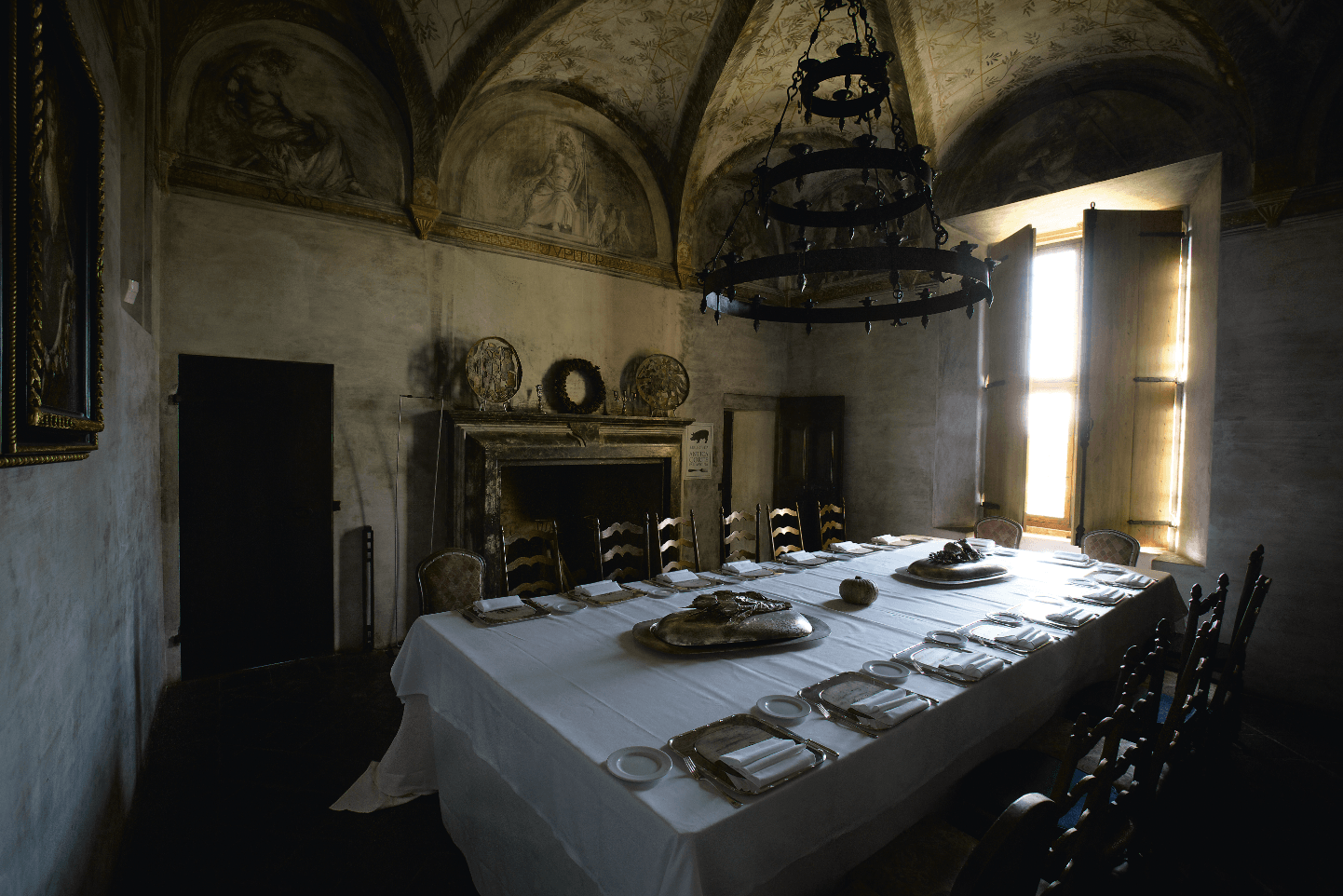
A table at Carte Pallavincini, a medieval castle turned restaurant, farm and hotel
Not that anyone shows the slightest concern. The general consensus seems to be: we’re here, so we may as well eat anyway. Namely at Corte Pallavicina, a medieval castle turned restaurant, farm and hotel that is home to Michelin-starred Massimo Spigaroli, dubbed ‘the high priest of culatello’. A self-styled ‘farmer chef’, Spigaroli’s links to the site date back to his great grandfather, who supplied Verdi himself with cured hams before moving here as a tenant farmer. In the warmer months he would tend pigs, cows and poultry (chickens, turkeys, geese and ducks) as well as farming everything from silk worms to watermelons, wheat and vegetables. From October to February, when the land is enveloped in cold fog and little other farming could be done, he would concentrate on curing pork, using ancient techniques and taking advantage of the damp conditions in the building’s cellars.
‘You want to understand my philosophy? First you have to eat more’
Over the years, the castle has been added to for a succession of uses – from a military garrison to peasant dwellings, while outbuildings have served various roles from ancient icehouse to a prison. Renovation in any proper sense only began in 1990 – incredibly, the last time the ruined buildings underwent what could be described as major restoration work was in 1550. In the intervening four centuries, the entire complex had fallen into disrepair not only through the passage of time and the usual exposure to the elements, but also thanks to the Po changing its course and flowing directly through the grounds.
Painstakingly restored using only local materials – stone, bricks made from the river’s mudflats, poplar and oak from the surrounding woods, Spigaroli has created a stunning restaurant, maintaining its medieval atmosphere and with sea level views of the Po. He talks of his ‘moral duty to respect the old ways’ – and this extends from the walls here constructed to the dishes he serves.
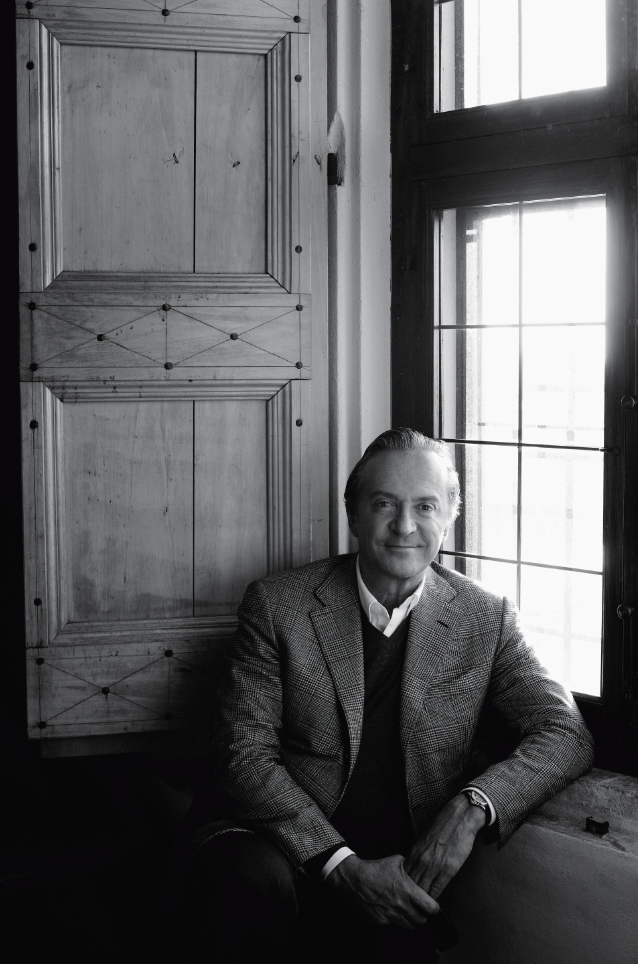
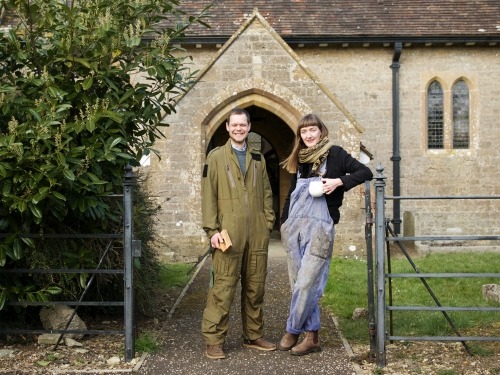
Menswear label Caruso’s MD Umberto Angeloni, the embodiment of sprezzatura, or effortless style
Culatello is a case in point. Said to have been invented when an apprentice made a mistake in the process of making prosciutto, salvaging what he could to cure, the first instance of culatello appearing on a menu is recorded as early as 1332 (for the wedding meal of Andrea dei ContiRossi and Giovanni dei Conti Sanvitale). To create it, an upper hind cut of the pig is seasoned and salted, often treated with wine, stuffed and tied in a pig’s bladder before being hung for a minimum of eight months to cure it. This is ‘slow food’ at its best: the restaurant’s speciality culatello, l’Oro degli Spigaroli, is left to cure for over 24 months (and sometimes up to 40 months). Furthermore, it has to be ‘breathed’ like wine and, sliced as thin as carpaccio, offers a slow release of subtle, nuanced flavours and melt-in-the-mouth consistency.
L’Oro degli Spigaroli is a ‘Riserva’ – a mark of out standing quality that also translates as ‘Forgotten in the Cellar’– a hint at how this variation was first discovered. The mysteries of the cellar are key to the production of this rare delicacy. The locals talk of the ‘noble moulds’ that occur due to a very specific set of conditions. The Consorziodel Culatello di Zibello, a regional body dedicated to maintaining quality control in the meat’s production, describe how ‘The ingredients for a good culatello are just a few and simple: people’s know-how, meat of a good pig, salt and fog.’
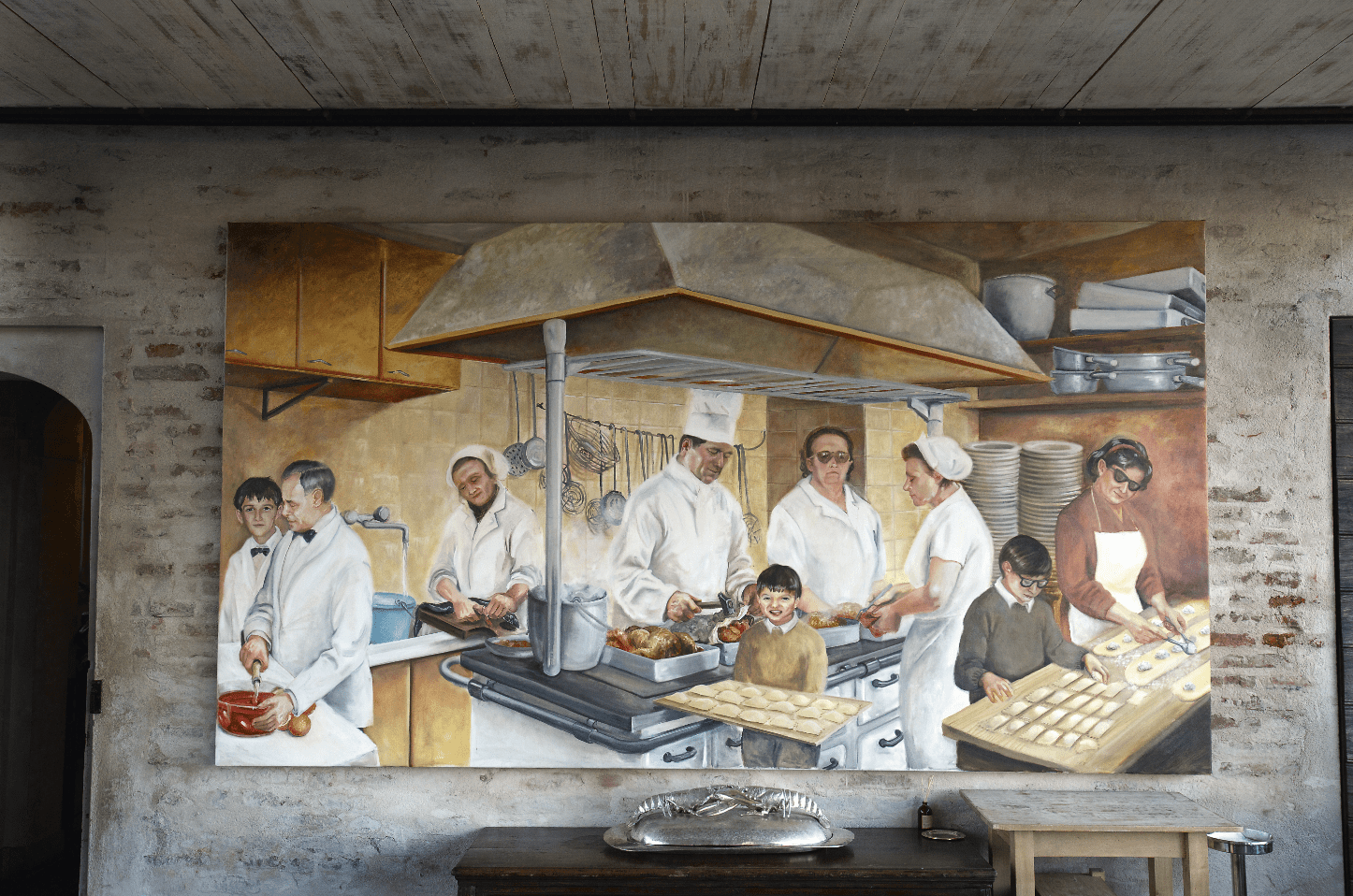
A mural of the Spigaroli family hangs in the main dining room (Massimo is the child in the glasses, yet to take over the family business)
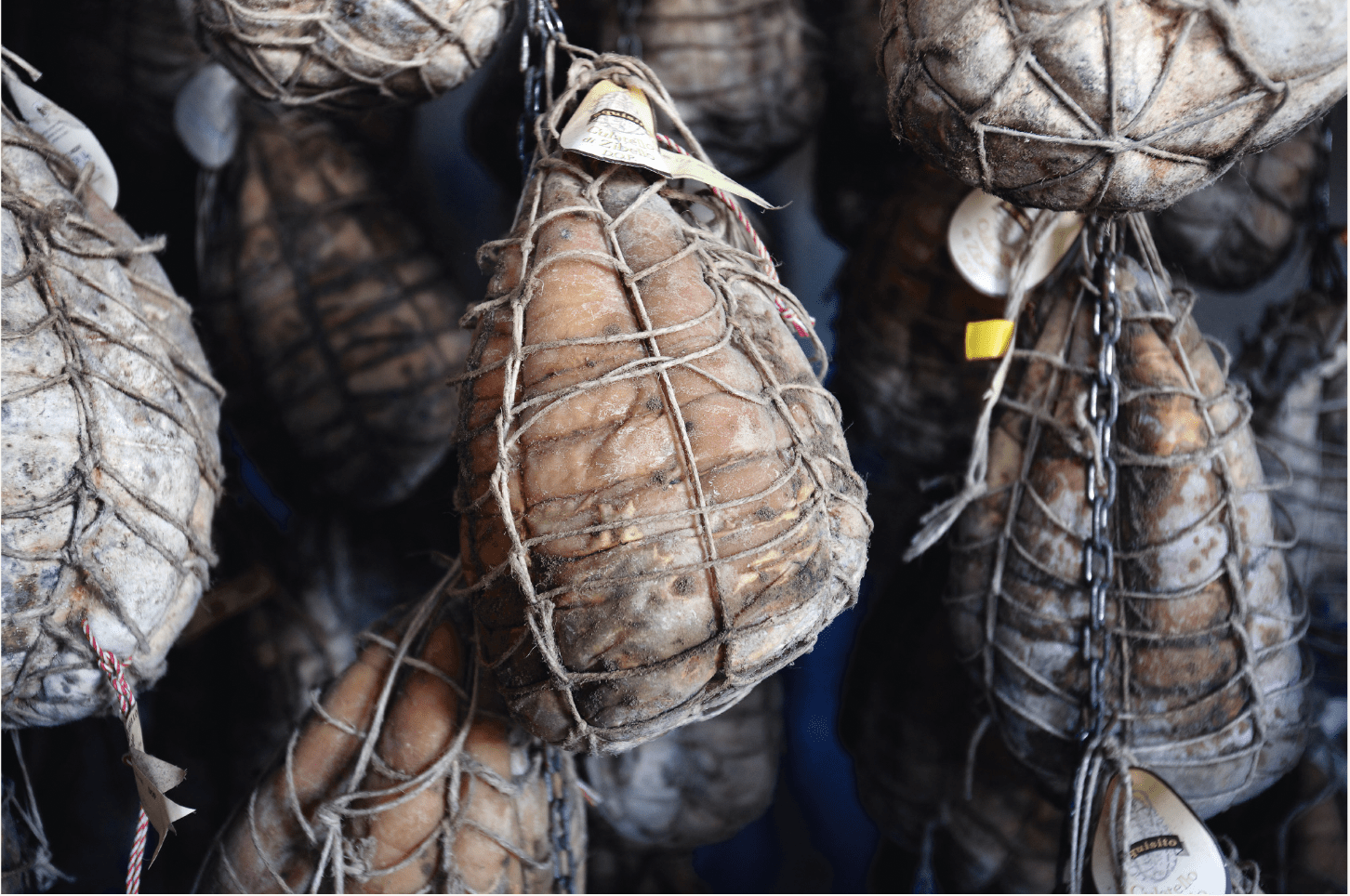
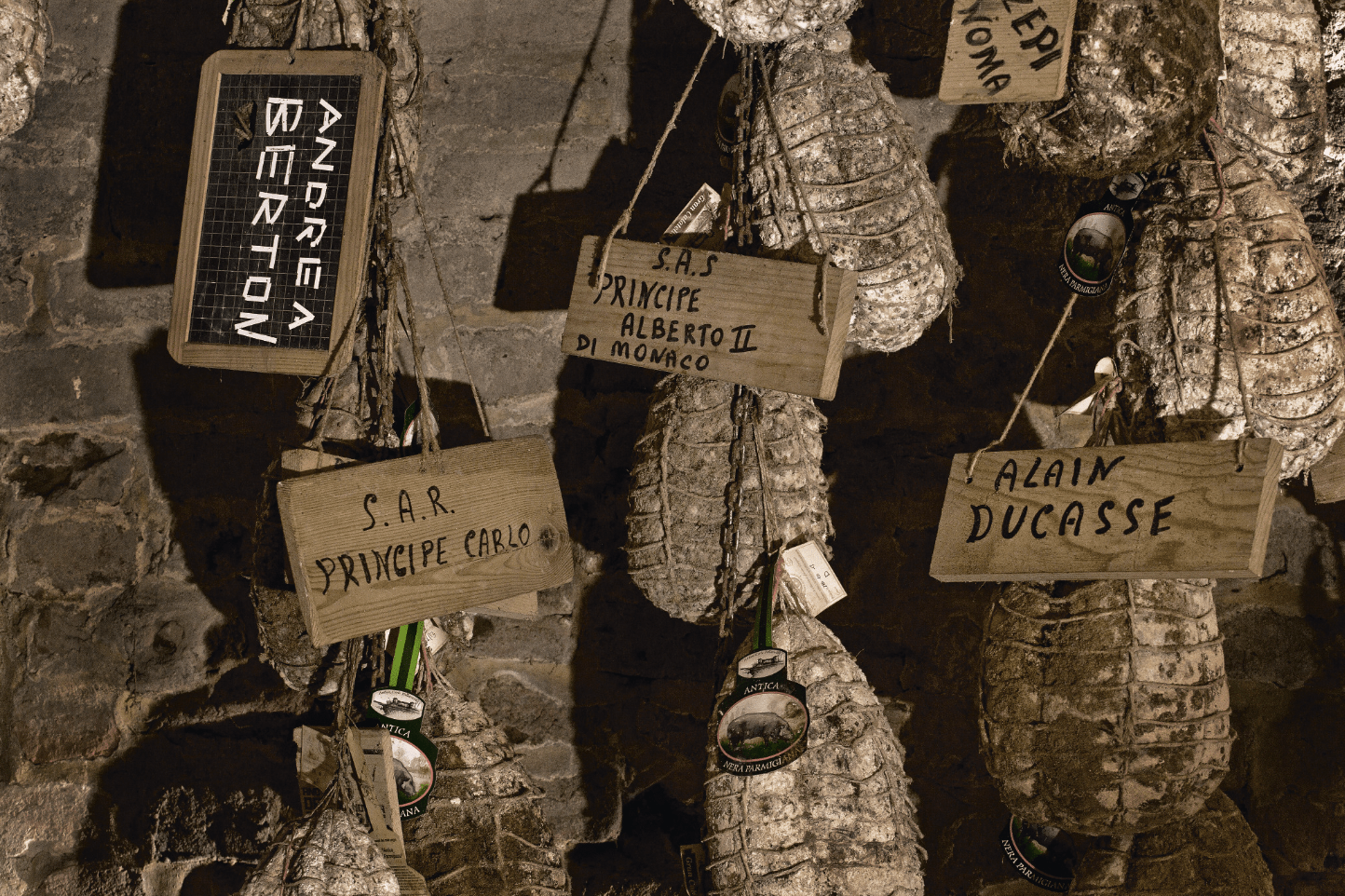
The winter mists that permeate every corner of the river basin combine with the damp, mouldy conditions of cellar rooms, that are often below the water table, to produce a perfect environment for curing. Such ancient, artisanal techniques are a health inspector’s nightmare – but, as our driver Giovanni cheerfully points out, no one complained for four centuries before the men in lab coats turned up. One thing is clear – no laboratory conditions can replicate those such as the basement of the Corte Pallavicina, where you’ll find culatello hanging from the rafters like pods from the film Alien, marked with chalkboards bearing the names of its illustrious clients – ‘Alain Ducasse’, ‘PrincipeAlbert di Monaco’ and ‘Principe Carlo’ (Prince Charles).
Another principe – the octogenarian bachelor Principe Diofebo – gives us a cheerful wave later that day as he cycles through the centre of Soragna in the direction of RoccaMeli Lupi, the medieval fortress that he calls his home. As this year’s (and indeed, every year’s) guest of honour at November Porc, the Principe was due to accompany us along with Mr Angeloni, extolling the virtues of the land and its produce. But with the River Po and Milan’s baggage handlers combining to keep us apart, the Principe has instead invited us for a personal guided tour of his home.
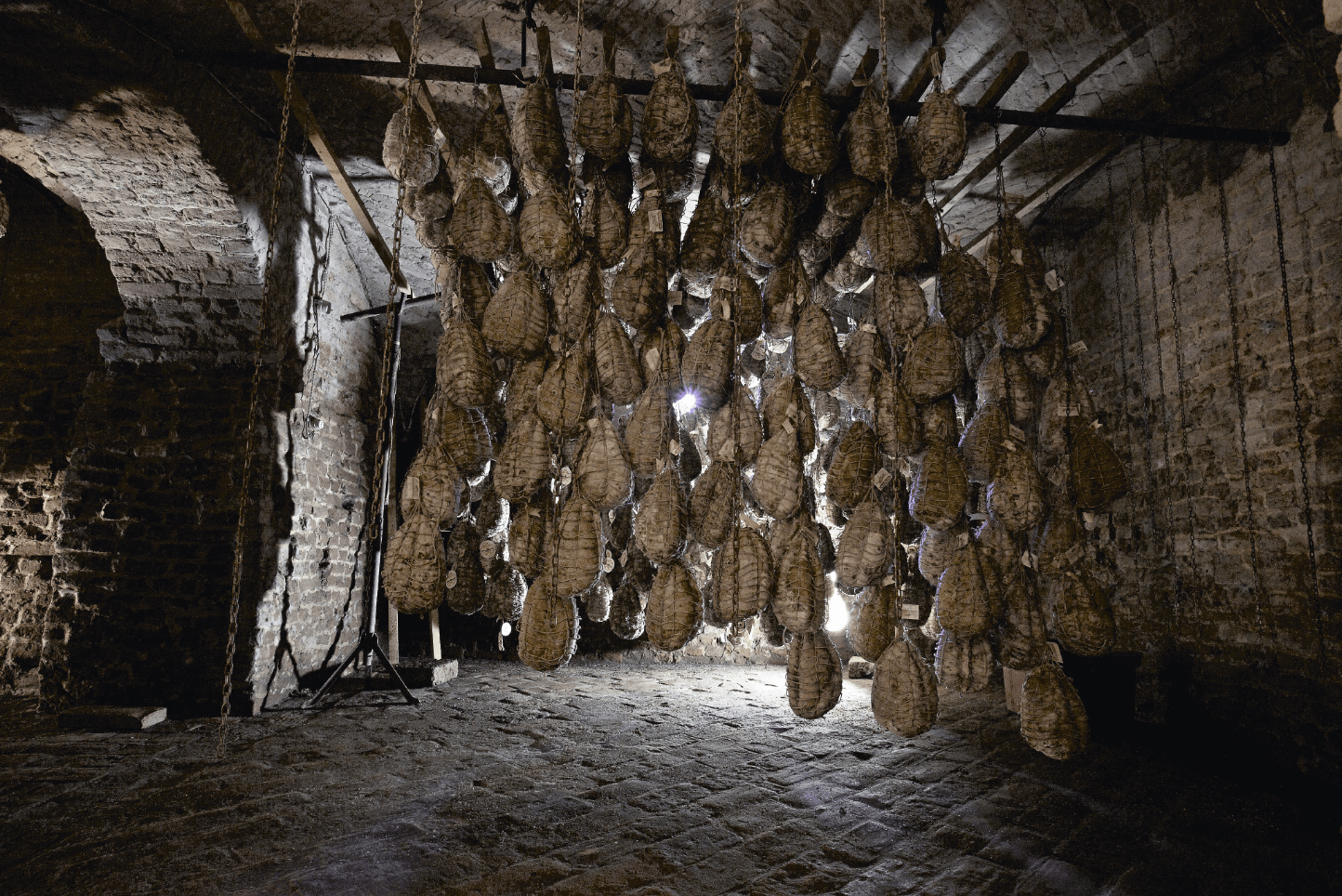
Hams hang from the rafters in the cellars of Corte Pallavicini, where the damp, mouldy conditions produce the perfect environment for curing
Like the Director’s Cut of Apocalypse Now, intriguing, unexplained characters keep appearing out of the mists on our trip. Trying to work this into a narrative – such as my attempts to prise Mr Angeloni away from his meal – are proving pointless. We’ve long since learnt to go with the flow, forget any idea of an itinerary, get into cars whenever a friendly face beckons us to and eat whatever’s put in front of us. It seems the only sensible thing to do.
Over the centuries, trade has replaced grudges as Soragna’s neighbours have fallen for its subtle, sophisticated charms, from its opera to its tailors to its cuisine. With November Porc cancelled and our personal tour through the town’s history at an end, there remains one last chance for the mists of the Po give up their secrets. As we wind our way back to Milan, Giovanni asks if we’ve had lunch. Being English, we say we’ll pick up a sandwich en route. Unimpressed, he turns the car off the main road and down what is little more than a dirt track that looks like it will peter out on the bank of the river.
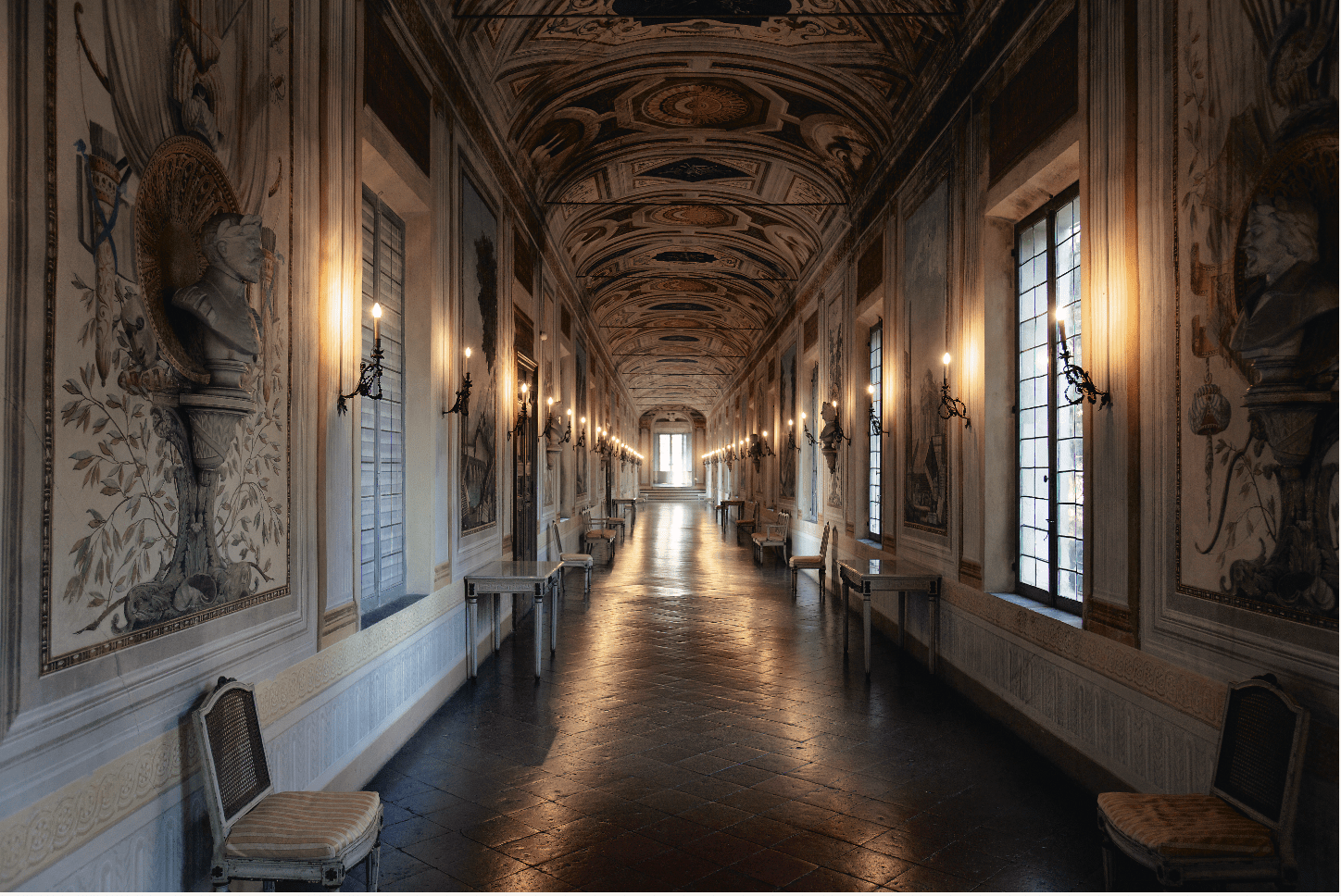
The medieval magnificence of the Rocca Meli Lupi includes its series of world-famous frescoes
Instead, we pull up outside a small taverna, La Vecchia Baracca, and Giovanni orders ‘something simple’. Cue piles of culatello, a vast chunk of parmigiano and a pot of honey. Plus, of course, a bottle of local Gutturnio – a weak, red frizzante wine which is drunk out of an endlessly topped-up bowl. (And ‘more like Ribena’, as Giovanni explains, while pouring us one more for the road.)
Simple it may be. It’s also the third best meal I’ve ever had. It would probably rank even higher, if I hadn’t just had the first and second best the day before. Nothing new, nothing flashy: just the simple things done to perfection, following age-old techniques and traditions, letting the vagaries and accidents of nature guide the way. In the words of Verdi, ‘Tornate all’antico e sarà un progresso’ – ‘Let us turn to the past: that will be progress.’
anticacortepallavicinarelais.com; ristorantestelladoro.it; Caruso is available at Trunk; trunkclothiers.com; carusomenswear.com