Family Repairs
Words KATIE TREGGIDEN
Photographs JASPER VAN DEN BOSCH
Repair skills used to be passed down through the generations, until they weren’t. But now a rising culture of craft is celebrating the lost art of repair – and the stories to be found in the stitches. We meet three London-based artists who are helping to turn the tide…
Ask people about mending and, chances are, they will talk about family: the grandmother who darned their socks or the mother who patched the knees on their jeans. Family stories are intertwined with repaired objects, either embodied in the damage and repair itself or captured in the cross-generational conversations that take place while the mend is carried out.
Traditionally, skills such as mending and sewing were passed, almost literally, from hand to hand – from mother to daughter. When the next generation wants to disassociate itself from the past or from traditionally female skills, or they become cash rich and time poor, or increasingly, surrounded by disposable consumer products, the motivation to learn dissipates – and the skills and the stories are lost. Recently, mending has been undergoing something of a renaissance and a search on Instagram for ‘#visiblemending’ returns more than 117,000 images. Contemporary mending is driven by a number of factors: environmental concerns, a desire to honour the labour of garment workers, as well as, sometimes, necessity. But there is also the desire to embrace the flawed realities of a life well lived and the storied patina of repair.
London-based artists Celia Pym, Aya Haidar and Ekta Kaul each have very different lives, but ask them about mending, and they will all tell you about how family is interwoven.

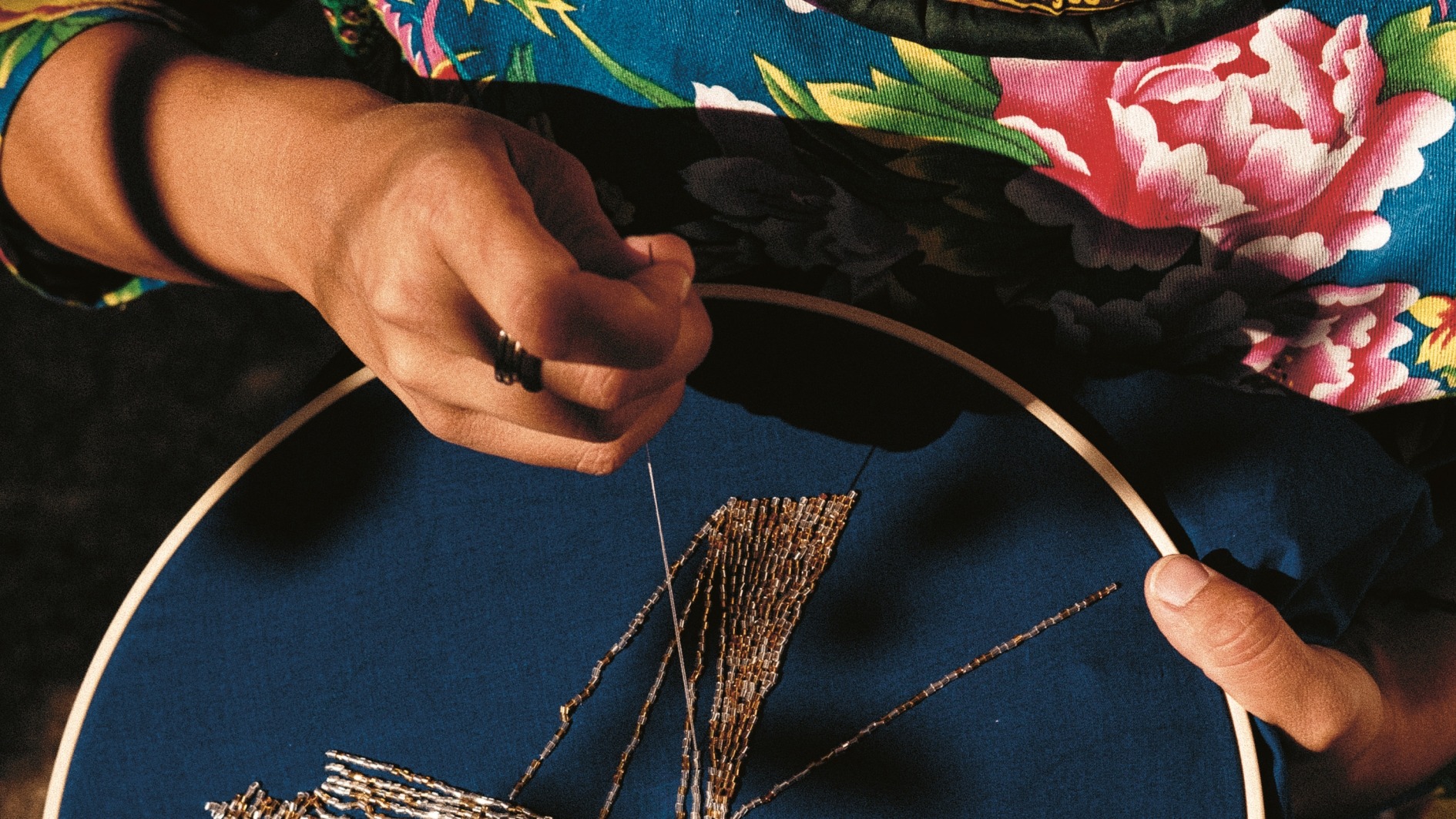
Growing up in India where mending was part of living, Ekta Kaul was first inspired by her grandmother, who would collect scraps of fabric and make them into quilts using the ‘gudri’ technique of embroidery
Ekta Kaul
Mending as a way of life
Textile artist Ekta Kaul sees mending as a matter of respect. She grew up in India, where mending was part of family life; a reflection of its deep roots in the wider culture, where everything from ceramics, jewellery and textiles, to electronic gadgets, is routinely repaired. ‘I always felt very connected to the land and the resources it provides,’ she says. ‘My ancestors were farmers, so my dad would always explain to us that somebody had worked really hard to get the food to our table – there was always this notion of respecting the land and the labour that had gone into it – any leftovers were reinvented into something else the next day.’
And it wasn’t only food that her family saved and repurposed. Kaul describes her mother as extraordinarily creative. ‘Apart from being a brilliant scientist, my mother was also a prolific needlewoman,’ says Kaul. ‘When we outgrew our jumpers, she would unravel them, steam the wool so it was nice and fluffy again, and then reknit it into new patterns she had learnt. She embroidered, knitted and playfully reinvented textiles constantly. I absorbed this throughout my childhood.’
Similarly, at the start of each winter, Kaul would see beautiful quilts laid out on the side of the streets, soaking up the sun before being used again for the next season. The quilts would be unstitched, the wadding taken out and beaten, aired in the sunshine, and sewn back together – often using the same thread. ‘I’ve often wondered if the idea of rebirth and the circularity of life, which is so entrenched in Indian culture, manifests in our culture of recycling as well,’ she says. ‘Mending was and still is very much a way of life.’
It was quilts that provided Kaul’s entry point into textiles. ‘My grandmother had a huge bag – it was blue with flowers embroidered on it – and she would tuck into it any scraps of fabric, or parts of saris, that she wanted to save,’ says Kaul. ‘Once it was full, we would start making quilts.’ Kaul would layer up the pieces of fabric, so her grandmother could sew them together with long rows of running stitch. Stitching layers of discarded fabric together into quilts – known as Kantha in the west – is a tradition practised in several parts of India, each with its own regionally specific name. What Kaul and her grandmother were practising was gudri.
Having studied at the National Institute of Design in India, Kaul travelled to the UK in 2005 to take a Masters in Textiles and was surprised to find that mending and respect for materials was no longer part of the culture. ‘There seemed to be this disconnect, where traditional knowledge – once passed down through generations – had been lost in the post-industrial era,’ she says. She soon found herself drawing on her upbringing within her artistic practice. Using techniques inspired by gudri, she now creates embroidered maps that explore places, history and belonging, through stitch. She won the 2021 Cockpit Arts Textile Prize and has work in the collections of the Crafts Council, Liberty London and the Gunnersbury Museum. Having lived in diverse, vibrant cities such as Edinburgh, Bath, Ahmedabad, Delhi and London, she describes her work as ‘rooted in the non-binary’ and imbued with a plurality of perspectives and cultural influences – not least those of her family.
Celia Pym
Mending as a method of communication
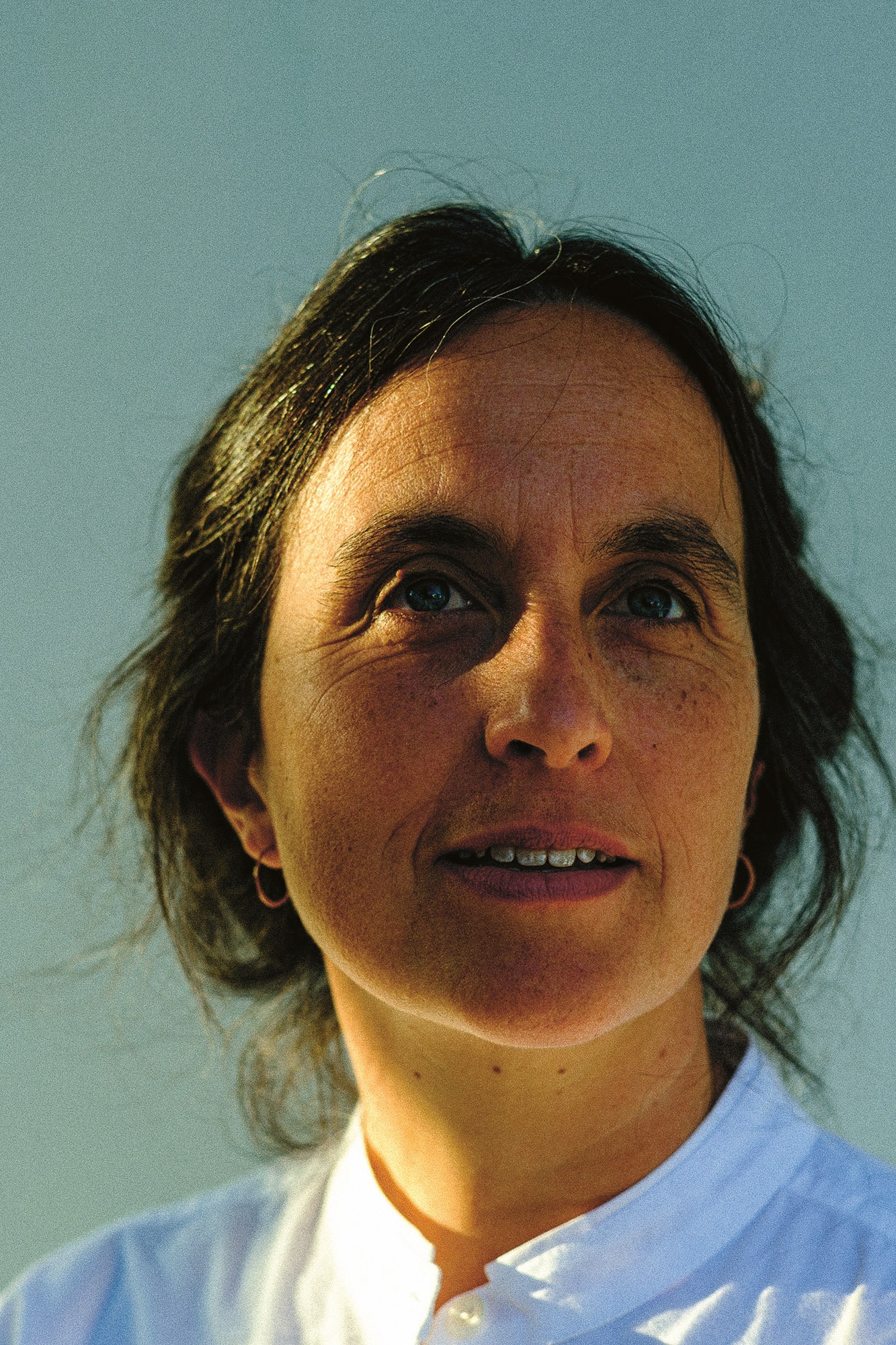
Celia Pym describes herself as someone who is more interested in damage and the conversations it sparks, than the act of repair itself. Even so, as a textile artist she has been exploring mending as a method of communication since 2007.
Her fascination started with a rather odd gift from her father. Her great uncle had recently died and her father had found a ragged jumper while clearing out his house. ‘Knowing that I like things that are a bit wonky and a bit lopsided and damaged and wrong, he gave it to me thinking I might be interested in it,’ says Pym. ‘And he was right, I was – in fact I was really quite taken with it.’
The jumper had been hand-knitted from a cream-coloured yarn and was full of holes in the forearms. Remembering that her great uncle used to sit in an armchair with a wooden board across its arms, and draw, she quickly worked out what had caused the holes.
‘My great uncle was an artist all his life, and as he got older, he would lean forward in this armchair and draw all day,’ she says. ‘So, when I saw these holes, I was really struck by how instantly I could see him sitting in that chair – how the damage could evoke the very particular and specific movements of his body.’ (She confesses that she is equally thrilled by the leg-shapes left in a pair of tights at the end of the day.)
Pym became curious about what she found so moving about this jumper and, as she looked more closely, she noticed that similar holes had been darned before. Her great uncle’s sister had undertaken a series of pragmatic and unsentimental mends over many years, using whatever yarn was to hand, but she had died a decade before he had. ‘Seeing her repairs next to this fresh damage, I couldn’t help feeling that we had somehow neglected him in these intervening years,’ says Pym. ‘And of course, he hadn’t been neglected. He was safe and well and had everything he needed, and yet, there were these fresh holes that nobody had been tending to.’
Determined to rectify that and having missed the chance to learn from her great aunt, Pym took herself off to the library, looked up darning in a book, and started to repair her great uncle’s sweater. The rest, as they say, is history. In 2017 Pym was shortlisted for the Women’s Hour Craft Prize with two darned garments, and her work has been exhibited all over the world – and all because her dad thought she might appreciate a tattered old jumper that had belonged to his uncle.

For Aya Haidar, mending is a way of telling and retelling her family’s stories
Aya Haidar
Mending as metaphor
As a self-described ‘mother, artist, and humanitarian,’ Aya Haidar’s creative practice focuses on found and recycled objects, through which she explores themes of loss, migration and memory. It all started with a very special sewing machine. ‘Every day after school, I would go to my grandmother’s house,’ she says. ‘I would sit across the table from her while she sewed and mended things on a Singer sewing machine – and she would tell me stories from her childhood.’
Haidar’s grandmother and her parents are Lebanese. The civil war led to her parents fleeing to Jordan in 1982, where they got married, then moved to Saudi Arabia. Haidar was born in 1985, and when she was six years old, the family came to England, leaving almost everything behind – apart from that sewing machine. It had come into her grandmother’s life in the most unexpected way. Aged six, at a tea party, Haidar’s grandmother took a sweet from a bowl and popped it in her bag to eat later. When she opened it, she noticed something on the inside of the wrapper. She had a won a sewing machine! It was duly shipped to Lebanon, and this was the machine she used, mending and remaking the family’s clothes until her death at the age of 99. ‘To be brought up with someone like my grandmother as a principal figure in my life, I definitely credit her for that influence.’
For Haidar, mending is a metaphor – a way of telling and retelling her family’s stories. For Recollections, from the Seamstress series (2011), she photographed sites around Beirut, printed them on to linen, and ‘repaired’ the cracks and bullet holes in the buildings with what Glenn Adamson describes in his book, The Invention of Craft, as ‘coloured bandages’. ‘It was about filling these voids with colour,’ Haidar says now. ‘It was a way of embellishing, but also highlighting, something that my family find ugly, not just ascetically, but in the sense that it reminds them of something horrific – but something that absolutely needs to be remembered.’
She continues to work with refugees arriving in the UK, running embroidery workshops as well as creating artworks that tell their stories. ‘I see my work as layering a story on top of a material that already tells a story itself,’ she says. Her Soleless series (2018) comprises shoes that were worn by refugees across borders and are beyond repair, but are now embroidered with images of their owners’ journeys. ‘Instead of throwing them away, I felt like they needed another layer, because they physically carried these people across countries,’ she says. ‘For me to embroider an image of that journey onto their soles tells that story so powerfully.’
Haidar’s education has taken in Chelsea College of Art and Design, the Slade School of Art, the School of the Art Institute of Chicago, and a Master’s in non-governmental organisations and development at the London School of Economics. Her career as an artist includes solo and group shows in London, Berlin, Jeddah, Paris, Dubai and Turkey. Her humanitarian work makes a difference to thousands of women and children, and talking to her, you get the distinct impression that her grandmother’s wisdom is being passed on to the next generation of women too.
Read more about these three artists in our Issue 22: Family.
It is available to buy here.