Reviving the tradition of British Glassblowing
Words Meena Sears
Mick, the cab driver who has collected me from Audley End train station, is nattering away unapologetically as we slalom down country lanes. We arrive at a cluster of old barns. One of them is decorated by the stylish logo of the glass design studio Batch.
‘Oh the glass-blowing place!’, exclaims Mick, one arm on steering wheel and head swivelled over shoulder, ‘You should have said! I shuttle people back and forth from here all the time.’ He is either referring to the Batch Academy or Batch Wednesdays, glass-blowing courses provided by this small, independent glassblowing company just outside Clavering, in rural Essex.
Batch, founded by Phoebe Stubbs and Jonathan Rogers, designs and manufactures small batches of hand-blown glassware as well as providing courses to everyone from absolute beginners to aspiring makers. It is becoming harder than ever to become a skilled glassblower in the UK, as courses such as the ones that Phoebe and Jonathan themselves took (Stubbs at Bournemouth and Poole College and Rogers at Edinburgh) are being closed down. Just recently, the undergraduate course at Wolverhampton closed leaving only four remaining, with one of them seriously under threat. The Batch team hopes to revive British glass-making by passing on their skills to anyone willing to learn and by maintaining the tradition of factory apprenticeship schemes.
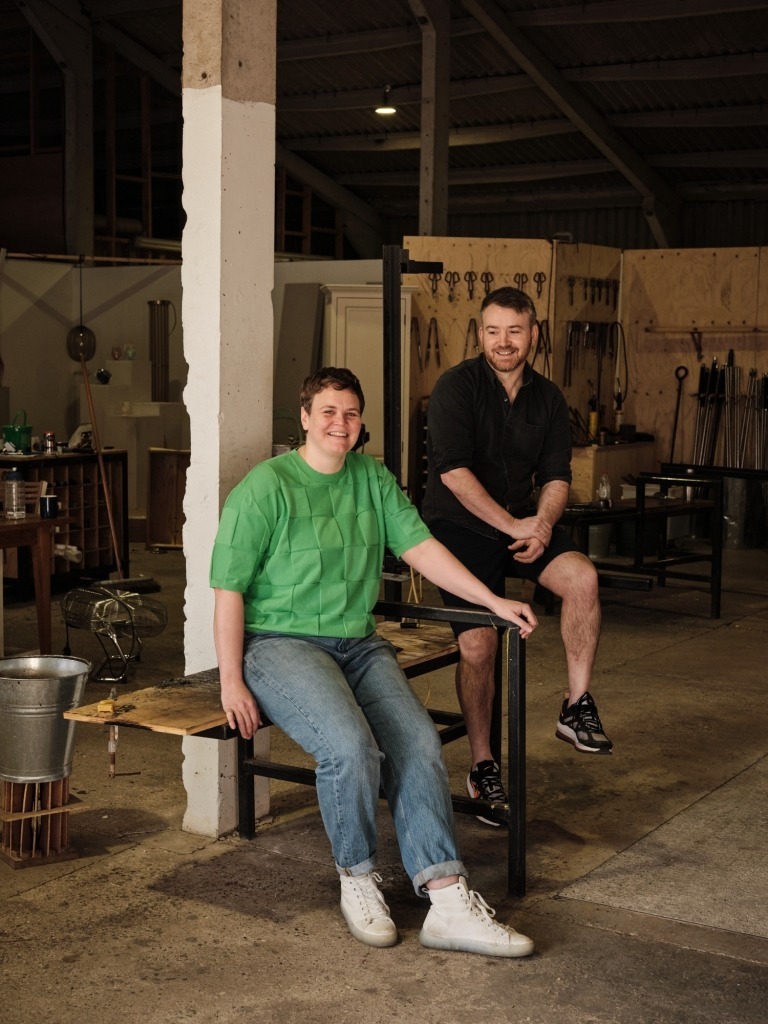
Batch founders Phoebe Stubbs and Jonathan Rogers
This tradition entails a training programme in which a maker teaches an apprentice to become an assistant and, eventually, a junior glassblower. The problem in the UK, Stubbs tells me, is that studios are generally not big enough to have two glassblowers and so, because the cost of starting your own studio is so large, people get stuck in the role of assistant. But Batch is looking to change this, and they have already taken one student, Will Rapley, down this training pathway from apprentice to assistant to production blower.
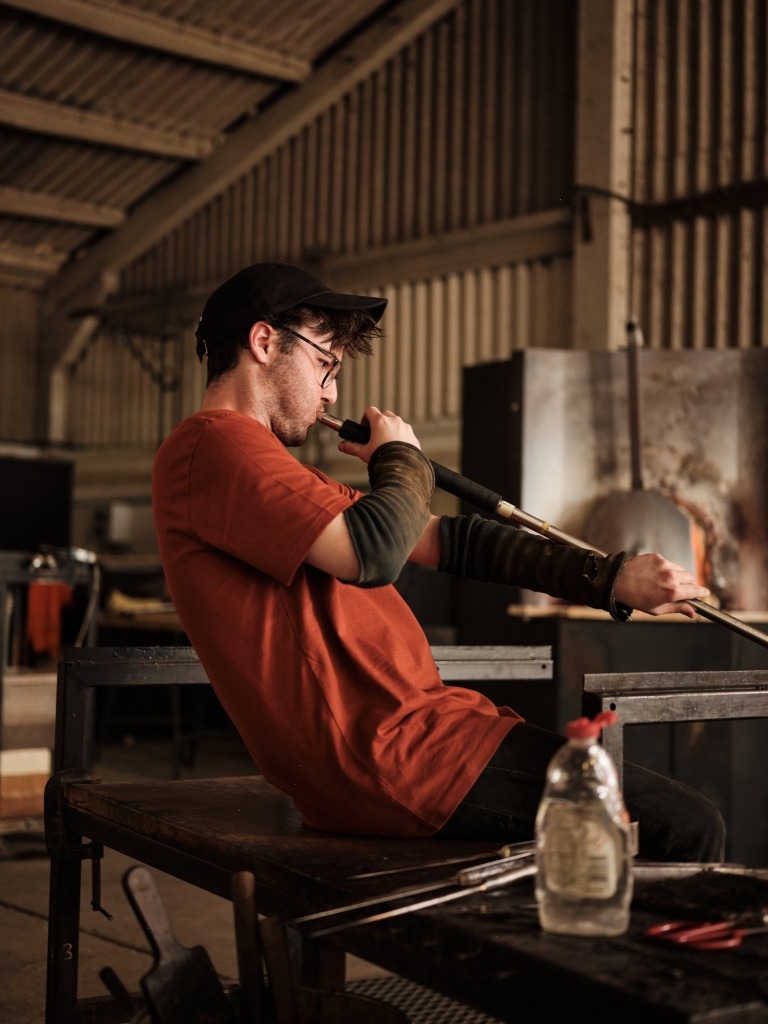
Batch student Will Rapley
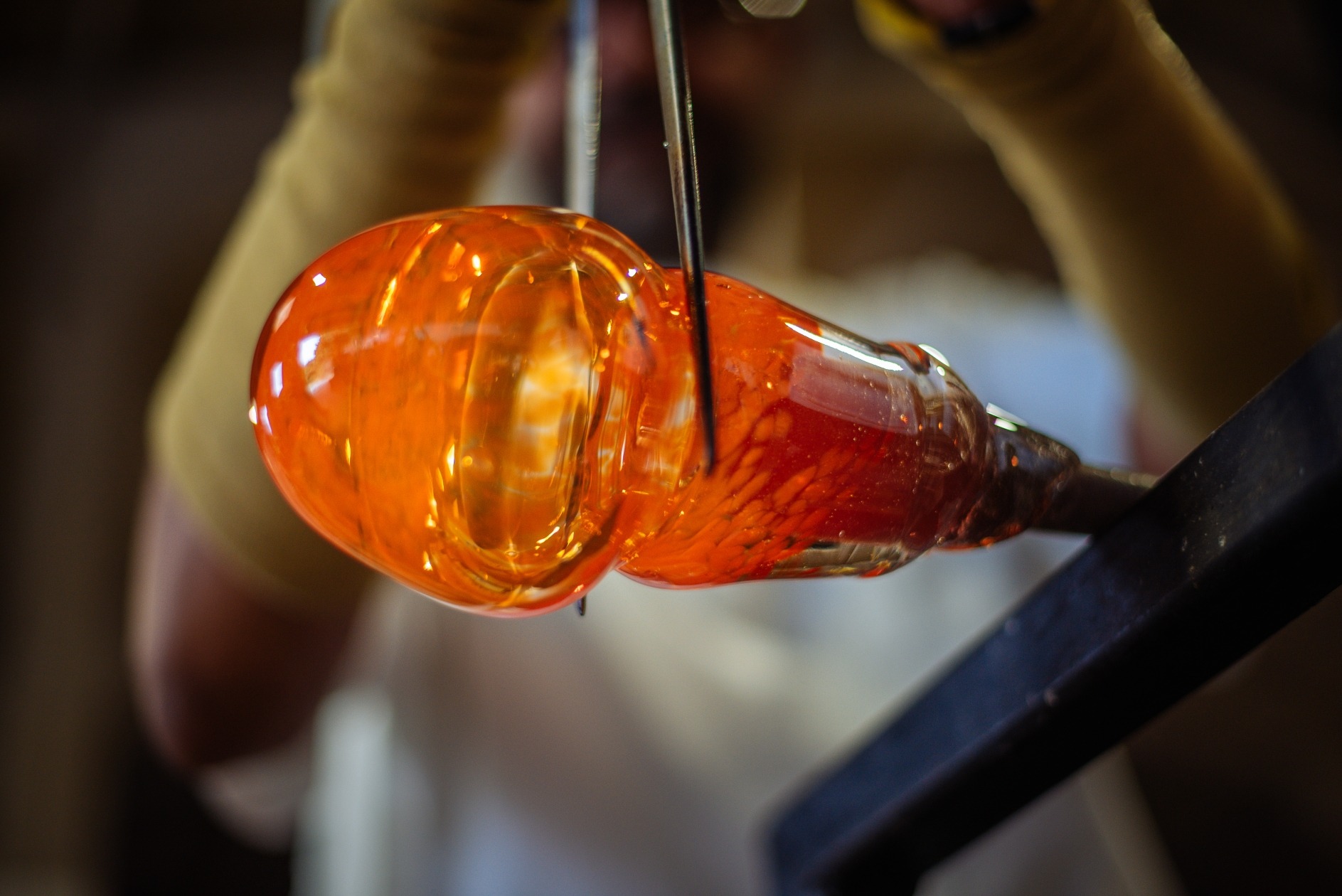
Inside the workshop, there is a large furnace (which looks a bit like a pizza oven) that is used to melt the batch – the raw ingredients that become the molten glass. ‘It’s like a pot of honey in there,’ Stubbs tells me as she slides the door across to show me the lava-like liquid. The heat hits my skin immediately. It must be constantly over 1,000°C in order for the glass to stay in its molten form.
We are surrounded, in the studio, by glassware of all shapes and sizes; some endearingly striped like candy cane, others sleek and sophisticated, ready to be shipped to various Soho House properties around the world. The company sustains its small-batch production by collaborating with a number of brands to design bespoke collections of lighting and tableware. Recent collaborations include those with Henry Holland and Eagle & Hodges.
Unlike other glass-blowing factories around the world, which mass-produce the same objects every day, Batch can adapt its workshop to make glassware for different collaborations. The name is a nod to this more traditional-style, small-batch process. The small team of makers is constantly learning new skills in order to create new glassware and take on different projects. As Stubbs says, it is a really satisfying experience to feel yourself getting better as you work and watch your team perfect a new skill. ‘When we start a new project, we have to figure out how to make it work and then, you watch everyone get better at it and it’s really satisfying.’
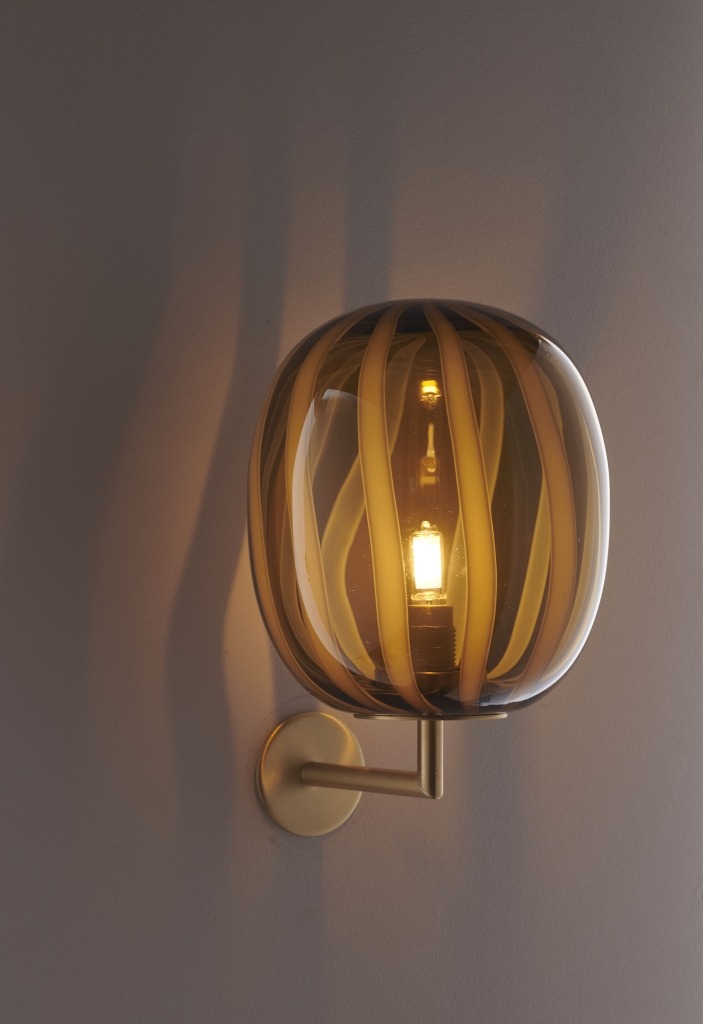
Batch Humbug wall light
She shows me a video of her team at work. They manoeuvre around one another with long steel rods – made all the more dangerous by the 700°C blobs of squishy glass at the end of them – as if the entire scene had been choreographed. While one maker gathers glass from the furnace onto their blowing iron, another is pulling at their blob with a tweezer-like tool. There is something exciting about the scene – the tension between the movement of the makers as they turn their irons constantly, maintaining momentum in order to prevent the molten glass from dropping, and the delicate work that is done to perfect these fragile objects. This is heightened by the constant flow of movement as they glide from the bench to the reheating furnace, knowing instinctively when it is necessary to reheat their glass so it doesn’t solidify as they are shaping it.
For Stubbs, this is what attracted her to glass-blowing when she quit her job as assistant to an architecture firm back in 2007. ‘I think anyone who has gathered glass from a furnace knows that feeling of making something that requires such total concentration from you that nothing else comes into your world while you’re doing it. If you even start entertaining thoughts of some argument you had, or something that is off in the distance, you can feel that everything starts to go wrong. It’s just pure flow, and it really keeps you in the moment.’
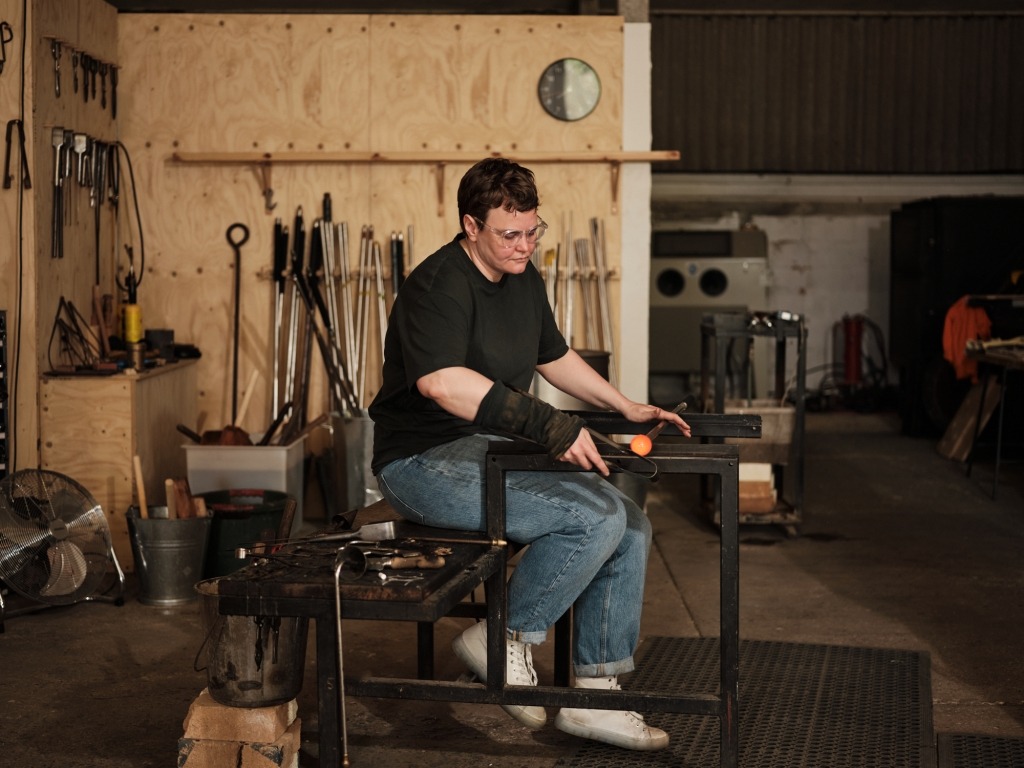
‘It’s just pure flow, and it really keeps you in the moment,’ says Phoebe Stubbs
Batch is planning to enlarge its team in an attempt to tackle the energy crisis, which has doubled their fuel costs overnight. ‘It may seem counterintuitive when costs are going up,’ says Stubbs, ‘but, for us, we have to be more efficient with each day, which means putting more glass in the annealer [the kiln that brings the glassware’s temperature down slowly overnight] per day than we were doing before in order to be more profitable.’ In fact, the rising cost of energy has amplified a problem that Batch was already thinking about and forced it to speed up its longterm plan of becoming more energy efficient. `We had been wanting to get an electric furnace anyway to run as a smaller furnace that we could use for remelting our waste glass to create a line of work that’s entirely recycled.’
For the moment, completely replacing their current gas furnace with an electric one would actually use more energy for the same glass output and be prohibitively expensive. ‘But,’ Stubbs tells me, ‘in the coming years, when UK electricity is drawn more from renewable sources and the equipment for melting large quantities of glass becomes cheaper, we will switch to an electric furnace.’ In the meantime, they are doing all they can to become more efficient and reduce energy consumption such as replacing their reheating furnaces with ones that are smaller and double-ended (meaning two makers will be able to work from the same workstation at once), which will almost halve the carbon footprint of the furnace.
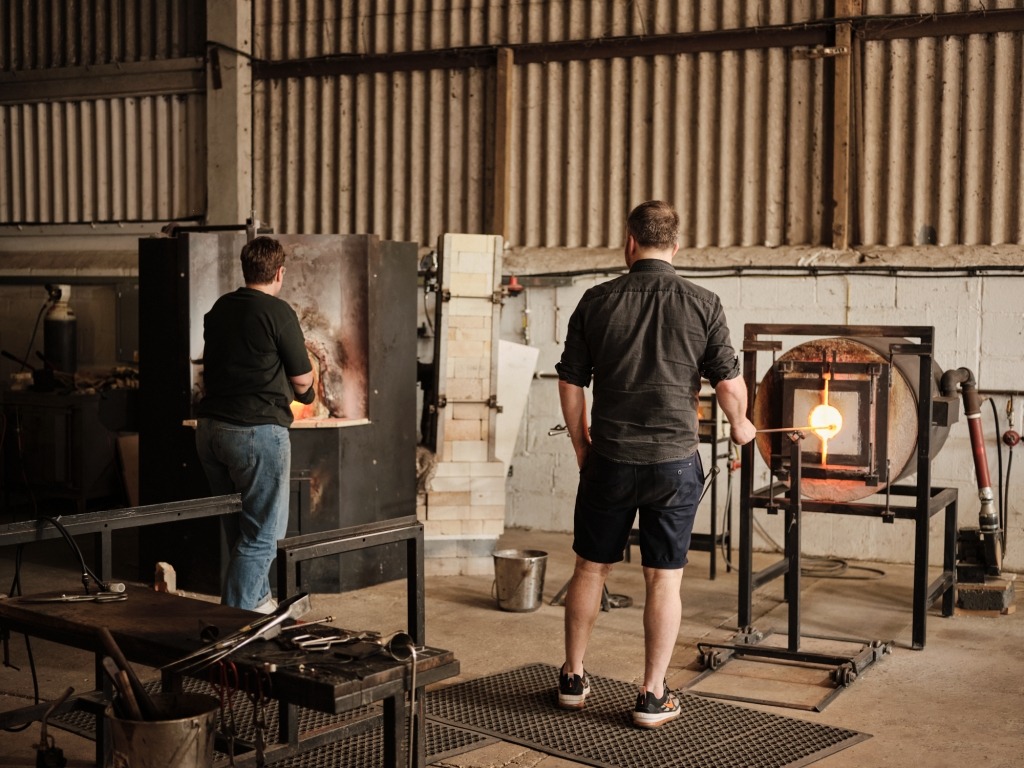
Phoebe Stubbs at the furnace (left) and Jonathan Rogers at the reheating furnace
Unlike other places she has worked, Stubbs explains, where you can’t measure your progress and you feel as if you never actually finish anything, there is a sense of satisfaction with glass-blowing: ‘You make something, then it goes in the annealer and then the following day it goes out the door.’ I am struck by the simplicity and truthfulness of her words.
To discover more, and to book at course on the Batch Academy, visit batch.glass