Labour of love
Words Craig McLean
Photographs Sam Walton
The descendant of Lithuanian immigrants turned miners, embroiderer Richard McVetis’s fascinating family history, deeply embedded in the coal industry, has formed the background and basis of his latest complex and extraordinary work, Coal Seams…
Richard McVetis’s great-grandfather docked at Leith, Edinburgh’s port area, in 1912. Christoph (or Christof) Makswitajatis and his family were travelling from Lithuania and Germany en route to America, to become farmers. They only disembarked because one of their number was ill. Then, ashore in Edinburgh, they were mugged; the Leith of 1912 seemingly as rough ’n’ ready as the Leith of the 1980s, of Irvine Welsh’s Trainspotting.
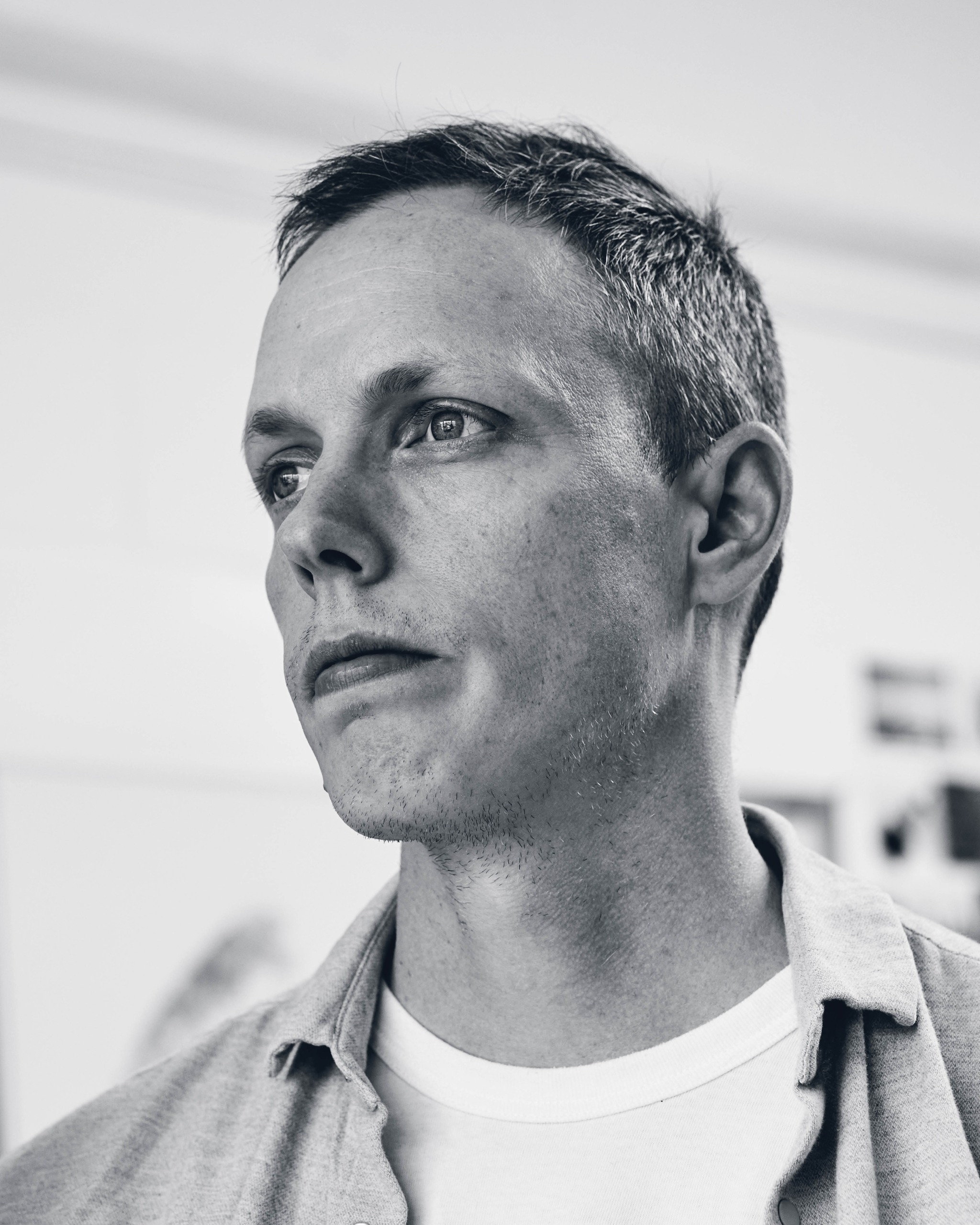
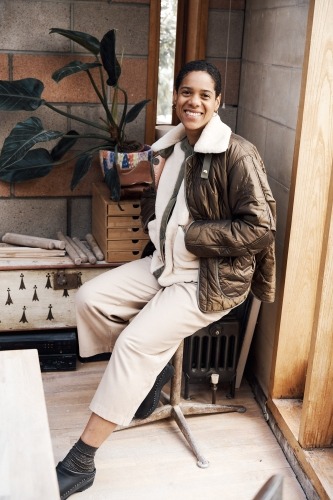
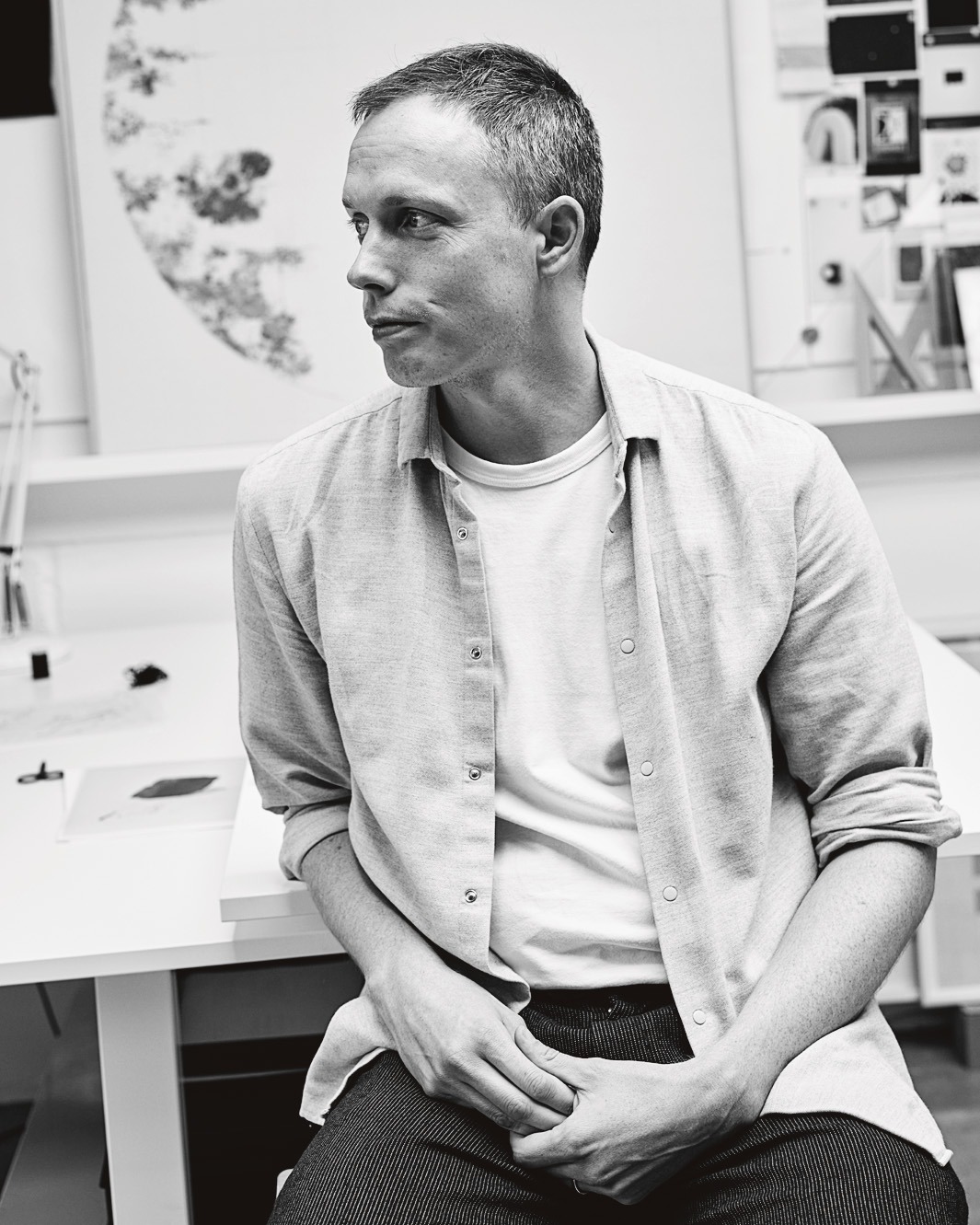
Embroidery artist Richard McVetis
This forced the Lithuanians to stay in Scotland. But with no money, no skills and no English language, Makswitajatis and his kin sought out the coalfields of Newtongrange, Midlothian and the Lady Victoria Colliery, which came into production in 1894. At least there they might eke a living by all they had to hand: their labour.
‘That was the start of our history in this village,’ says McVetis. The embroidery artist, 38, studied Embroidery at Manchester Metropolitan University and graduated from the Royal College of Art in 2008, with an MA in Constructed Textiles. He picked up a needle when he was 21, after seeing a degree show ‘and was really drawn to the potential of it as a drawing process. l like things that take a long time, so it connected with that. It really was just a chance encounter with textiles.’
Much of his hand-embroidered work is abstract. A piece like White Circle on Black (2021) is just that, a disc of white embroidery in a black square of wool. A Happening of Things (2021) is a sliver of a waning, lunar-like planet. Fade to Grid (2021) is a white, woollen cube, delicately dotted with black embroidery on its faces and edges. In that simplicity, by his painstaking, purposefully labour-intensive, micro-specific artistry, McVetis creates worlds of wonder. As his website puts it: ‘The mapping of space and marking time and form are central themes… Ideas are often developed in response to, or created specifically to, a moment, visualising and making this a tactile and tangible object.’ Until 2018 he also had a parallel career in retail design; ‘flying round the world designing stores for Adidas and Reebok’.
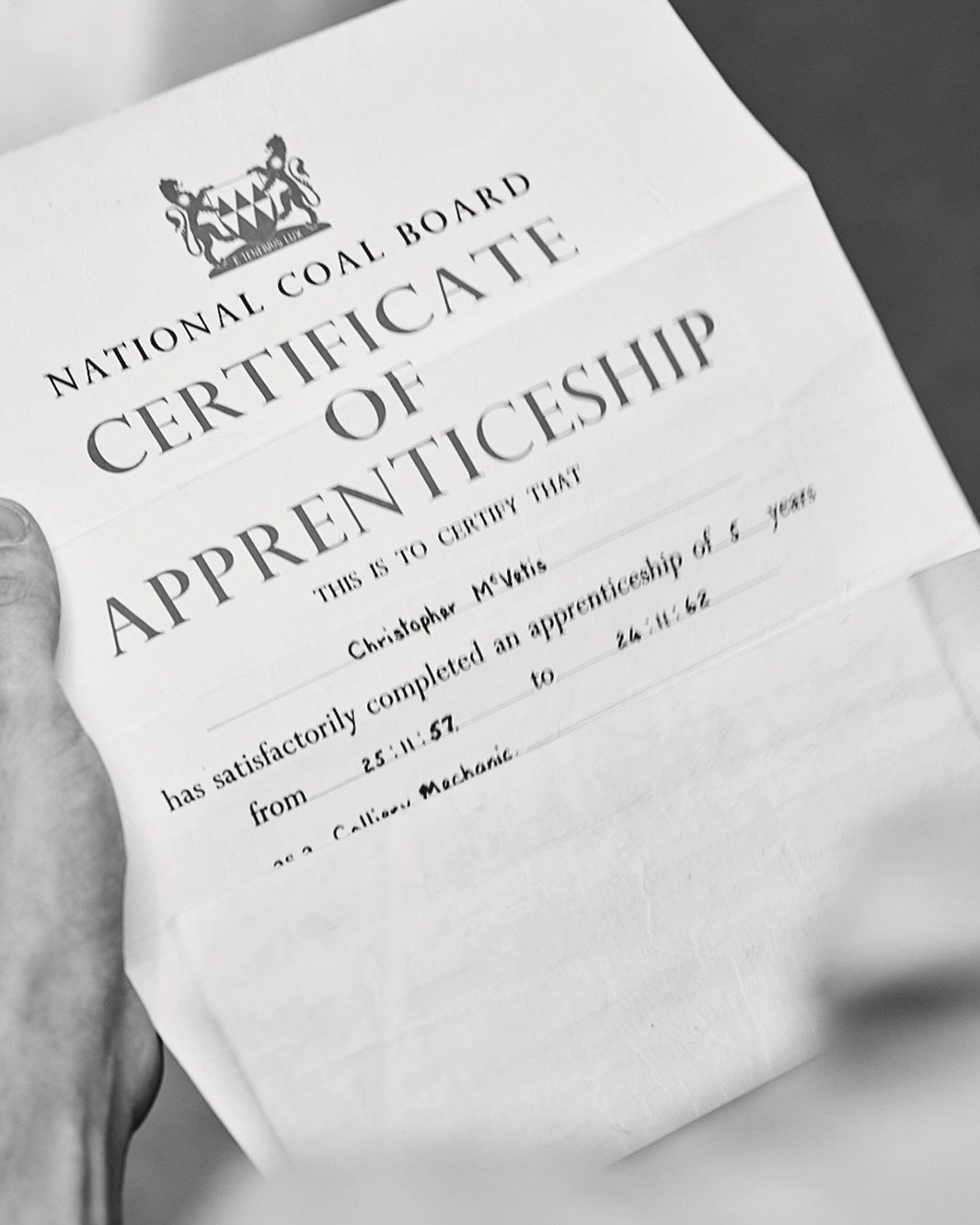
The National Coal Board certificate awarded to Richard’s father on completion of his five-year apprenticeship as a colliery mechanic between 1957 and 1962 at Esk Valley Technical College. ‘My dad was super clever,’ says McVetis, ‘but his only option was to work in the mine’
We meet in the Saturday morning quiet of the cafe at the National Mining Museum at Newtongrange. McVetis’s trip from his home in Stoke Newington in north London to this mining community, 30 minutes south-east of Edinburgh, was ostensibly to visit family, but it has been complicated by Covid. They have to self-isolate so, having come all this way, he can’t actually see them.
McVetis lifts on to the table the research behind his new work. This file of family papers, genealogical history, geological drawings, United Nations reports and 19th-century Encyclopaedia Britannica entries are the resources and inspirations he has woven together into a new piece he unveiled in October, at the British Textile Biennial in Lancashire.
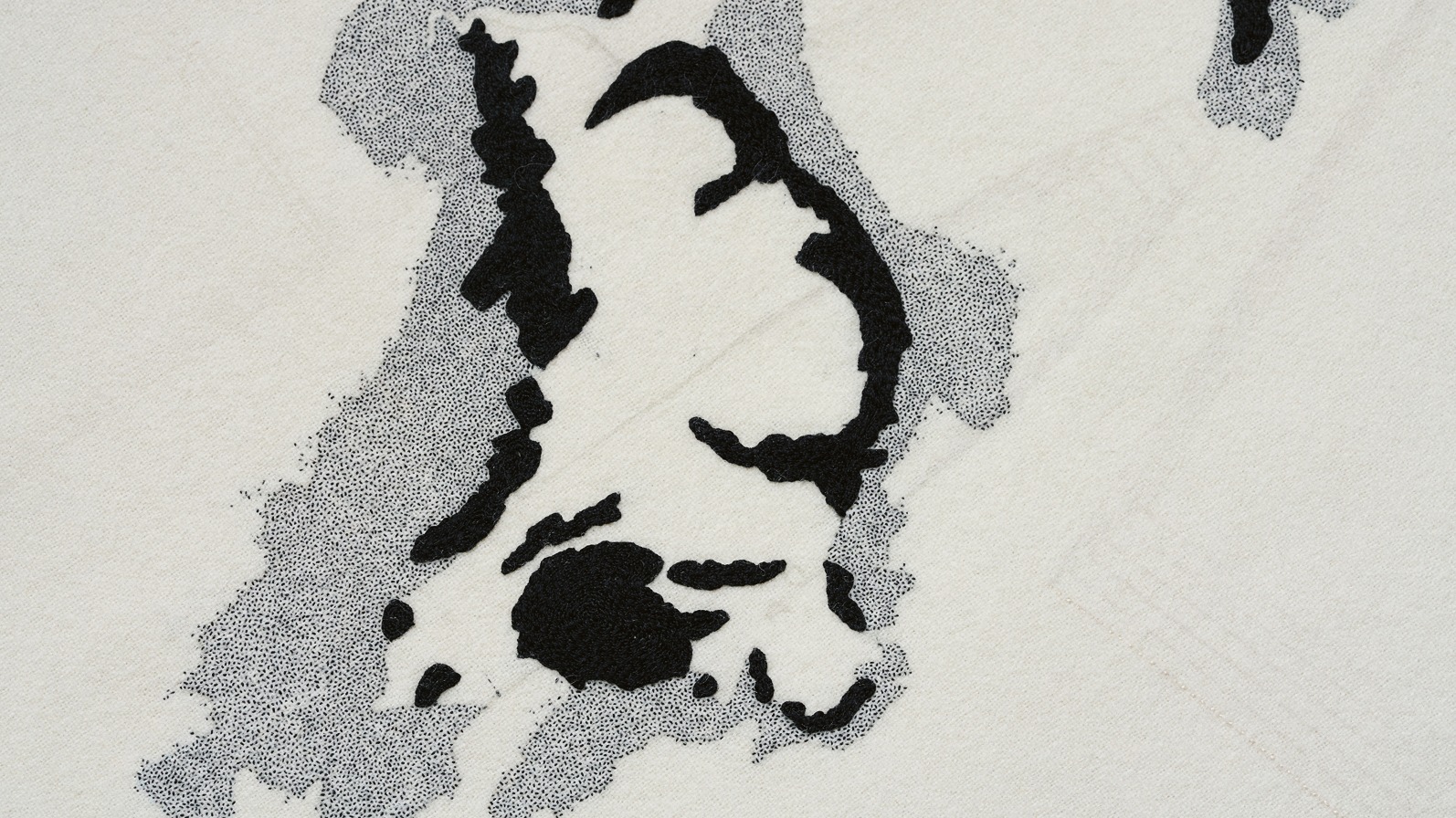
It is called Coal Seams. In finely stitched lines, swirls and spirals of black-on-white design, it is a beautiful, abstract expression of the ground beneath our feet: the industry that powered his family and the material that, literally and figuratively, made him – all of us, in fact. As he says: ‘The human body is 18 per cent carbon.’
His great-grandfather Makswitajatis worked in the mines until he was 71. He only came up from the underground and retired when his son persuaded him that, yes, really, someone would pay him a pension. Son followed father down the mines, as did brother, as did their sons. The family’s employment path remained consistent, but their name did not. ‘Makswitajatis’ became ‘Makivitics’, which became ‘McVetis’.
In those three names, the story of 20th-century emigration and assimilation is encapsulated: of melding into British society and, as the First World War flared, ‘hiding your roots’. Then, as the Second World War raged, keeping them hidden. It was a teacher who finally renamed their family, gifting them a ‘Mc’ prefix ‘in order to integrate them more into Scottish and British life. ‘You wouldn’t get away with that now,’ he notes with a smile. ‘So, anyone who’s called McVetis actually is my family, because it’s a completely made-up name.’
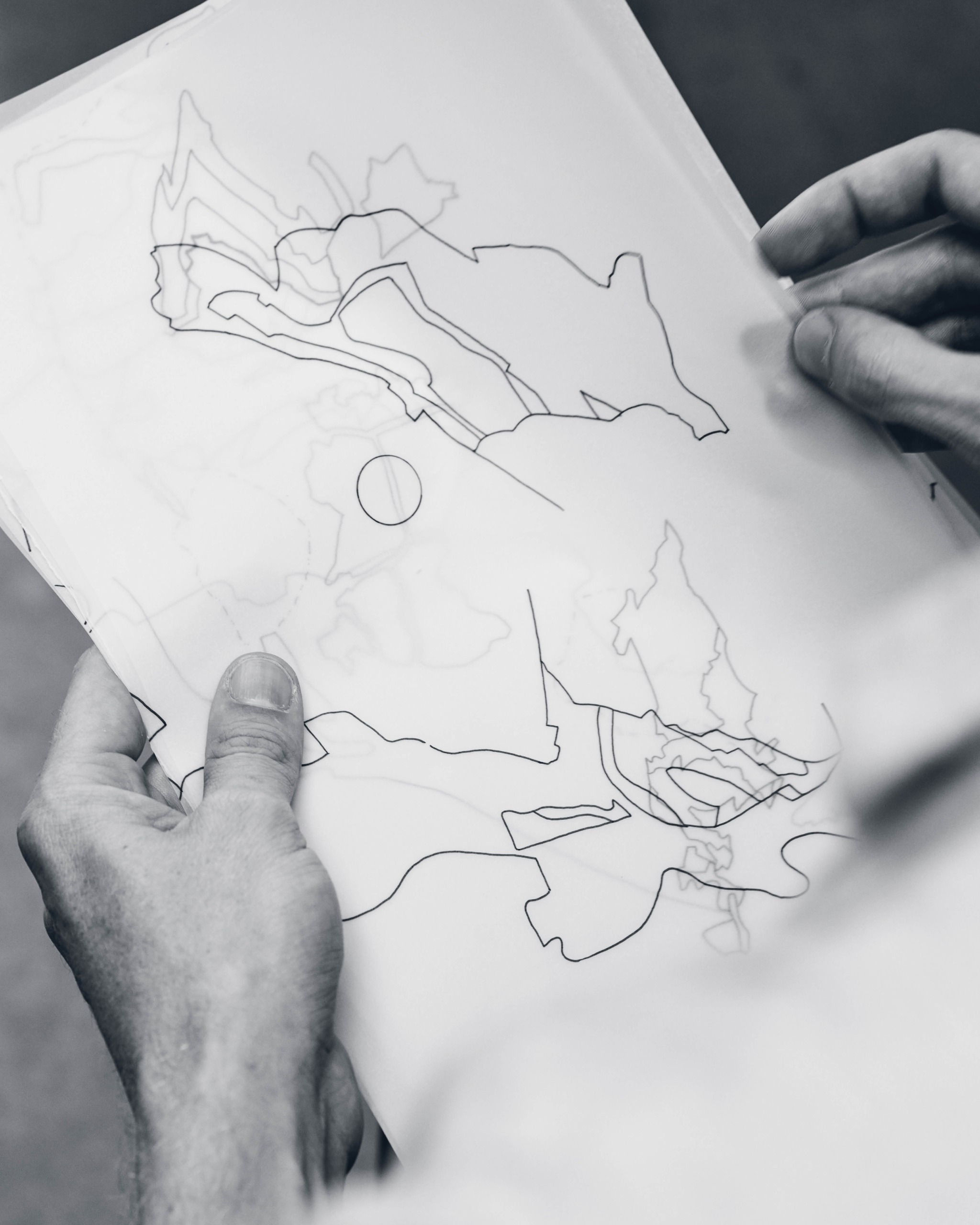
Preparatory sketches for the finished embroidery work
Meanwhile the McVetis men kept going underground. ‘My dad was super clever, really good at art and science, but his only option was to work in the mine,’ McVetis says, showing me a first piece of paper. Dated March 5, 1958, it certifies 16-year-old Chris McVetis’s National Coal Board Apprenticeship Indenture as he embarks on a five-year craftsman apprenticeship as a colliery mechanic.
And then, they kept moving to other mines in other parts of the country, or the world, wherever the work was. In the late 1970s his father relocated to Rugeley in Staffordshire, working as an underground fitter at Lea Hall Colliery, which fuelled the adjacent power station. There, in 1978, he met Elizabeth, the woman who, the following year, would become his wife and mother to Richard and his sister.
In 1982, with the UK coal industry heading into the crisis that would culminate in the Miners’ Strike two years later, Chris and Elizabeth moved to South Africa, lured by the promise of good jobs, good homes (with a swimming pool) and even household staff. The following year, Richard was born in what was then known as the Transvaal, in Witbank, the biggest coalfield in the country. ‘Witbank’ is Afrikaans for White Ridge. Post-apartheid, it reverted to its African name, Emalahleni, which means ‘place of coal’
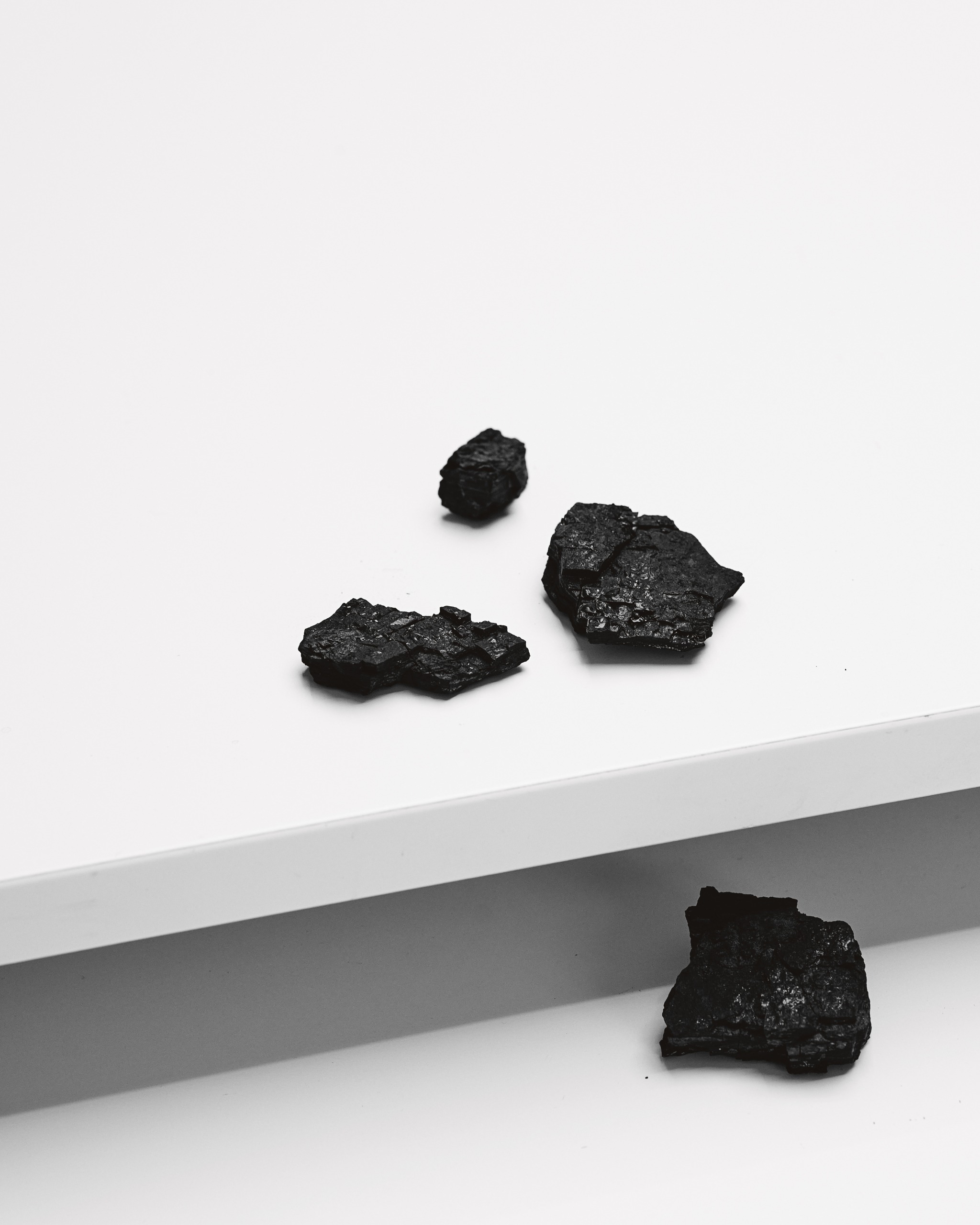
Splint coal from Newtongrange, portraits of which formed part of the exhibition of the finished ‘Coal Seams’ at the British Textile Biennial in October
In 1993 the four of them returned to the UK, in part because they were missing home. Initially they lived with Chris’s family in Newtongrange, but jobs and council accommodation were scarce. So they moved back to Rugeley, initially living with Elizabeth’s mother. There, eventually, Chris secured a job on the production line at the Armitage Shanks’ sanitary porcelain factory. Elizabeth found work at the Elkes biscuit factory in Uttoxeter.
It was his mother’s passing that set McVetis on the creative path that has brought us here today. After she died in 2018, aged 56, he went through piles of papers kept at her house, all relating to the ‘coal journey’ and 40-year career of his father. He died aged 58 when Richard was 16, of Chronic Obstructive Pulmonary Disease, a disease now linked to being a miner.
McVetis views both his parents as having been ‘worked to death’ by ‘that sort of life: labour, manual process, of the hand. I feel I can connect to them through my process. And I feel very privileged to be an artist, one generation later, from my dad being a coal miner.’
The loss of his mother led McVetis to quit his day job in retail design and focus full-time on making. Then, last April, he was approached by the British Textile Biennial in his capacity as a member of the 62 Group. Set up in 1962, it encompasses artists who use all forms of textiles. They were given a brief relating to the Biennial’s 2021 focus: ‘Connected Cloth – Exploring the global nature of textiles’. To McVetis, the Lancashire setting of the exhibition, at The Whitaker in Rossendale, was also important: ‘it was the centre of the cotton industrial revolution’.
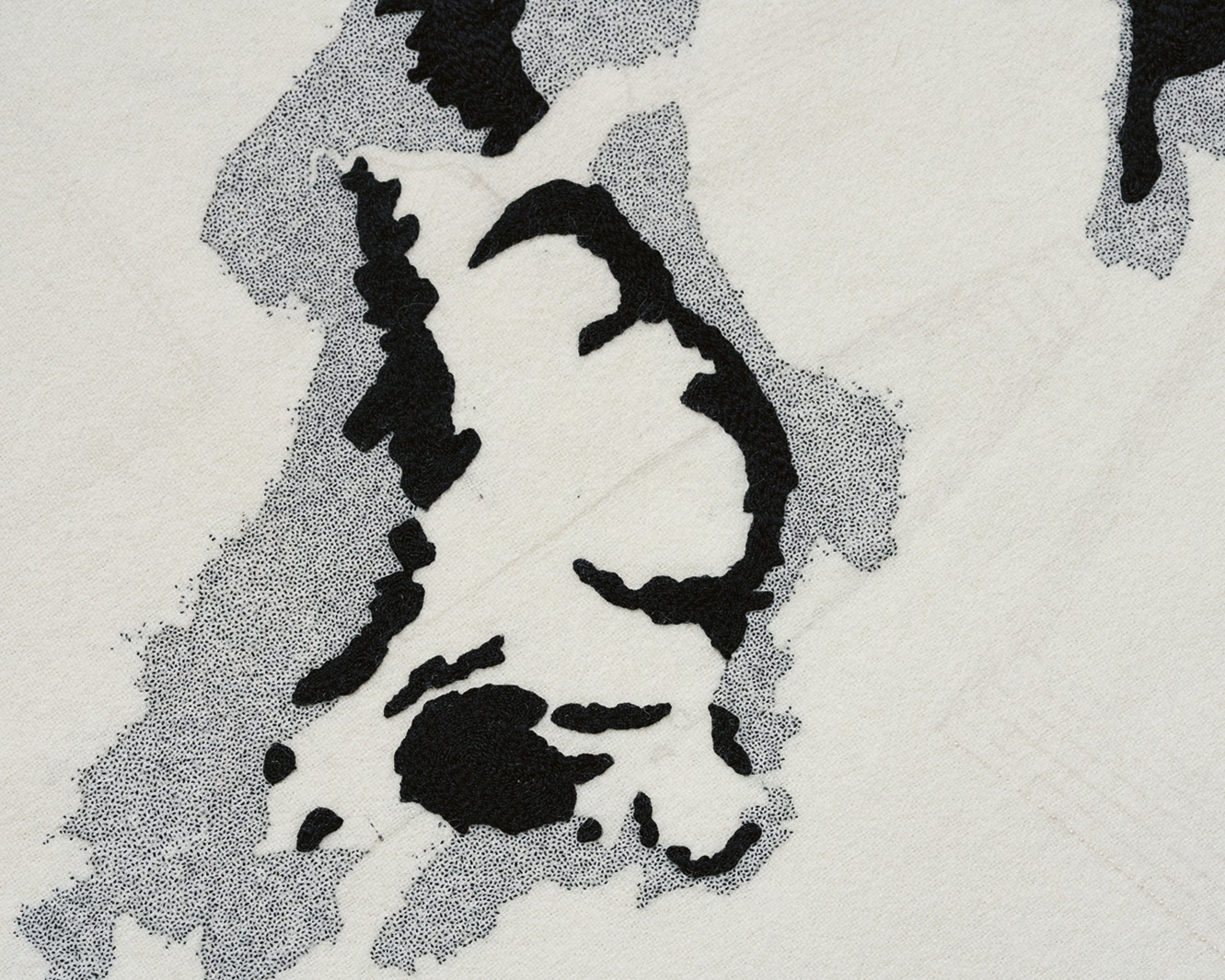
Details of the final work, showing Lancashire coal seams, top, and Scottish coal seams. McVetis created ‘Coal Seams’ with extremely labour-intensive methods of stitching called couching and seeding, in honour of the grinding hard graft carried out by his family
McVetis was drawn to the commission – an unfunded project which he is doing ‘for the love of it’ – on a personal level: with his family history, he knew the importance of raw materials to people and place. ‘But I wanted to interrogate that brief, because it’s very different to the work I make normally. So actually, it was a bit of challenge. But I had all of 2020 to think about it, and it was on my mind the whole time.’
In the early days of lockdown, McVetis read David Olusoga’s Black and British: A Forgotten History, which talked about ‘the cotton famine and how [some people in] Britain [were] against slavery, but it really needed the cotton from the slave plantations’. And he read Robert MacFarlane’s Underland: A Deep Time Journey, ‘so I was thinking about those hidden landscapes underneath us’.
Ideas about class, race, emigration, immigration and industrial revolution ‘were spinning around in my head’. But ultimately, they all centred on one thing.
‘Coal has shaped my life. So [the project] was a way of connecting with my family. Other than my auntie, there’s no one left apart from me. So, it’s a chance to process all that through making, through textiles, through embroidery.’
But before he picked up his needle, McVetis wanted to trace the threads that brought him here. He wanted – needed – to dig deep, to do the laborious research and preparation that would let him honour his family’s graft.
From the bulky file sitting on the table between us, he pulls out his dad’s record of service from his four years in South Africa. It lays bare the back-breaking, lung-clogging work: ‘Total shifts worked in a “dusty atmosphere”: 510.’ The quote marks prove it: the industry knew coal dust was ruinous to health.
McVetis retrieves another document, created for the United Nations Centre Against Apartheid, a 1983 report titled ‘Emigration of Skilled Personnel to South Africa’. It shows how South African companies would come to the UK and purposefully target high-unemployment areas to persuade skilled workers to emigrate in order to maintain the apartheid status quo. For working-class Brits, a house, a maid and a gardener were tempting. ‘They just wanted a better life,’ he acknowledges. ‘But my life there was at the expense of the people in South Africa.’
There was, then, a huge amount of information to process. How could McVetis communicate it in his medium, with needle and thread?
He hands me photocopied pages from Encyclopaedia Britannica, 9th edition, printed between 1875 and 1889: ‘Coalfields of Great Britain, shewing [sic] the areas of exposed and concealed coal measures.’ The image shows a black belt across the waist of Scotland.
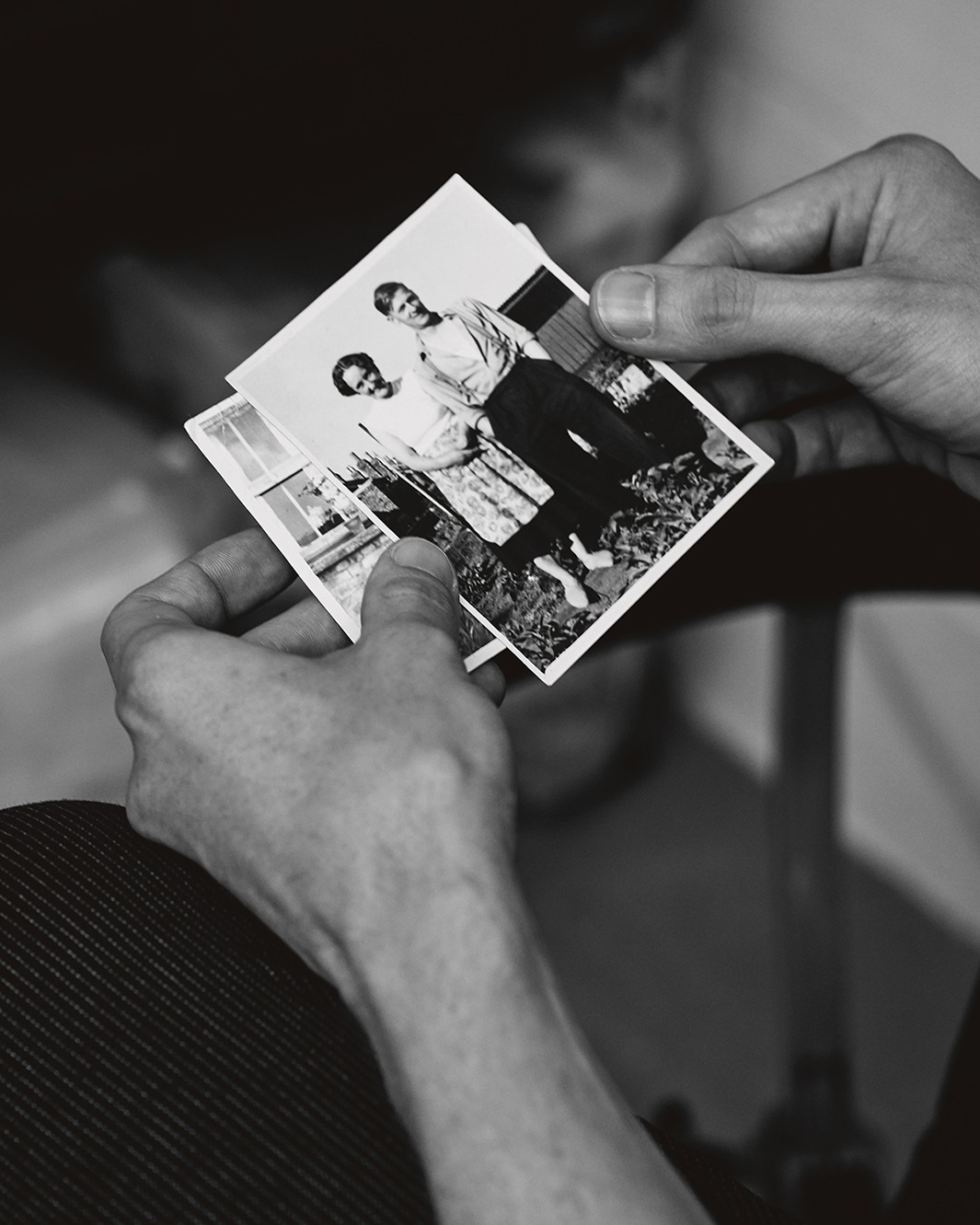
Richard McVetis holding a photograph of his ‘Nana and Pop in their back garden at Fifth Street, Newtongrange, in 1957 or 1958’ – part of the family history that McVetis has stitched into his latest work, ‘Coal Seams’
These geological drawings, he says, ‘really appeal to me from the idea of pattern, perspective and scale – these big, sweeping expressions of geological time. And our family worked across many of these coalfields.’
As soon as he saw that map, his imagination sparked. ‘I love the marks it makes. I’m very graphic in my work, and [I love] black and white – and I like it when you remove the context, leaving these abstract shapes. And I’m really interested in time. Coal is geological time, and it’s cosmic in the way it’s been formed over 300 million years, by gravity, heat and movement – these cosmic forces. Our fate is already written into the material of the land. So what you have in these images is a record of the movement of the landscape beneath our feet.’
The more he looked at the geological maps of the UK’s underland, he saw ‘scars’ of materials beneath the landscape. ‘I automatically knew I wanted to take those out and use them as inspiration for a piece of work.’
The images could also be their opposite, of the heavens, of an inky night sky. A thoughtful, methodical man, he nods in eager agreement. ‘That’s the bit I really love. I like to play with the celestial and the cellular. You don’t quite know what you’re looking at. I like the repeating pattern at different scales. Is this a cluster out in space, or the landscape under our feet?
‘Also, I’m a pattern finder, and taking these out of context, they become something else – an interplay of shape, line, form. There’s something really beautiful about this idea of time and how it repeats at different scales.’
Then, circling back to textiles, he lit upon the donkey jacket worn by his dad and every miner – and by my dad, who worked in power stations run by the Scottish Hydro Electric Board. McVetis explains how the early prototype of that jacket, a symbol of the Left, is a worker’s jacket – ‘which is very on-trend right now’ – developed for navvies on the Manchester Ship Canal. And the first design was created in Rugeley, Staffordshire, in Lower Brook Street; ‘the street I walked down every day to go to school. I got goosebumps when I read that’.
Then, words: coal seams and clothing seams. A seam in a garment is a construction method, joining pieces of fabric, giving a garment shape. And what do coal seams do? As he sees it, they’ve shaped our lives. ‘I like those plays on words.’
So he ‘started mapping all the coal fields my family worked at, across Scotland, Staffordshire and South Africa. And I wanted to include Lancashire for the Textile Biennial.’ Then he found an original worker’s jacket pattern, overlaid it onto those mappings, ‘and the process was filling it all with intense stitching’.
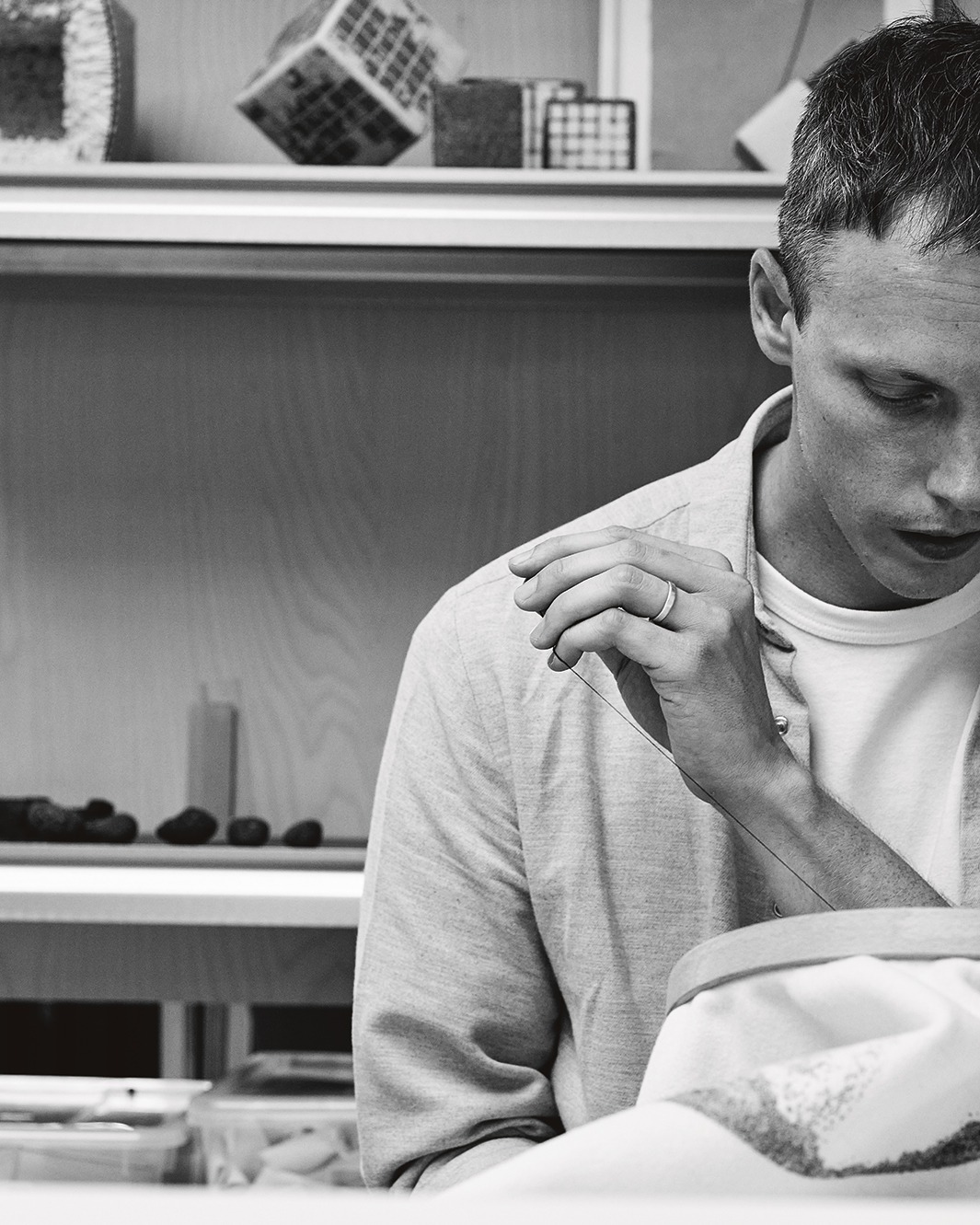
McVetis at work in his studio
FOR ME IT’S ABOUT LABOUR. INVESTING TIME IN VERY ORDINARY MATERIALS. HERE I AM, STITCHING LANDSCAPES CREATED BY TIME. IT’S A FULL CIRCLE MOMENT
Finally, having explained to me how he tunnelled into his family’s past, and into the millennia-old history of coal, McVetis pulls out his piece. Coal Seams is a black-on-white cosmic map, its lines tracing history and cosmology, geography and geology, family and (mis)fortune. It comprises 120cm x 75cm of wool flannel, the base material he’s used for 15 years but also the material of Scotland; threaded with cotton, the material of the industrial revolution. ‘It was important that I used those materials.’
It was created using a method called couching: the process of laying a piece of thread on the fabric, then securing it with tiny stitches. All done by hand, and almost but not quite finished at the time of our meeting. McVetis began stitching in May, for eight or nine hours a day. It has been a hugely labour-intensive undertaking (‘back, fingers, eyes, and all the mental focus’). But he needed it to be, to accurately reflect the heavy manual labour of coalmining and millwork and the mundanity and the grinding repetition integral to those industries.
‘For me it’s about labour. It’s about investing time in very ordinary materials. Here I am, stitching landscapes created by time. It’s a very full-circle moment. And it is about the graphic-ness of it, and I wanted to capture that sort of landscape. It can exist by itself, but also I like the narrative around it.’
There are, then, layers to the work, like layers in a coal seam. His titular work, which will be displayed flat, and presented like a map, will come surrounded by photographic images he’s taken – powerful portraiture of lumps of coal, shiny as black gold – and his research materials.
But for all his rigorous digging, Richard McVetis is aware he has only scratched the surface of the subject. He has ideas for a piece based around the etymology of his surname, and wants to do something with a poem written by his great uncle, another Christopher McVetis, titled ‘Last Man in the Waa’, where ‘waa’ is ‘wall’, which is the coalface.
‘There’s so much more in here – it’s an endlessly rich subject matter,’ he says. ‘But it still feels really connected to what I do, which is looking at time, process, materials, labour. And it’s comforting that I can connect with my dad and my family in this way. It’s been sort of a therapy to go through it.’