Ishkar Rugs, Christopher and Edmund Le Brun
Words Sophie de Rosée
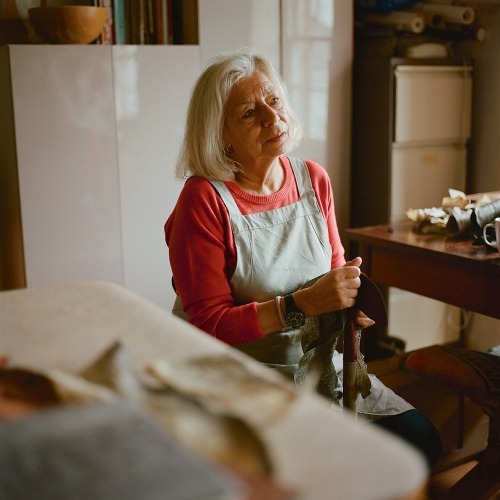
In the light-filled London studio of British artist and former president of the Royal Academy Sir Christopher Le Brun, beautiful paint splatterings across the floor, the story of a family collaboration is unfolding…
Having designed a rug once before with Christopher Farr in 2015, Le Brun wanted to create a new rug for his own home, which he shares with his wife, fellow artist Charlotte Verity. In 2020 he enlisted the help of his son Edmund, who knows a bit about carpets since founding Ishkar in 2016 with his wife, Flore de Taisne, to preserve luxury craftsmanship in countries defined by conflict.
One carpet turned into a collection of seven limited-edition, hand-knotted carpets. Each design was translated from a set of prints that Christopher had already created and hand-knotted by a team of weavers in northern Afghanistan.
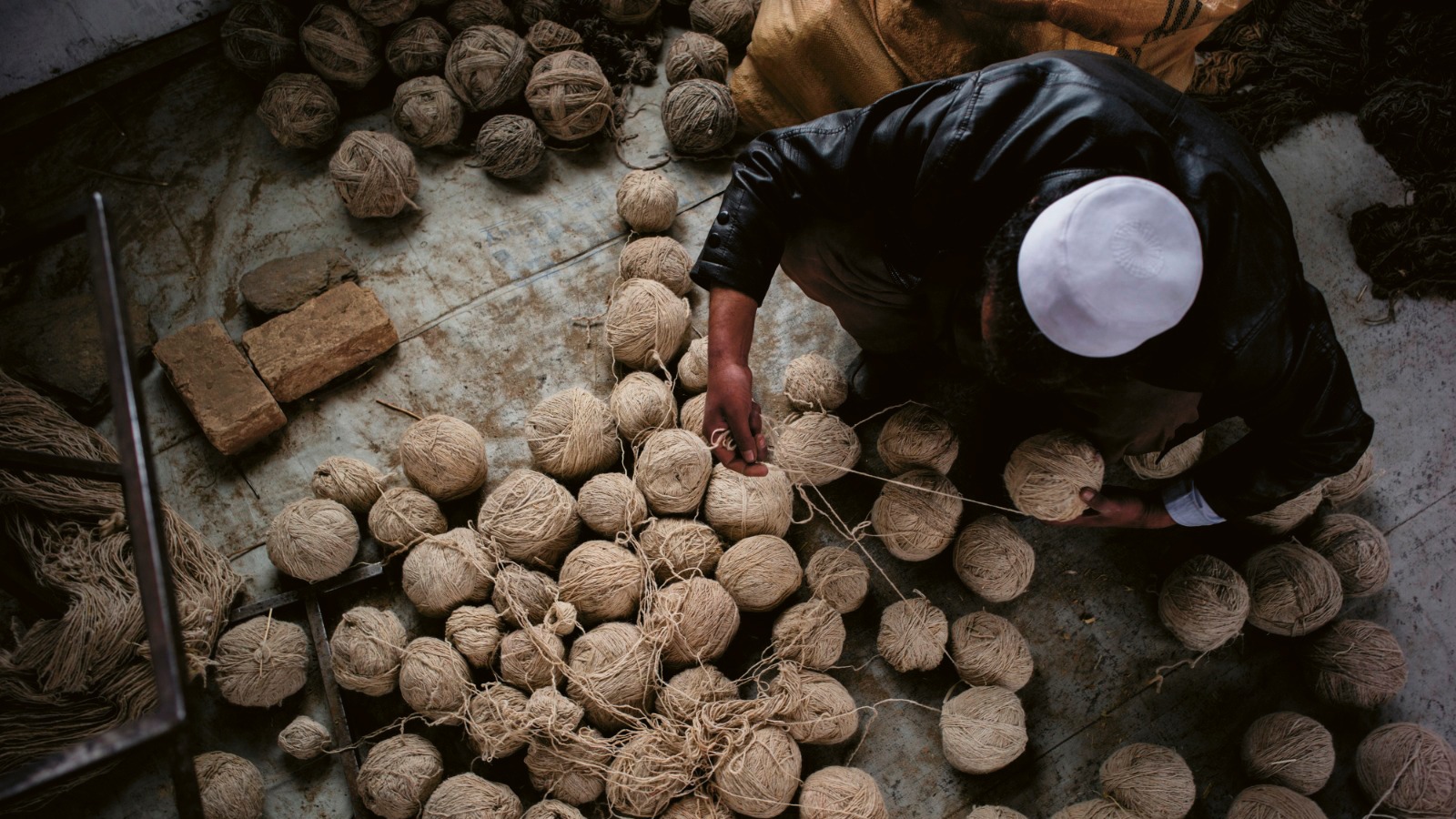
Every stage in the process is done entirely by hand, from spinning the wool, to making the dyes, to finally weaving, washing and shearing the carpet down to its supple finish
Having lived and worked in Afghanistan, Edmund and Flore became frustrated with the perception of the country ‘through the lens of terrorism and poverty’. Ishkar, named after the unremarkable-looking Afghan desert plant famed for its ‘hidden alchemic properties’, was set up to showcase the country’s incredibly rich culture of artisan craftsmanship and reinvigorate dying craft industries.
Ishkar is responsible for supporting the last remaining glassblower in Afghanistan, a craft that has existed in the country for more than 2,000 years. Ishkar has since ordered 35,000 glasses and counting from that one glassblower, who has taken on apprentices as a result. Among other products from Afghanistan are carpets designed by Frank Gehry, Zaha Hadid and Choose Love. Despite ongoing challenges presented by conflict, Ishkar also continues to source and sell clothing from Pakistan, jewellery from Mali and Burkina Faso, quilts from Lebanon, traditional Yemeni lanterns, homeware from Myanmar and shawls from Syria, among other things.
With Christopher’s artistic expertise and Edmund’s knowledge of the finest carpet weavers in the world, the first Le Brun father-and-son collaboration was off to a smooth start.
Seeing the pair side by side in Christopher’s studio in September, it’s evident they work well together. Christopher jokes that during the design process Edmund kept him on track. ‘Because otherwise, I’m just a hamster on a wheel. You have to stop me, to focus me.’ After a few samples and erroneous colourways, the first carpet arrived in London. The blue and bone design (sitting in Christopher’s studio before reaching its final destination: his and Charlotte’s sitting room) is exquisite.
‘Ishkar was set up to preserve luxury craftsmanship in countries defined
by conflict’
The lines from the printing press on Christopher’s original designs are echoed in the subtle variations in the depth of pile. The collection is called Courts and Fields, incorporating ‘the idea of flat things, levels, areas, arenas, enclosures and so on’, as Edmund explains, as well as courts because of the garden motif in Middle Eastern carpets and fields, because of ‘colour fields in painting’s vocabulary’.
Known for his vibrant, abstract painting style using colour, light and touch, what interests Christopher is the translation of his artwork through the filter of the wool and the artisans in rural Afghanistan. ‘With a print you get immediate results, but with this you have to wait six months every time,’ says Christopher. ‘The anticipation is wonderful.’
‘What makes these Afghan rugs so special is this Ghazni wool, which takes the colour in a very interesting way,’ says Edmund of the luxurious wool from the Ghazni area of central Afghanistan. ‘It absorbs it quite unevenly, giving the carpets “abrash”, the term used to describe the mottled effect given by each strand of wool’s subtle variation of colour. At the same time, it’s got a natural lustre, that slight sheen.’
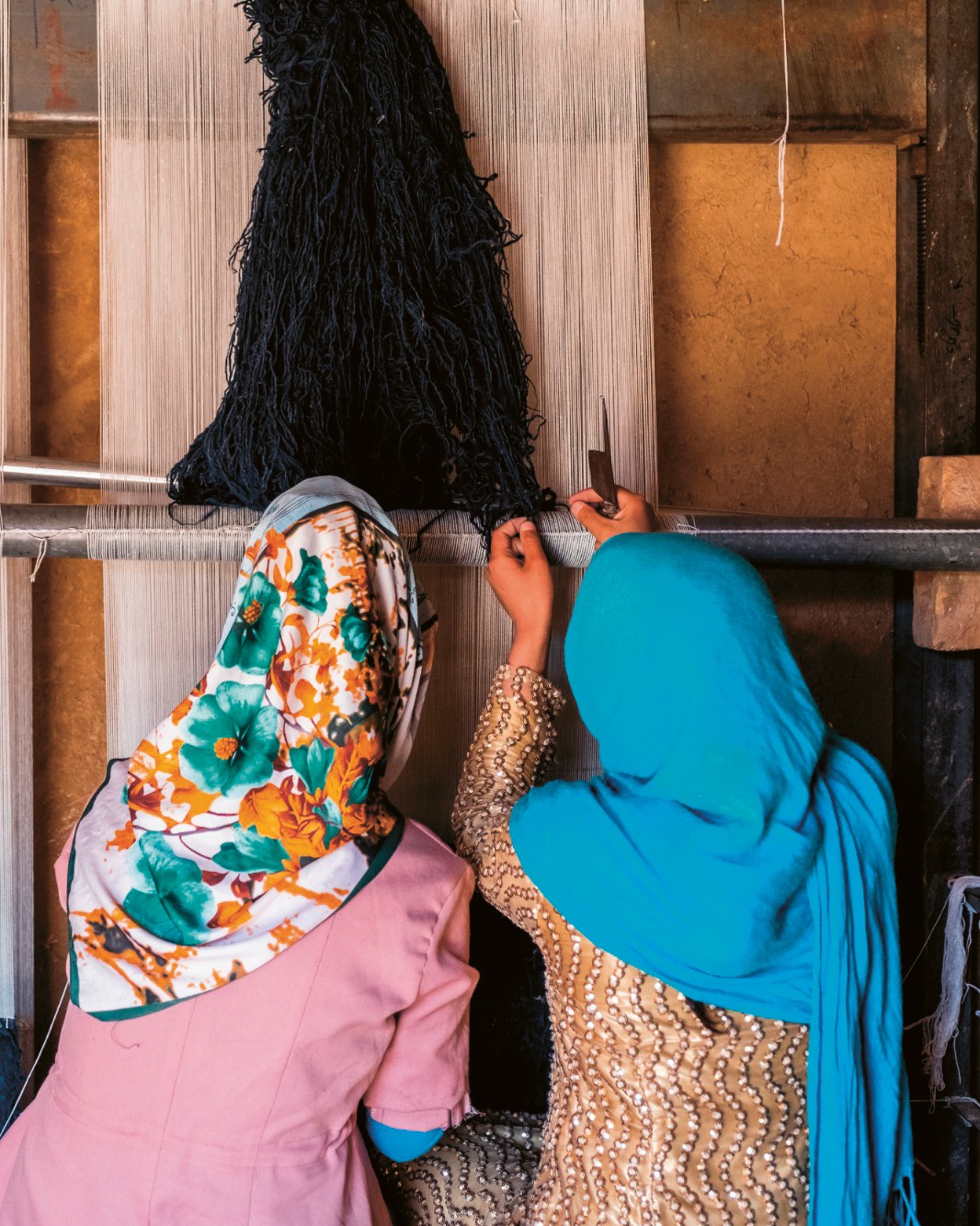
Together they explain that each carpet takes two women three months to weave on a loom in their home. Each rug has about half a million knots. Every stage in the process is done entirely by hand, from spinning the wool, to making the dyes, to finally weaving, washing and shearing the carpet down to its supple finish.
‘They move so fast; they are so skilled,’ Edmund says of the women, whose craft is built up over generations, but which is dying out due to machine-made carpets costing one-tenth of the price. ‘It’s an amazing sight to watch them work.’
After seeing the exquisite quality of the first sample, in early 2021, the full collection was commissioned by Ishkar with its team of weavers.

Each finished Ishkar rug comprises half a million knots and takes two women three months to weave
But never in a million years could they have foreseen the fall of Afghanistan to the Taliban in just a few days in August. ‘It’s since been a different level of challenging,’ says Edmund stoically.
To lower shipping costs, Ishkar partnered with an Afghan dried fruits and nuts trader who ships regularly to Europe in large volumes. With the Taliban gaining power, the carpets were packed with $12,000 of Ishkar stock (glassware, clothing and homeware) to move out of the country as quickly as possible.
‘The shipment passed through customs two days before the Taliban took Kabul [on August 15]. Since then, the airport is just a complete mess,’ says Edmund. ‘The dried fruit and nut trader is in a hurry because his goods are perishable, which bodes well for Ishkar.’ A few weeks after we met, Edmund sent word that the consignment had been located and he was hopeful that they would get them to Uzbekistan and from there, they would be shipped to the UK.
In theory, future production of the carpets should be unaffected. Designs are sent via WhatsApp and the Taliban ‘don’t care if women are working at home where their looms are’, says Edmund. Getting the carpets out of the country remains the biggest challenge, due to corrupt customs officials demanding bribes.
Since the Taliban took control of Afghanistan, Ishkar has worked to ensure the safety of the artisans and craftspeople they have worked alongside for years, including a ‘very deep clean’ of their website and social media to protect identities. A photograph sale raised £120,000 for EMERGENCY UK hospitals in Afghanistan.
As soon as the carpets have arrived safely in London, Christopher and Edmund plan to host an exhibition to sell the carpets and spread awareness about Afghanistan’s rich craft traditions, and by doing so generate employment for Afghan artisans at a time when economic opportunities are desperately needed in the country. Christopher’s gallerist in New York has already put his name down for one.
It shouldn’t be, but there’s a certain appeal in owning an object that was present at one the most historic events of the 21st century. If only carpets could talk.
Each carpet is numbered and limited to an edition of five, available in Large (2m x 1.2m, £5,000) and Small (1.75m x 1m, £3,650) plus an option for bespoke measurements; ishkar.com

Hole & Corner Event | Christopher Le Brun x ISHKAR Q&A plus Artist’s Studio Tour
March 26, 10.30am

On Saturday 26 March at 10.30am, Hole & Corner and ISHKAR invite you to the studio of Sir Christopher Le Brun, for a talk about Court and Fields, a limited-edition collection of carpets designed by the artist in collaboration with ISHKAR and handwoven in Afghanistan.
Le Brun Studio
108c Warner Road
London, SE5 9HQ
26 March 10.30am – 12pm
Refreshments will be served.
Tickets are £7; free to Hole & Corner members