Isabella Smith celebrates the doyenne of British post-war pottery, Lucie Rie
Words Isabella Smith
The first thing that got me was the buttons. Lucie Rie (1902-1995), the doyenne of British post-war pottery, had always struck me as icily elegant – more figurehead than flesh and blood. Those iconic images of the great potter dressed in white, perfectly poised; eye-wateringly expensive sales, record-breaking auctions; the association with rich collectors and their trinkets; Edmund de Waal’s description of Rie as ‘dauntingly rude’ – all attributes that awe, rather than endear.
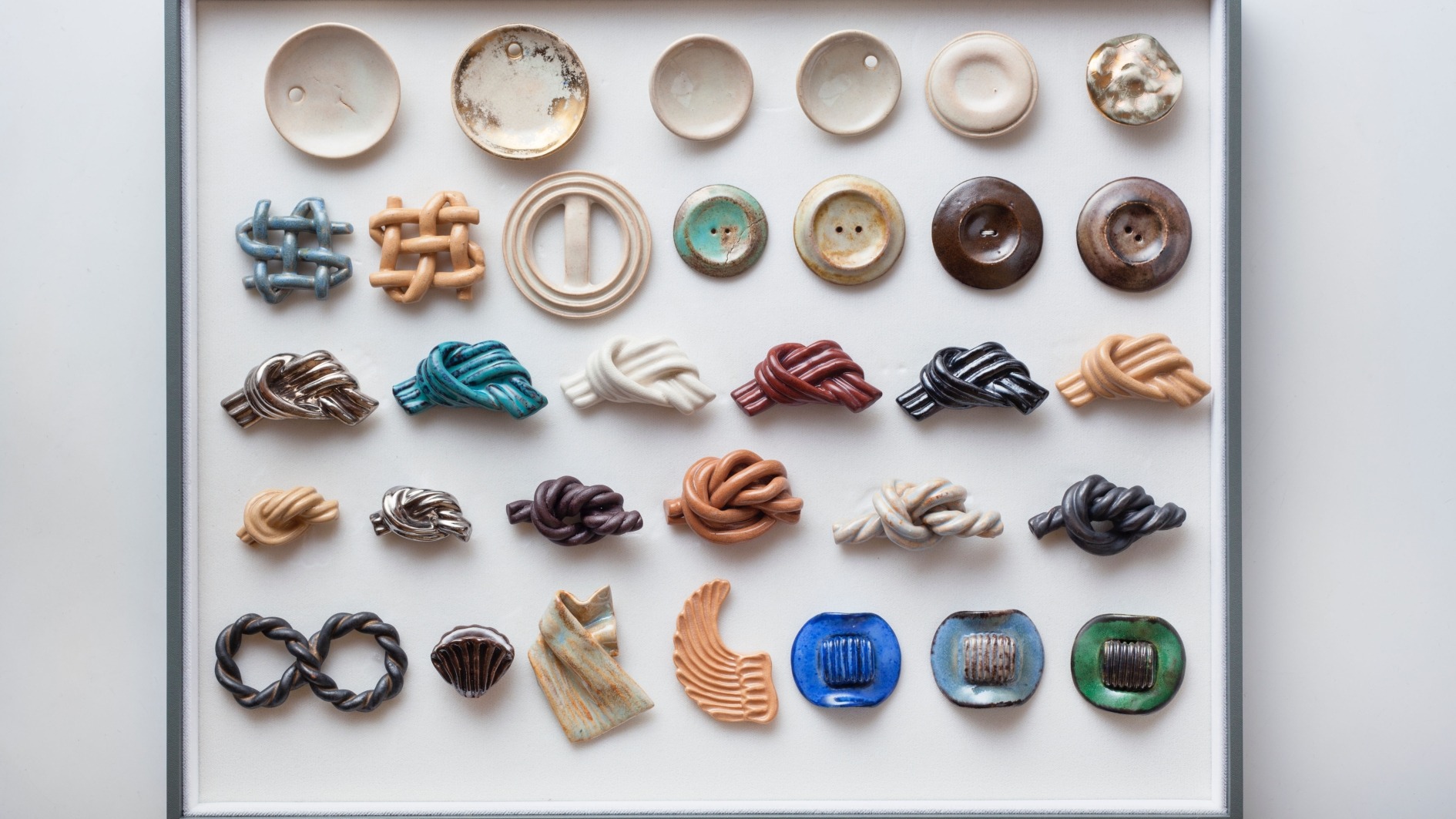
But in 2018, I saw an exhibition at the Centre of Ceramic Art in York that put the buttons she made front and centre. It made all the difference. The buttons were intimate, approachable: miniature sculptures at once both jewel-like and tactile. These were created out of necessity by the Jewish potter, who had fled Vienna for London with her then-husband, Hans Rie, in 1938. It was the buttons that hooked me in – and eventually led me to write my book on the woman herself. The late Issey Miyake would have approved: when the fashion designer first encountered her buttons, he was so inspired that he based his Autumn/Winter 1989 collection around them.
 Lucie Rie at home in Albion Mews in the late 1960s, surrounded by her own and Hans Coper’s pots. Photo by Jane Coper © Estates of the artists.
Though by the end of her life Rie was the most fêted potter of her generation, on her arrival in Britain she was a nobody. In 1939, newly separated from her husband, she moved, alone, into a small mews house near Hyde Park (where she was to live and work – the garage her studio – until her death in 1995). During the war, Rie made ends meet as a button-maker: hand-forming or throwing each button, using these to create moulds from which multiples could be rapidly produced. Some were plain round buttons, versatile and tasteful; others were lavishly sculpted and glazed in a rainbow of hues. Colour-matching buttons to fabric swatches led to a deep knowledge of glaze chemistry: a key part in her subsequent rise to the top of the UK’s ceramics scene.
Across her 60-year career, Rie continually evolved her forms, glazes and surfaces – her focus always on tableware and vessels. Today, many of her forms are design classics: chocolate-coloured tableware with scratchy sgraffito decoration; swirled-clay vases with wide, flared rims; brightly coloured bowls with dripping manganese rims.
 Porcelain covered bowl with inlay on exterior and sgraffito on interior, manganese glaze on the interior, lip and handle, c 1958. Photo: Phillips Auctioneers Ltd
Her many collectors include the fashion designer Jonathan Anderson, the cook and writer Nigel Slater, and the broadcaster David Attenborough. Any trip to the V&A’s ceramics galleries is incomplete without seeing Attenborough’s BBC documentary, Lucie Rie, which screens on a loop beside a reconstruction of her workshop. Originally broadcast in 1982, it features the memorable moment a lunge into her top-loading kiln sees the octogenarian artist get stuck with her legs in the air; Attenborough has to haul her out by the ankles.
In researching my book, I relished glimpses of this other, less rigidly decorous Rie. She was there in candid snapshots with her closest friend and fellow refugee, the ceramic artist Hans Coper; she appeared in reminiscences from friends, who described her pastiching her own pots when making Bernard Leach a birthday cake that mimicked the look of her lava-like glazes. She was there, too, when I discovered shakily handwritten notes in an archive, written, in uncharacteristically emotional terms, following Coper’s premature death. When the time came to write the book, I made sure that this other Rie was there too.
While elegance was a defining quality of both the work and the woman, who famously always dressed in white despite the muck and mess of a pottery studio, there is more – much more – to Lucie Rie than that.
‘Lucie Rie’ by Isabella Smith is out now; eiderdownbooks.com