Leif Bersweden on why he took an epic botanical journey on his bike
Words Leif Bersweden
Courtesy of LINDSAY FREENEy
Early on a midsummer morning, at a time when people should still be sleeping, I decided to go to the Downs. They ran west, away from the village, about half a mile from where I lived: a patchwork of farmland, dirt tracks and nameless flower-filled meadows. It had rained during the week, so the ground was soft and springy. I crossed the bumpy grassland at a diagonal, winding along a public footpath. Far away I could make out pockets of woodland visited on previous botanical expeditions: Night wood Copse, Pope’s Bottom, Hazel Hill Wood. Memories of Fly Orchids and Bluebells flicked through my mind.
Before long I had reached the three oaks that marked the way through to the wheat field. Traveller’s Joy and Honeysuckle had snaked themselves through the twigs that brushed the top of the hedge. I squeezed through the tiny gap and into the colourful field margin scattered with clover. Pyramidal Orchids poked up through the grass, perilously close to the edge of the crop. I followed the tree line south, until there, where the edge of the wood veered away to the left, I came to my spot.
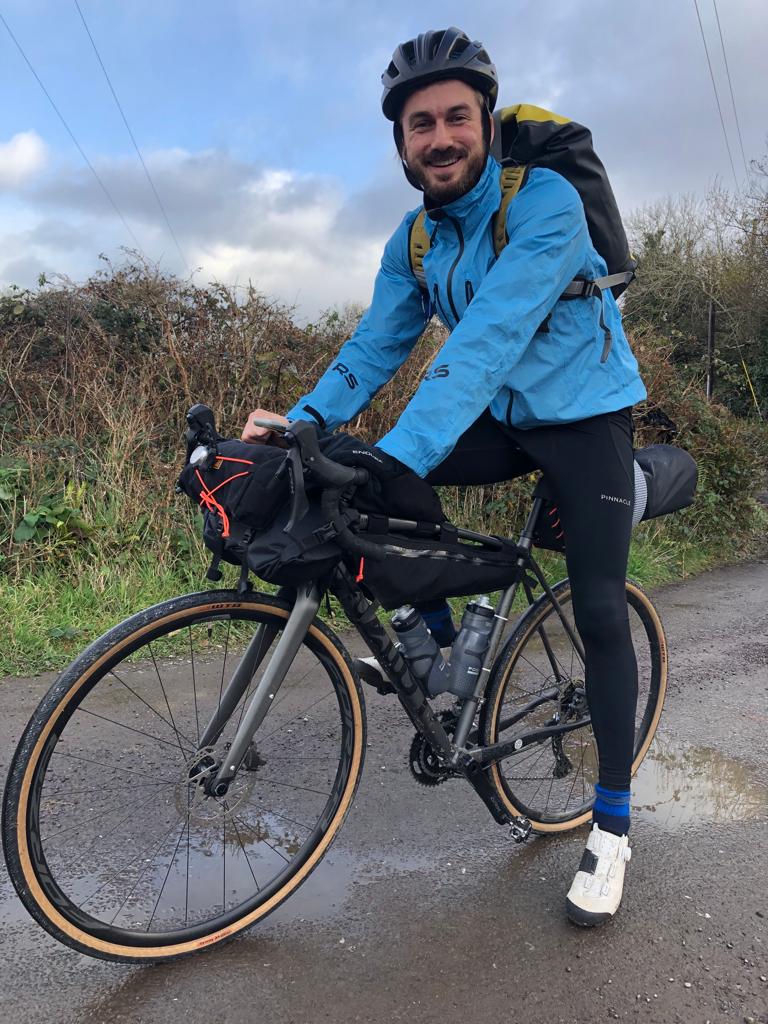
Bersweden has travelled by bike all over the countryside in search of our native plants
Tucked into a thicket of blackthorn was a thatched bowl of yellowing oat-grass and fragrant thyme. A well-positioned beech provided a backrest. I wiggled myself into a comfortable position and looked out over the familiar features of the surrounding countryside. On the other side of the field, where domestic met wild, there was a tangle of lemony St John’s Wort and lilac Wild Marjoram. Bright-yellow wands of Agrimony were just bursting into flower. As the land sloped away, lines of wooded hedgerows layered themselves one after another, field after field, silhouettes of ever paler greys and charcoals.
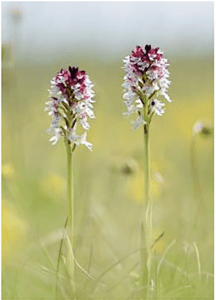
Burnt Orchids (Neotinea ustulata) on Salisbury Plain
I first started coming here to record wildlife when I was 11 years old. Pitton Ridge, as I knew it, was extremely species rich and I recorded nearly 300 plant species in that little corner of Wiltshire. When I first started asking my mum about wildflowers, I could hardly tell a poppy from a buttercup. Botanising –the art of simply wandering along and noticing the plants growing around you– was a relaxing activity full of intrigue and new discoveries.
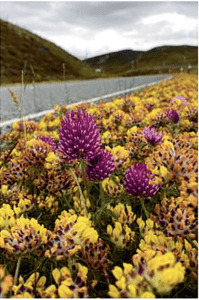
Red Clover (Trifolium pratense) and Kidney Vetch (Anthyllis vulneraria) on a Shetland road verge
My love for botany manifested itself in wanting to bring plants to the attention of others. It bothered me that none of my friends were interested in plants like I was. Not because I particularly wanted company, but rather because I had begun to learn about how vulnerable our wildflowers are. In the past century, we have ploughed, felled, fertilised and drained many of our wildflower meadows, ancient woodlands, peat bogs and wetlands, ‘improving’ the land for the benefit of agriculture and urbanisation. Mountains are relentlessly over-grazed, hedgerows are being removed to increase farming efficiency and even our road verges, once managed in a way that benefited wildflowers, are regularly razed unnecessarily to the ground.
By the time I had moved away from Wiltshire, much of the downland that had provided so much comfort for me over the years had been ploughed up and planted with winter wheat. In a matter of hours, fields had been transformed from species-rich havens to furrowed monocultures. Today, with words like ‘Acorn’, ‘Bluebell’ and ‘Dandelion’ falling out of use, plants are no longer deemed relevant in a society that has largely fallen out of love with the natural world. I didn’t want to believe what I read about the decline of so many of our native plant species, nor the diminishing interest.
So I decided to go on some adventures. I travelled through the places our plants call home, learning about their ecology, their role in our culture, the threats they face, and what it is about them we have grown to love. I dedicated an entire calendar year to walking along wind swept clifftops spread with Thrift and roaming through flower-filled woodland brimming with Bluebells; I scrambled up mountains, climbed trees, squelched around marshes and bobbed about on lakes and ponds; documenting my adventures through the seasons as I tracked down our most well-known wild plants. Along the way I walked with people who still have a connection to their local flora; to prove to myself, if nothing else, that our instinctive love for the botanical world has not wholly vanished. And, just as I had done throughout my teenage years, I did all this botanising with my bike.
Extracted from ‘Where the Wildflowers Grow: my Botanical Journey through Britain and Ireland’ by Leif Bersweden (Hodder & Stoughton, £20)