Behind The Curtain
Words Tamsin Blanchard
Photographs Toby Glanville
Backstage at Glyndebourne opera house, a dedicated team of pattern cutters, master tailors, machinists, finishers and textile specialists ensures that no one makes a crisis out of a drama…
The approach to Glyndebourne through the green hills of the Sussex Downs is enough in itself to lift your spirits. But once there, wandering through the immaculate gardens, deep in ferns, glorious flower borders, the dark green shady lake, and the contented bleating of sheep as they graze in the fields, you feel somewhere close to paradise.
‘The graciousness of civilisation here surely touches a peak where the arts of music, architecture and gardening combine for the delight of man,’ wrote Vita Sackville-West of Glyndebourne in 1953. What Sackville-West did not include in her trio of fine arts was that of costume design and construction, without which the operas at Glyndebourne would not be brought so vividly to life. As audiences – themselves dressed in their own summer finery – are immersed in this season’s productions at the opera house, the extraordinary amount of time, energy and craftsmanship that has gone into every single piece of costume worn by the artists on stage is forgotten. And that is as it should be. The audiences are transported to other worlds that – however fantastical – must also be believable.
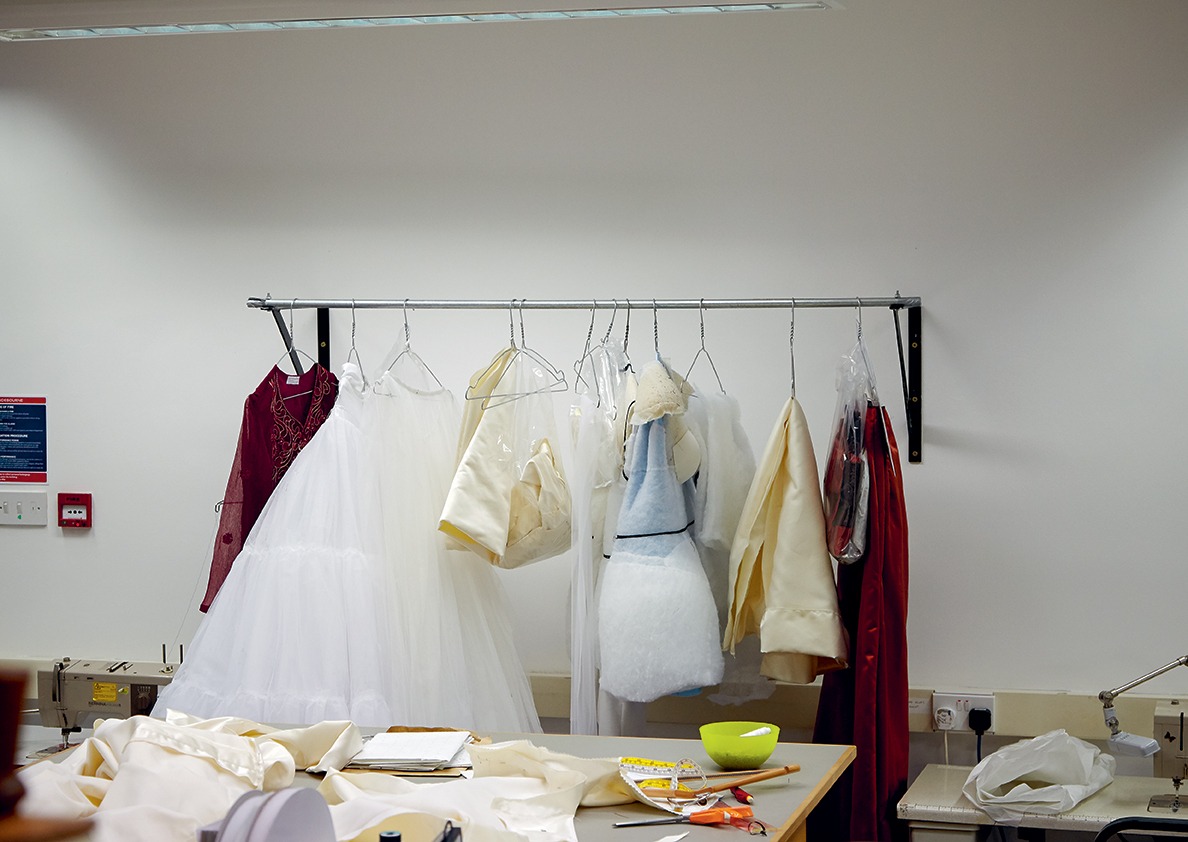
Three operas meet on a rail in the workroom, in a variety of chorus women’s costumes
Hidden from view behind the theatre and the gardens is a series of buildings housing everything from props to wigs to the costume department, which is where every piece of clothing has been honed and crafted for months ahead of the production. Since joining the company as head of costume in September 2016, Pauline Lecrass has a huge amount of responsibility on her shoulders.
When I visited there was less than a month to go to the opening night – a new production of Hipermestra by Francesco Cavalli, an early Baroque opera set somewhere not too specific in the modern-day Middle East. Lecrass was busy (though all on schedule), but managed to spare an hour on a Friday afternoon ahead of the May bank holiday as she negotiated her way overseeing the completion of costumes for three new productions – La Clemenza di Tito, Hipermestra and the world premiere of Brett Dean’s Hamlet – plus three revivals, La Traviata, Ariadne auf Naxos, and Don Pasquale – for the season ahead.
The costume department at Glyndebourne is unique in that it works on so many diverse productions concurrently. The three new productions each require costumes made from scratch, while the costumes for the revivals need to be unpacked from the archives, adjusted, finessed and sometimes – depending on changes to the cast – completely remade. The department itself has nine full-time members and approximately 25 seasonal staff : pattern cutters, master tailors, machinists, finishers and textile specialists, who work from January to October each year.
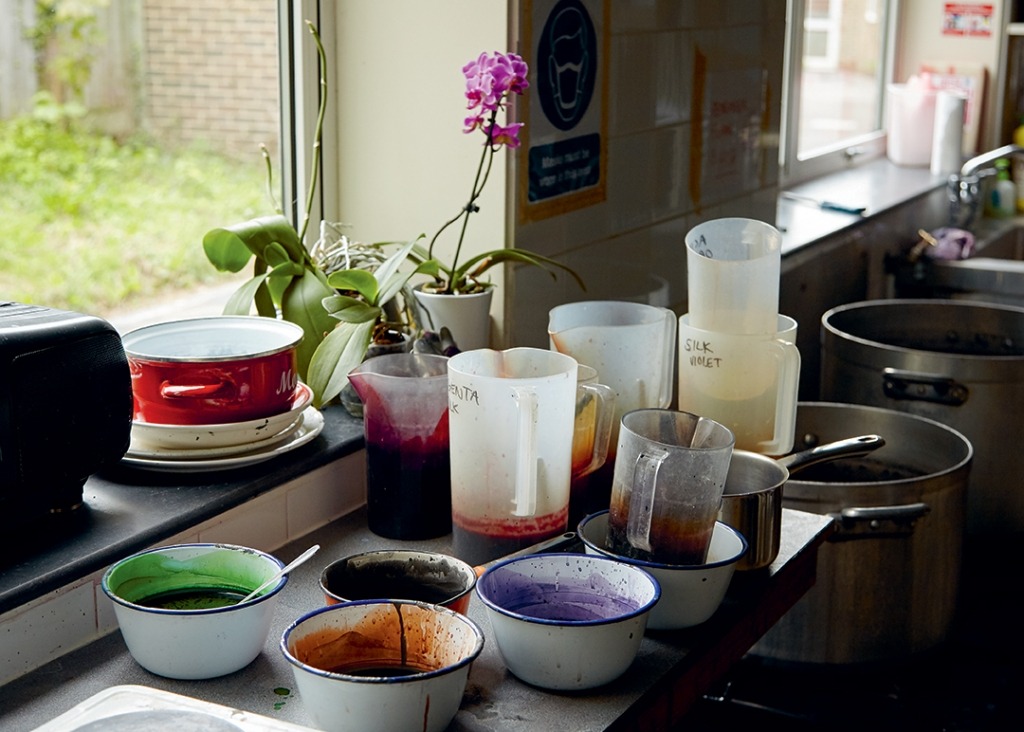 Colours are lined up in the dye room
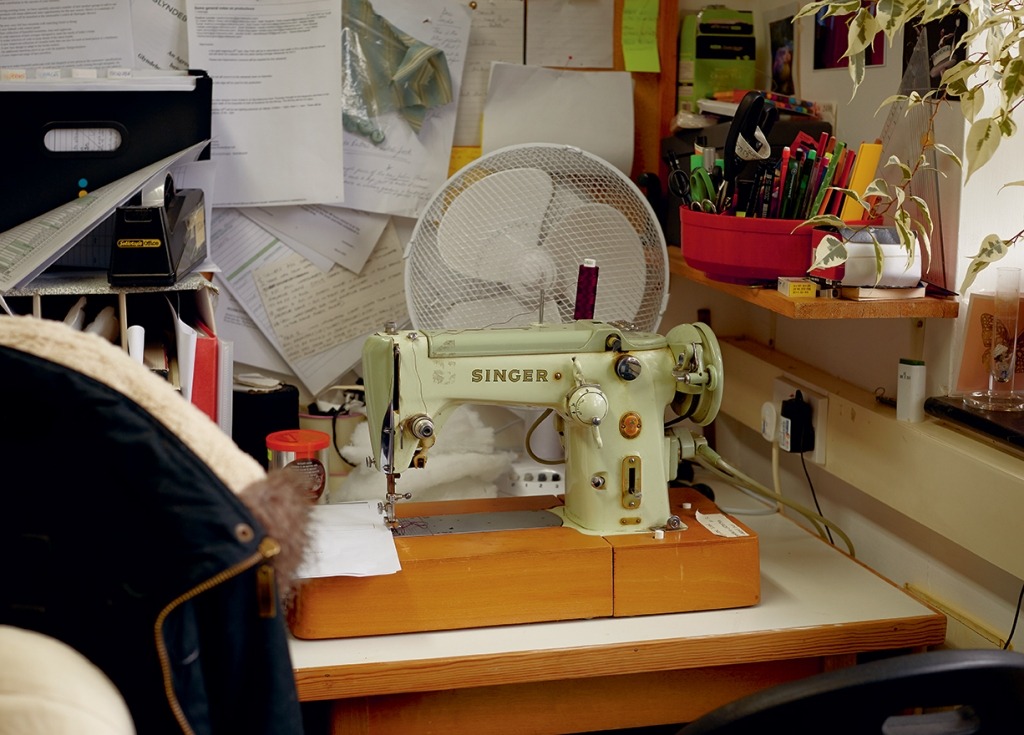 Tools of the trade, including a sewing machine, of course
The behind-the-scenes buildings at the back of the theatre are modern and functional. ‘We are all quite fortunate to have this facility here and the proximity for us to the theatre means people can actually go and see the rehearsal process and truly understand what’s happening with the pieces they are creating,’ says Lecrass. She takes us past the fitting rooms – the principal artists usually have two fittings for each costume and these are in full swing – as well as a well-equipped dyeing room and a design studio. Upstairs, there are two large studios for tailoring and three rooms for women’s dress. The corridors in between are packed with rails of clothes, army jackets, ball gowns, wedding dresses, voluminous skirts and half finished corsets, and there’s small army of dressmaking stands awaiting their next job.
Among the many challenges facing theatre production seamstresses is that, unlike in real life where people are expected to fit into one of a few regular sizes, opera singers need to perform in costumes that fit them perfectly. As it’s not possible for everyone to have their own bespoke mannequin, the principals and lead characters have the next best thing: their measurements are precisely translated onto topographic layers of wadding built up into a stretch body suit that can be miraculously zipped on and off the dressmaking stands as required, allowing for endless permutations of the most generous of bosoms, the curviest of hips – all shapes, sizes and silhouettes. Some of the artists’ ‘bodies’ are hung on rails. Others are zipped in place on the stand, ready to be dressed.
A white lace wedding dress lies across a table in the dressmaking room. In fact, there seem to be wedding dresses hanging all around me. I have walked into the world of Hipermestra, an opera that tells the story of King Danao of Argos, who marries off his 50 daughters to the 50 sons of his twin brother, King Egitto. In order to thwart a prophecy that predicts that his life and kingdom will be taken by one of his dastardly brother’s sons, the king decrees that his daughters must all marry and then murder their new husbands.
‘The idea is to erase things you’ve seen before – to simply create something new…’
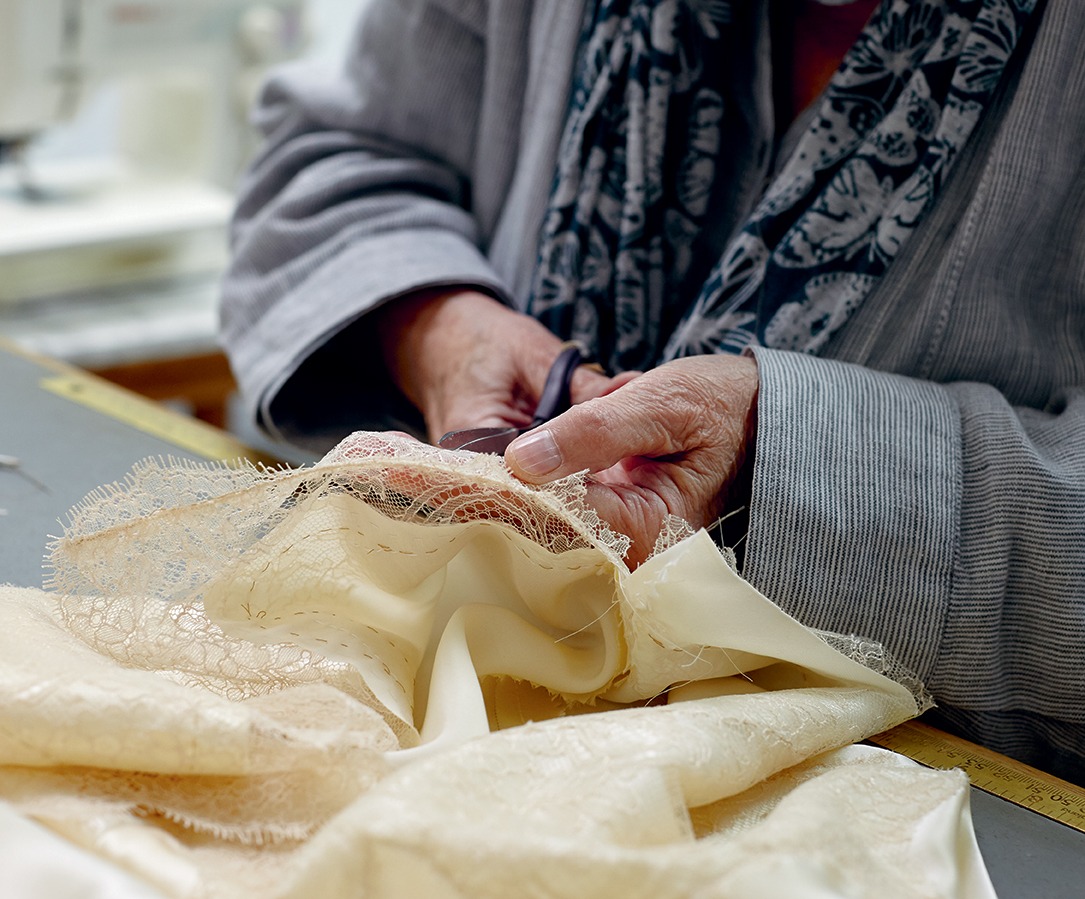
Great patience and delicacy is required while constructing Violetta’s silk and lace slip for La Traviata
Thankfully for Lecrass and her team, there isn’t room on stage for 50 brides. Instead, there are 11 extras who are rotated on and off stage. However, Hipermestra, who falls in love with her husband and refuses to kill him, requires three wedding dresses – one for her wedding and two more for increasing stages of distress, shredded and torn for the dramatic crescendo when she has to climb the set for her attempted suicide. (The team have also had to create a second identical dress for the stunt double who performs on behalf of Em˝oke Baráth, who plays the lead role).
It’s senior cutter Kathy Turner’s job to make sure the wedding dresses are pitch perfect – literally. The dresses are cleverly constructed with expert underpinning and boning. Turner opens a drawer and shows me the two different types of bones she has at her disposal. These are no longer whalebones (which ceased to be used in the 1950s – although she says she thinks there was still a stock of real whalebones there when she began working at Glyndebourne in 1988), but there’s a choice of flexible strips of tightly coiled steel or flat lengths of plastic-coated steel. Turner explains that some singers prefer to be pulled in tight because they like to feel something pushing against their diaphragm. She can pull in a corset to reduce a waist by as much as five to six inches, she tells me.
But however complex the construction of a dress, there are other, more practical requirements too. Everything must be made to be taken off or put on in seconds if a quick change is required. Fragile fabrics are mounted on a layer of functional cotton drill to ensure they are sturdy enough to keep up with the rough and tumble of a performance – and also to make them strong enough to stay in the repertoire for years. Some costumes go on tour. Others are hired out. One of the big differences with clothes made for costume is that they have much bigger hem andseam allowances. They are constructed to be as adjustable as possible, to be let in and out, up or down as required. They will also be fitted with dress shields to absorb sweat, because these costumes cannot be chucked in the washing machine overnight – they can be cleaned at specialist dry cleaners, but not after every performance.
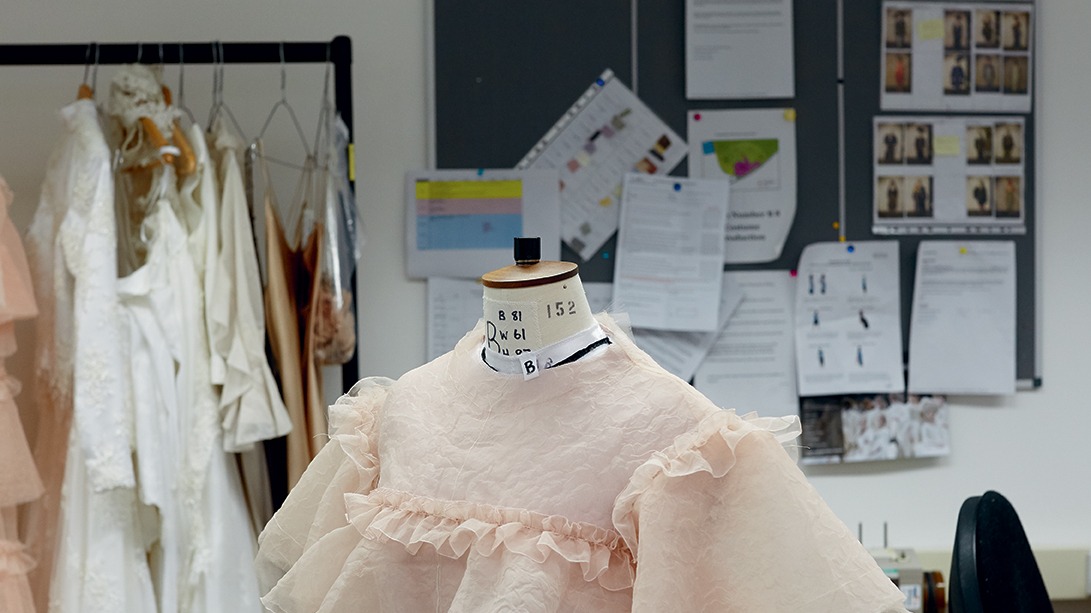
And of course, there is the matter of movement. A singer must feel comfortable in his or her costume, and must be able to breathe and move. During fittings, there will be a dialogue between the maker and the artist about so much more than the length of a hem or the position of a button. And then, during the all-important piano dress rehearsal ahead of the opening night, any other issues will be ironed out with the costume designer. It might be the way a skirt hem hangs with the rake of the stage, or the way the light hits a line of stitching. It’s a truly complex business. Costumes might end up back in the dye rooms to have their colour enhanced. And it seems that operatic heroines often need more than one dress in order to demonstrate their altering state of mind, which is usually symbolised by increasing states of dishevelment. It’s the same with Ophelia for Brett Dean’s new production of Hamlet. On the rail next to senior cutter Karen Wilson is the deliciously ruffled dress for Ophelia in a lighter-than-air, peachy waffle fabric. It has a double that will be slightly more distressed. The costume designer is Alice Babidge, who graduated from the National Institute of Dramatic Art in Sydney in 2004 and has worked with Opera Australia alongside other theatre and film companies.
‘We always retain our sense of humour. We use the word “flexible” a lot…’
According to Wilson – who is working closely with Babidge to translate her drawings and her vision – there is a Sixties flavour to the design. Wilson is an old hand at this. Having started off as an assistant, this is her 22nd year at Glyndebourne. She shows me some of the photographs from recent fittings and how they translate from the designer’s original drawings. It is during the fittings that they might decide a shape is not working on the singer, so proportions might change. ‘Every designer is different,’ says Wilson. ‘Some are very specific, some are more collaborative.’ It is important to realise that vision as accurately as they can, so a calico toile is made to reflect as closely as possible the finished design. If it is a new production of a classic opera, Wilson says the idea is to erase things you’ve seen before – to simply create something new.
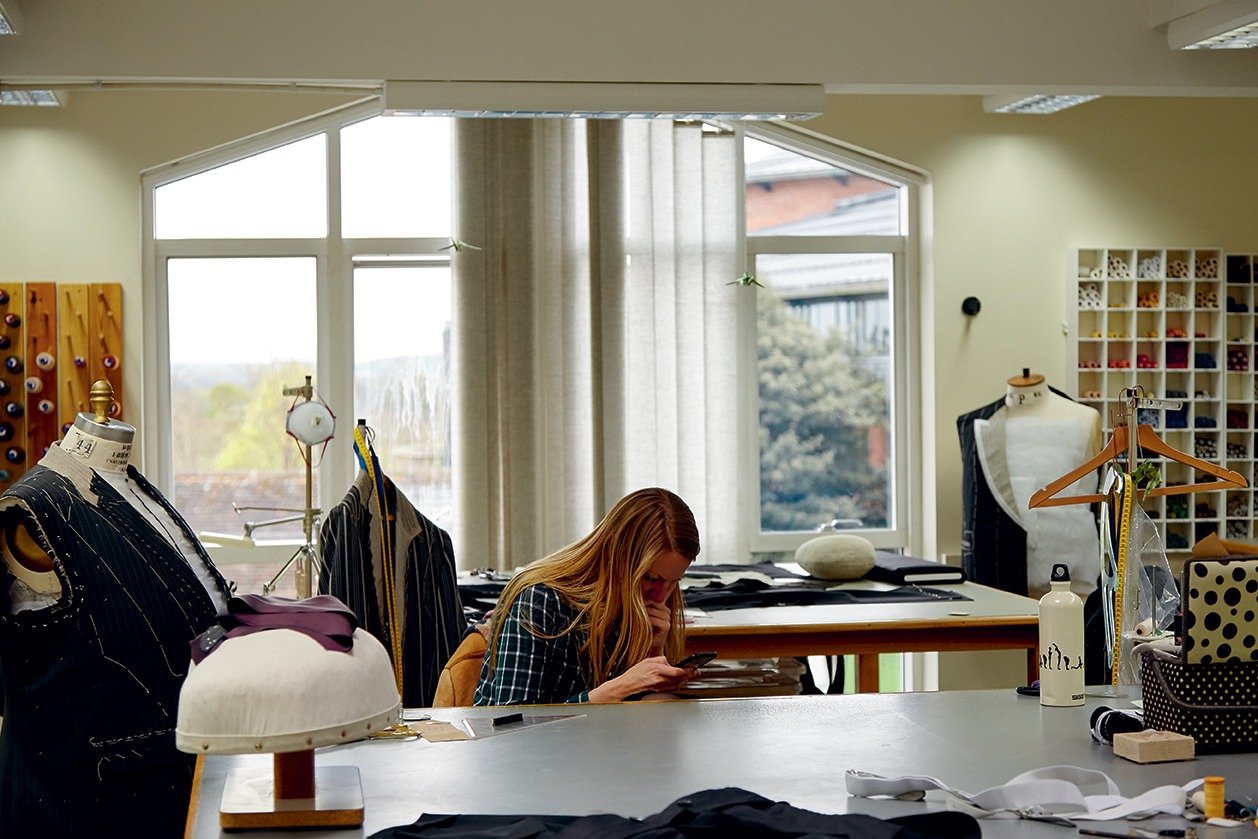
The men’s costumes are tailored to Savile Row standard
Over in the tailoring room, things are a bit more hardedged. Senior men’s cutter Natalie Weber is working on the military uniforms for Ariadne. On her table is an Encyclopaedia of Uniforms of World War II. Not only must the tailoring be impeccable, so too must the historical accuracy. ‘This year is very tailoring heavy, which is very exciting for us,’ she says. The Glyndebourne team of up to a dozen tailors, many trained in Savile Row, are being put to good use. ‘People come in various shapes – as do their voices,’ Lecrass says as we examine an impressive khaki wool jacket constructed for a very well-developed chest. In this department, it’s not just tailoring that is completed with Savile Row skill, but flights of fancy, too – like the flies and spiders that the tailors produced for a previous production of Hippolyte et Aricie.
There is something magical about seeing a Glyndebourne production coming to life. And the alchemy seems particularly real when we are shown into the dye room. There’s an acrid smell from something baking in the oven to fix the dyes. A pair of industrial rubber veterinary gloves lie across a sink where textile samples and costumes are dyed. And – a world away from the romance of Ophelia’s dress hanging upstairs – there are two mannequins wearing military jackets with Arabic scarves wrapped around the necks. A pair of fatigue shorts is suspended above them. These garments – from Hipermestra – all look well worn, dusty and stained thanks to a lot of careful work with sandpaper and specialist paints and dyes applied layer by layer to build up the look of desert combat fatigue. The garments have all been dyed dark indigo blue to ensure they are part of the same world – with the artful addition here and there from an old jam jar with a hand-written label that says: ‘Good Sweat Dye’. To make the pieces look well lived in, they are tied up and steamed to make creases in all the right places.
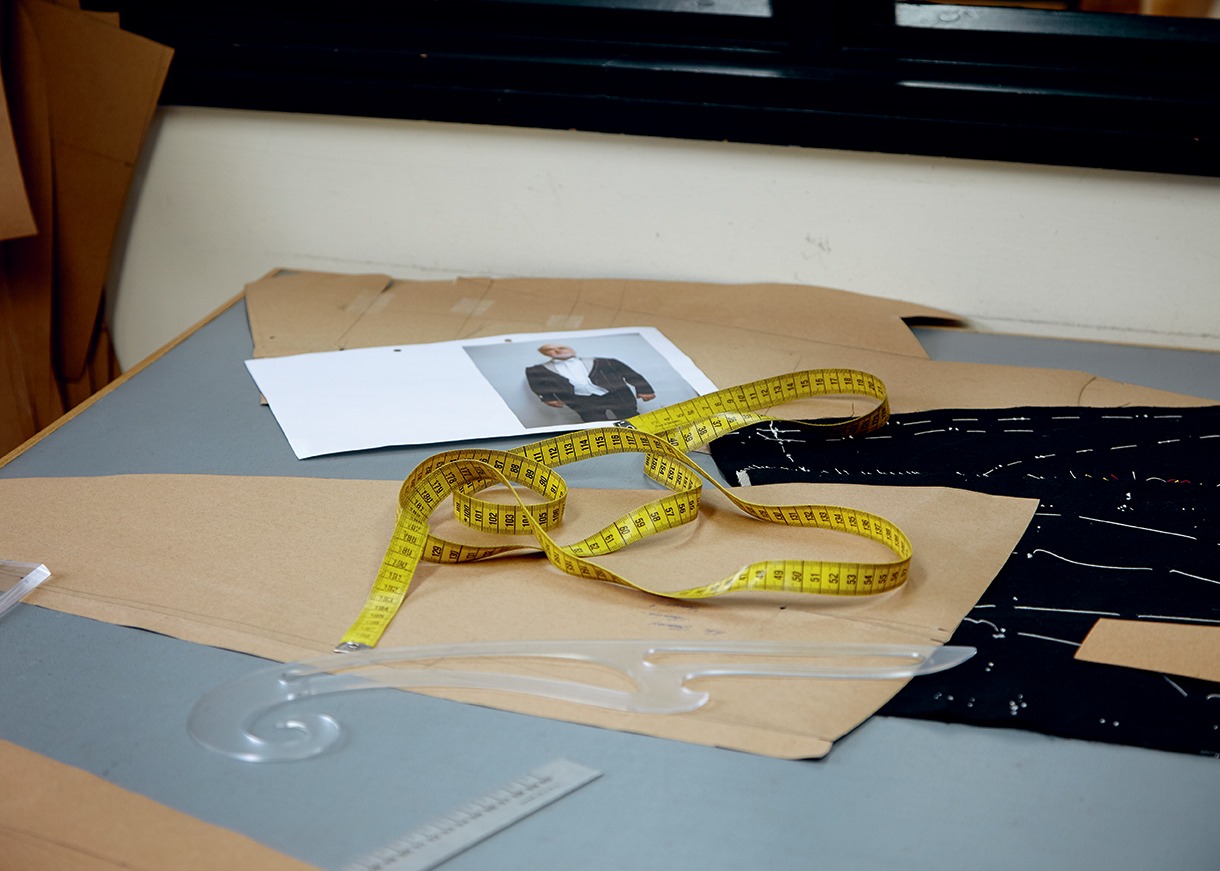
After fitting Polonius’s first tail suit for Hamlet, any adjustments to the pattern are marked in order to complete the duplicate suit
Pauline Lecrass’s world is one built on traditional craftsmanship, tailoring and dressmaking techniques, but lifted into another realm altogether with the addition of special effects, making things never quite what they seem. Digital printing is used to give the look of elaborate embroidery or tapestry. A historically correct costume will be fitted – invisibly of course – with contemporary snap fasteners and zips for quick changes. And everything is made to be reworked and remade for the production’s next revival. Hamlet will tour after this Glyndebourne season and everything will be hung up, packed in tissue and transported to its next destination, along with a chaperone from the company who will make sure everything is well looked after and up to scratch.
It’s a pressurised world, where the impossible is achieved every season. ‘We always retain our sense of humour,’ says Lecrass. ‘We use the word “flexible” a lot. The team is very committed and dedicated. It’s always interesting when you see the new productions because you’ve been working on them since the inception. And the revivals are just as lovely, but more of a known quantity. It’s just wonderful to be able to watch on stage when it all comes together and you’ve got the orchestra in the house and everyone is sitting there seeing what they’ve been working towards.’ She pauses and smiles. ‘It’s a huge sense of achievement.’