MYTHICAL BOWIE
Words and images by Hormazd Narielwalla
I started the work for the Diamond Dolls project towards the end of the first UK lockdown in 2020. I feel very fortunate that, being an artist I was able to continue my work during this turbulent time and that the act of making in itself, is a form of catharsis. Like many people, I needed a way to be able to escape this new reality – to time travel, to transform, to be somewhere different, to be someone else.
Time slowed down drastically and we had lots of it. Isolated from friends and family, connected only by screens or telephones, I started thinking about my childhood and my formative years.
‘Will you stop day dreaming!’, was my mother’s recurring scold when I was growing up. A good middle-class Indian boy had to excel in their exams, get a degree and become a professional – a doctor, an engineer or an accountant – something respectable. There was no room for day dreaming, or creative expression. We had to follow the rules of order, to be able to raise a family, and pass on disciplined structures to the next generation.
As a young gay man growing up in India, Western culture hardly permeated. It seeped in very gently, drop by drop. Then in the 1990s, MTV started broadcasting music videos from the West and my first glimpse of David Bowie was from the 1970s, with his bright red hair and green, glass-like eyes. His beauty captured my imagination immediately. Despite my family’s initial ambivalence towards my sexuality, I had been encouraged to listen to Freddie Mercury because as a Parsi, he shared our Zoroastrian heritage.
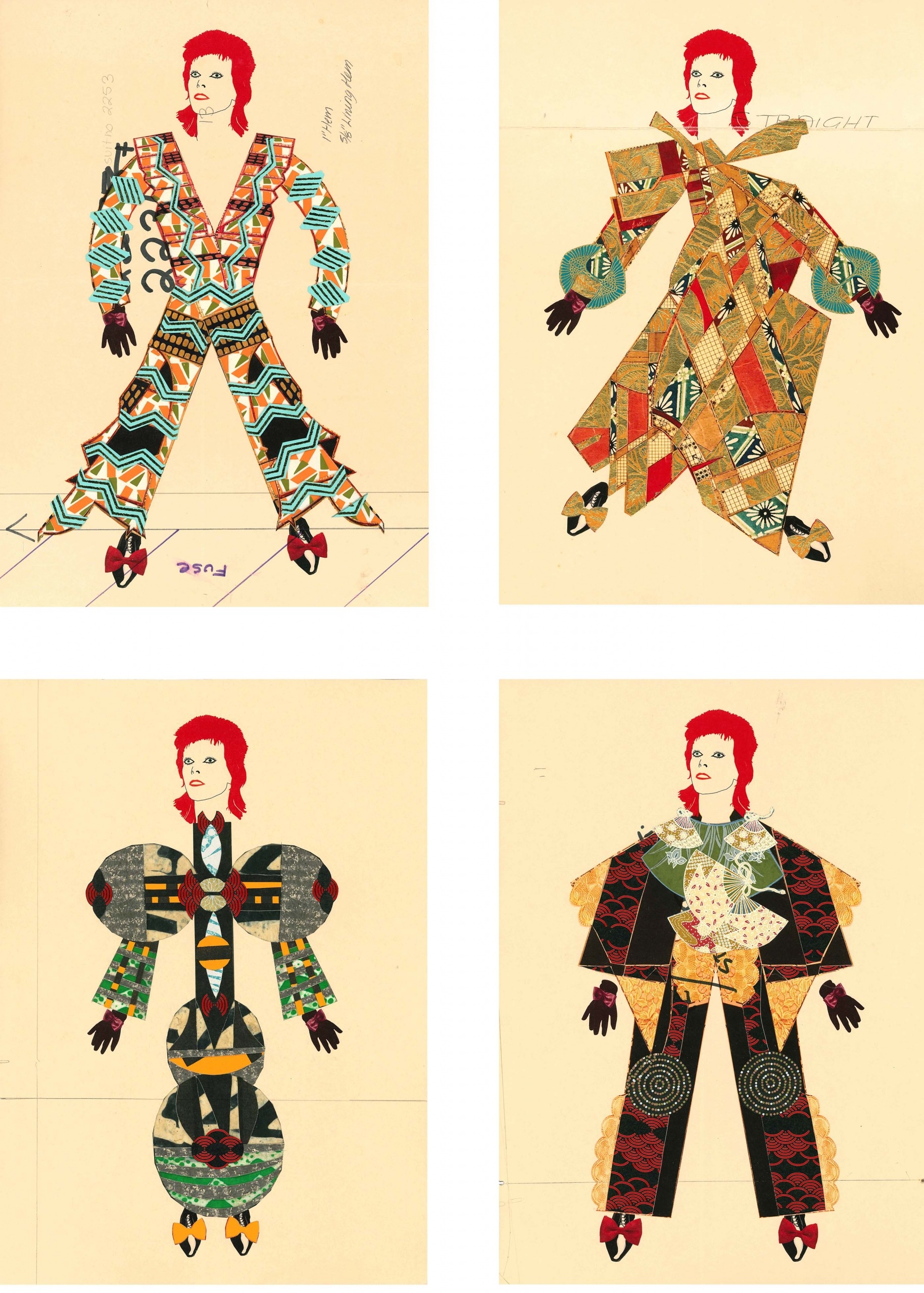
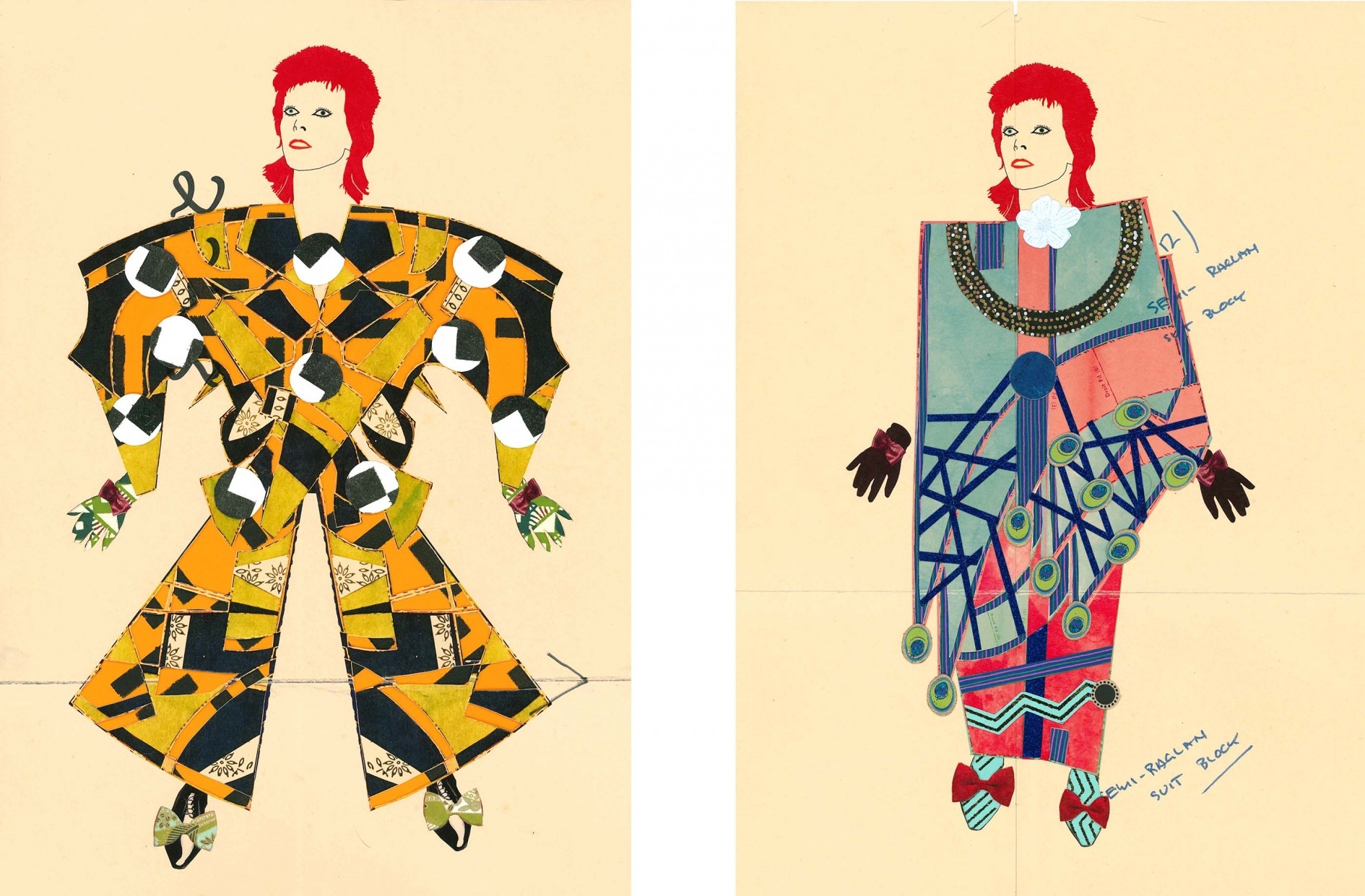
The David Bowie-inspired collages from Hormazd Narielwalla’s book, Diamond Dolls, which explore the idea of transformation into another self.
‘Apro Freddie (Our Freddie)’, was what my family would say in front of the TV. Then I saw the vision of this pale, skinny, eccentric-looking Englishman, part human – part alien, dazzling the screen. I did not at the time understand the constructs of gender neutrality or sexual fluidity, things that I recognise now. Bowie showed me a different kind of masculinity in the character of Ziggy Stardust – the hair, the make-up, the costumes – in addition to his music and stagecraft.
Bowie’s shape-shifting ability to create different personae was the starting point for a sequence of 36 collages. At their basis, the images explore ideas of transformation into another self. My dancing dolls are also a form of celebration. My initial training was as a fashion designer and I remain fascinated by the power of adornment to express the spirit of the inner self.
As with much of my work, the collages are made onto backgrounds of vintage tailoring patterns that allude to a number of recurrent themes – identity, the body and diasporas, among them. The collages are highly decorative, drawing on an extensive collection of papers I have sourced from all over the world, ranging from Japanese chiyogami, Nepalese lokta, Dutch gold and hand-blocked papers. Beauty as a form of seduction.
Although the images initially read as figurative and are assembled using repeated details of Bowie’s ‘Ziggy’ face and hands, they also operate in an abstract way and I have used the sense of costuming as a way to explore many different cultures and traditions. I am fascinated, for example, by the way the Madonna is represented in different strands of Christian culture, becoming through these different representations less human and more ‘divine’.
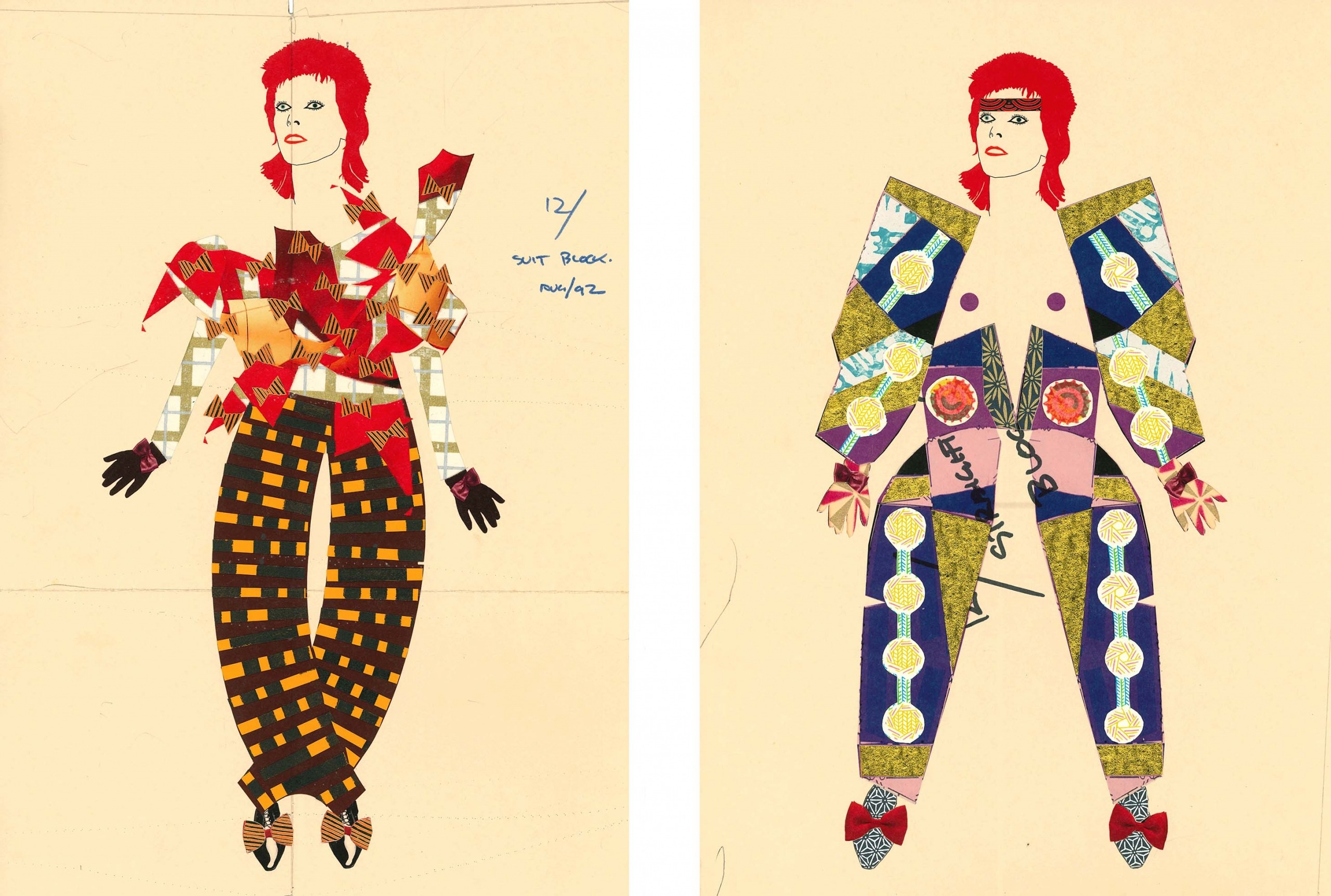
The David Bowie-inspired collages from Hormazd Narielwalla’s book, Diamond Dolls, which explore the idea of transformation into another self.
Some of the Diamond Dolls images push the parameters of the human body towards almost mythical forms. In my own background, many of the Hindu gods are represented as part human, part animal – transformations that emphasise their ‘otherness’, elevating them to deities.
The decision to make an artist’s book from the collages was influenced both by the uncertainty of when I might be able mount physical exhibitions again and the opportunity to collaborate with two publishing imprints – Concentric Editions and EMH Arts. Collaboration with others, albeit remotely, brought a vital sense of creative connection. We saw the book as a kind of portable exhibition space, curated and enhanced by our individual approaches to craft. Conceived as a sculptural object in three parts and designed to stand like a series of shoji screens, it reflects many aspects of Japanese aesthetics that Bowie admired.
The original images are reproduced both front and back to reveal the ‘artifice’ of cutting and pasting involved in their construction. Details – including the distressed silver foiling of the page edges and abstract patterns debossed into the surfaces of the covers – gives the opening, and the arranging, of the book a performative quality. It is completed, in a sense, by its audience.
I wanted the book to be beautiful, playful and profound. It has been made during a time that has brought questions of human fragility to the forefront – a period that has made me question, as an artist, the idea of legacy. The objects artists create have a life of their own once they pass out of their maker’s hands. All cultures preserve almost above anything, the artefacts that express and embody what is most important to them.
Bowie developed a kaleidoscope of shifting personae in part to escape feelings of dislocation engendered by his upbringing, ultimately metamorphosing into the enduring icon he remains. Diamond Dolls is a form of escape – the fruit of day-dreaming. A thought experiment initiated to transcend reality.
Hormazd Narielwalla’s ‘Diamond Dolls’ is co-published by Concentric Editions and EMH Arts, London, in a limited edition of 300 copies, £190. Buy now…
‘Diamond Dolls’ will be on show at The Eagle Gallery from July 15 until August 7. 159 Farringdon Road, London EC1R 3AL
Open Wednesday to Friday 11am-6pm, Saturday 11am-4pm
Find out more…