In conversation with... Cecilia Charlton
Words Augustine Hammond and Cecilia Charlton
Photographs courtesy of Cecilia Charlton
Hole & Corner spoke to London-based American textile artist, Cecilia Charlton, about her intricate, illusion-like work, which is on display at the Jerwood Art Fund Makers Open Exhibition. Known for her largely embroidered, multicoloured textile artworks, Charlton’s work elevates this ancient craft, stitching together notions of tradition, folk-art, fine art and geometry.
After receiving a BFA in Painting at Hunter College in New York, the artist gained an MA in Painting at the Royal College of Art in 2018. Since then, she has exhibited internationally, her most recent solo exhibits include; Mammoth Loop at SPACE in Ilford, 2021 and Aurora at Candida Stevens Gallery in 2020.
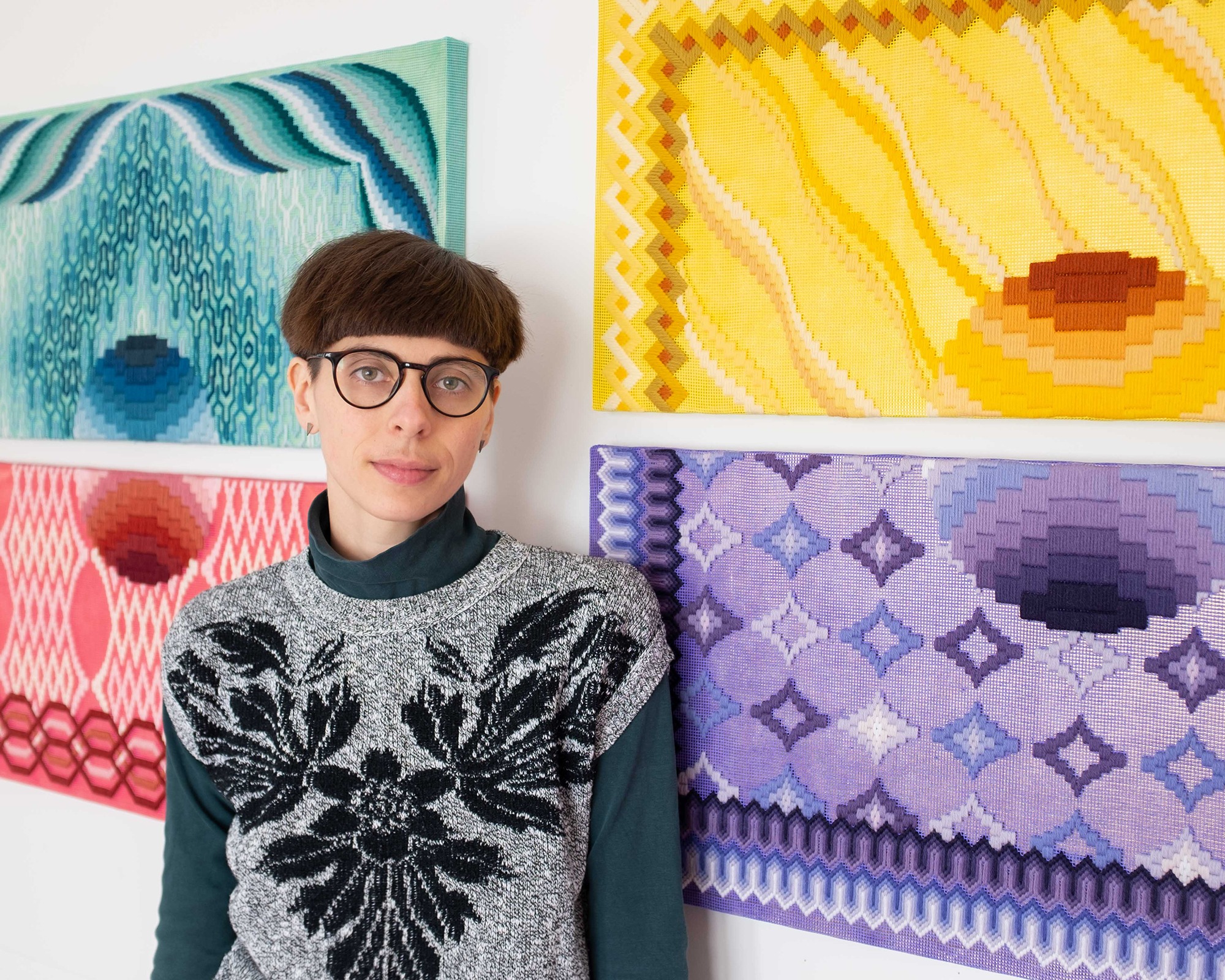
London-based American textile artist, Cecilia Charlton, with some of her work
This month, Charlton’s latest work will go on display at the Jerwood Art Fund Makers Open, which returns in 2022 for its eighth edition. Alongside work by handpicked creatives including; glassblowers Jahday Ford and Vicky Higginson, artist Anna Berry and metalsmiths Francisca Onumah and Helena Russell, Charlton’s work will be shown at Jerwood Space until April 9, before travelling to Penzance and Aberdeen later this year. The artists will also be showing at The Craft Council’s Collect from February 24 – 27 at Somerset House.
Tell us a bit about yourself and what you do…
I had a long and winding path to where I am at the moment. My mum’s a seamstress so I grew up sewing. She’s a pretty voracious textile fan herself so I think that’s why it took me a while to see it as an art form.
After high school, I initially studied engineering because of my background in science and maths. I come from Corning, New York, which is an area heavily based on research and technology and I have a mathematical brain, but it wasn’t the right place for me. I then worked in metal and ceramics and finally went and got my BFA in painting. You can follow this trajectory of me circling in on fine art and I finally got there.
How did you get into textile art?
In 2017, I started using needlepoint instead of paint and I found that shift in materials added a certain amount of personal relationship to the artworks. There was this inherent intimacy that you achieve in using textiles as opposed to acrylic paint. For me personally, it added a lot of meaning because of the history with my mum. There’s a real depth to the relationship in my lineage with textiles but I also find that this is quite universal. We all have our own narratives in relation to textiles and I think that creates a really interesting relatability to my practice.

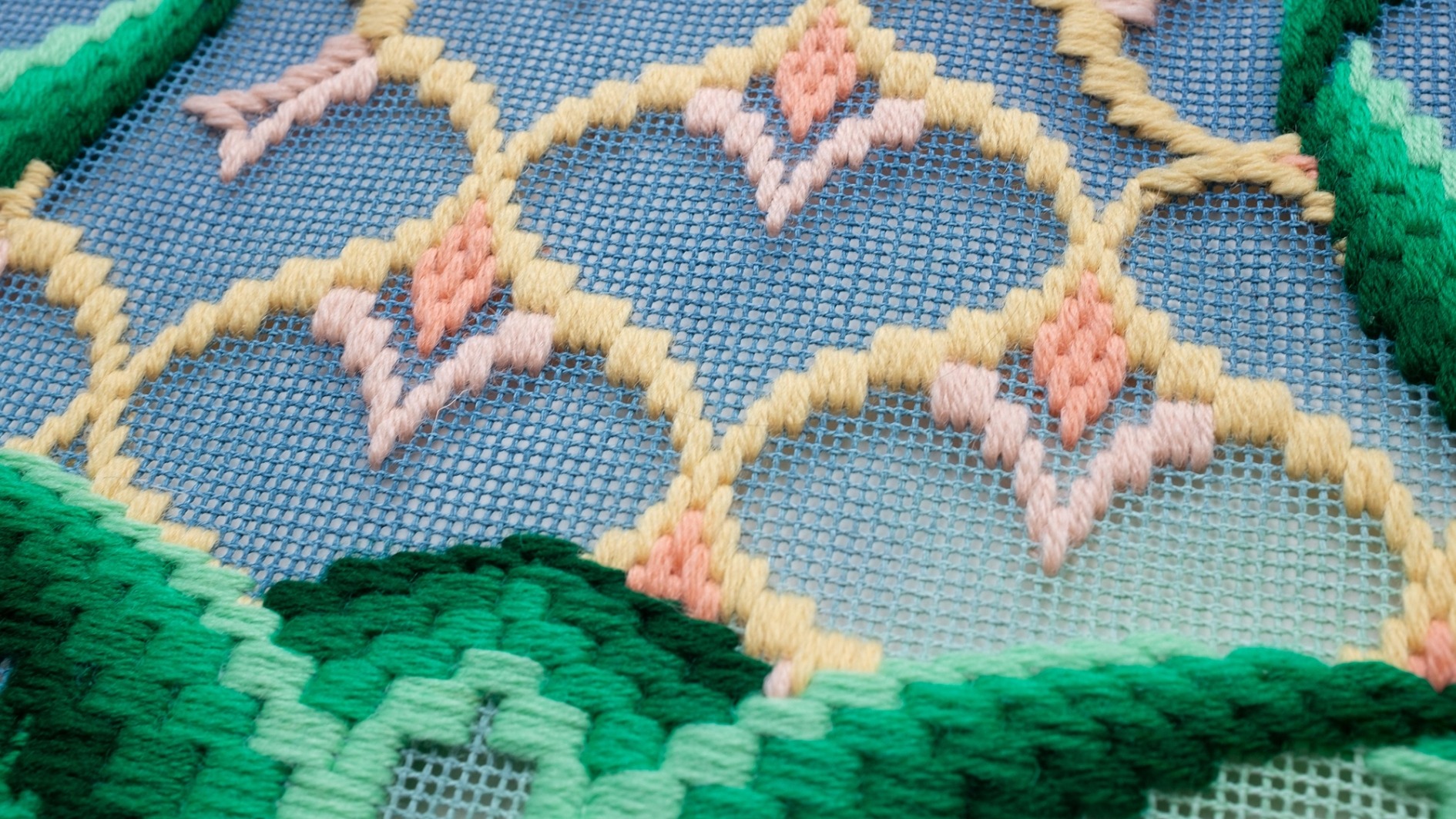
Charlton at work: ‘I mostly use bargello embroidery, which results in unique designs that appear mathematically laid out, which actually happen impulsively as I go along’
Where do you look for inspiration when designing?
What I look at for inspiration is really quite broad but usually in the end each artwork ends up being about something very specific. I think generally I am interested in ways of being, analysing human life on a larger scale rather than focusing on the individual. I think the style of embroidery that I do has the potential to open up those kinds of universal conversations. Focusing on the universe gives me perspective and on a personal level helps me to not take things too seriously, those are the key ideas that drive me to make work.
What are the recurring themes within your work?
What usually happens in the process of making work is that new ideas evolve. The nice thing about embroidery is that while you’re working on a piece you are up close to it. I recently read a book called Braiding Sweetgrass by Robin Wall Kimmerer, and when talking about weaving she writes, ‘when the hands are busy the mind is free to wander’. As I’m embroidering, I find myself making connections with things that I’ve been watching on TV or something that I’ve read in a book, or current events. My starting point is always material and process-driven but usually, by the end of the work, it means something completely different and a lot more specific.
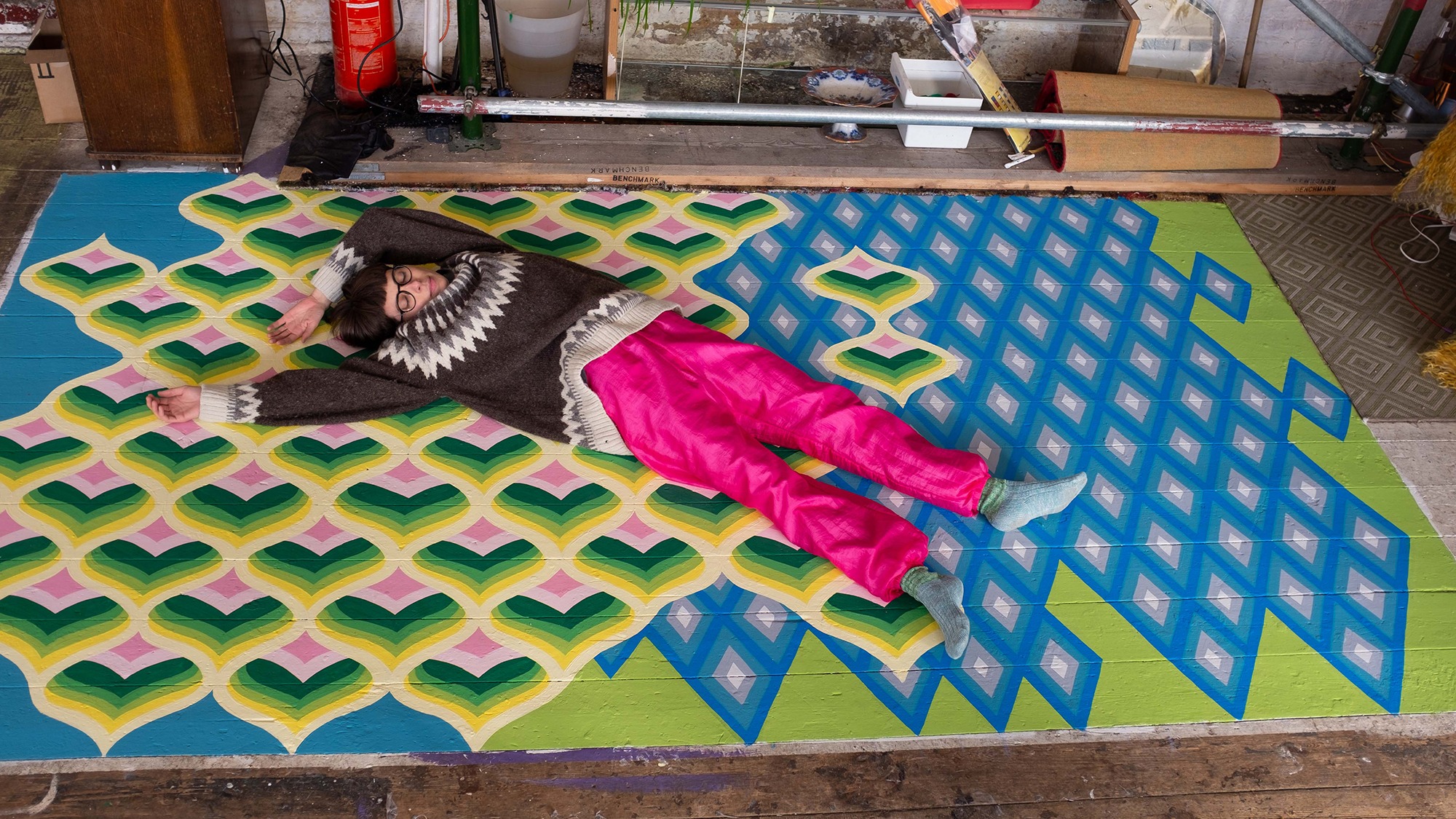
‘The nice thing about embroidery is that while you’re working on a piece you are up close to it’
What making processes do you employ?
People often ask whether I plan out my work ahead of time and I’ve thought about that a lot. The reason that I don’t is that then the embroidery process would only be about execution – execution of an idea that I’ve already had and mapped out. For me, it’s really important for the creative process to exist at the same time as the embroidery process. If I was trying to always follow a pattern, I would go crazy. I mostly use bargello embroidery, which results in unique designs that appear mathematically laid out, which actually happen impulsively as I go along.
What are you excited about this coming year, tell us more about your involvement in the Jerwood Makers Open?
The award is geared towards creatives working in craft mediums and aims to support them in making a step-change in their practice. The step-change that I applied with was to start using a bigger embroidery frame. The new frame means that I can work on a larger scale, from a piece of canvas that is a metre wide and as long as I want it to be. From this new process, I was interested in creating a specific artwork, which I will be showing at the Jerwood Art Fund Makers Open.
I have created a triptych of embroidered canvases inspired by the myth of the three fates. Each piece in the series resembles one of the three sisters responsible for spinning the thread of life, measuring the thread of life and cutting the thread of life.
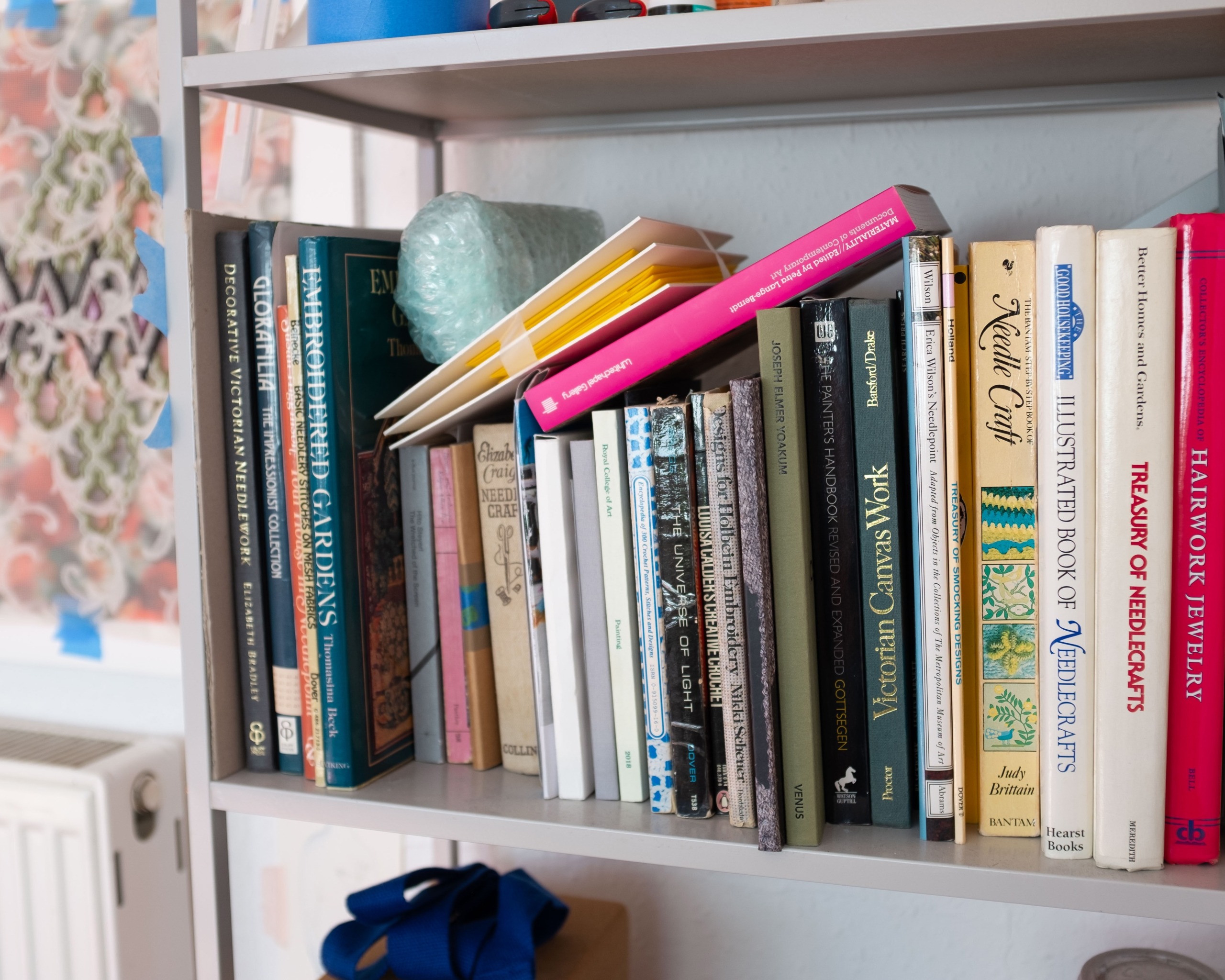
‘As I’m embroidering, I find myself making connections with things that I’ve been watching on TV or something that I’ve read in a book’
What is the best advice you could pass on?
I often make my way through life like I make my way through my artworks – it’s all pretty intuitive. I have a feeling about something and then I try it. When I was about to move to New York to study art, I emailed an artist whose work I admired to see if she had any advice. She very graciously wrote back to me and said that her advice was to never compare yourself to anyone else. That advice is something that I’ve carried with me throughout my career. As an artist, it’s hard to continue to believe in yourself, but what makes the art world exciting is bringing your own uniqueness to it.