Look! Listen! Vibrate! Smile!
Words Justin Quirk
Photographs Marius W Hansen
What is perfect sound? Can it ever be achieved? Join us on a voyage back to the future of recording technology to discover the magical, obsessive world of the analogue audio experts…
Inside an unprepossessing industrial unit off a choked A-road in north London lie hundreds of examples of the most radical, ambitious engineering that the 20th century produced. Piled up for delivery, or half-unwrapped from the polystyrene, plastic and shipping material that has safely transported them halfway around the world, or lying on a crowded workshop bench with their electronic guts hanging out and wired up to oscilloscopes and wobbulators, these items range from priceless collector’s items to one-off curiosities.
Funky Junky in North London is perhaps the leading facility in Europe – if not the world – for the repair, restoration and trade of vintage recording studio and audio equipment. A vast array of equipment – Compex limiters, Roland echo units, Sequential Circuits Prophet synths – fills every gap and surface. Had Mr Toad lived long enough to get bored with open-top cars and experience instead the golden age of studio recording, one images his loft would have looked similar. ‘Demand [for this equipment] is from everywhere’, says manager Adam Crowe. ‘It’s the same as being a collector of butterflies, of stamps, or whatever. The only difference is that you can actually use this stuff. You can enjoy it.’
And enjoyment – or at least use – is the key to this world. Funky Junk is part of a small network of companies, studios, facilities, businesses and individuals keeping alive the physical iteration of audio recording’s high technological watermark, and making sure that it doesn’t just become a world of obsolete pieces and private collections. In many cases this has required invention, repurposing, a lot of soldering and some grafting together of the old technology with the new. But it is working.
‘I’m the sales manager. Whatever you want to call it. I do everything – sales, support, running around, the digital side, therapy… whatever people need. It’s not your conventional retail environment, by any stretch of the imagination.’ Adam Crowe gives a sly grin. ‘The staff are as weird as the clientele.’
Funky Junk specialises in the electronic tools that were intrinsic to the capture and creation of music with an extra historical resonance: the music that formed the spine of the post-war pop culture as it spread to all corners of the globe. ‘Everyone needed to record. That’s the point – music was made everywhere around the globe. Back in the 1950s and 1960s, places like EMI and Decca established headquarters in other countries. And the big difference back then was that you couldn’t go out and buy a piece of kit. Nobody else made one. So if you wanted a compressor, you made one. And a lot of what we now consider vintage and extraordinarily valuable gear was the stuff that these guys made in-house.’
These companies built equipment to an incredibly high standard before it was broken up and scattered, as the labels’ foreign outposts were wound up or evolved into the digital era. It is now slowly finding its way back to north London from some unlikely places. ‘Some years ago we found (an EMI console) in Lagos. Mark Thompson (Funky Junk’s founder) identified it from spotting a corner of the desk, behind a stack of tyres, in a photo that someone sent him. That went to private hands for an extraordinary amount of money.’
Microphones are a particular area of interest in the audio collector world: the Telefunken ELA M 251; the AKG C12; the Neumann U47 that was made famous by Sinatra; and the BTX, the BBC’s own version of the RCA microphone, that ‘gives you this beautiful, low newsreader gravitas’ (few of these ever come to market, due to the Corporation’s erstwhile habit of marking a newsreader’s retirement by painting their microphone gold and gifting it to them). Similarly, much AKG stock was lost when a clause in a European grant that saved the company from bankruptcy in 1994 necessitated the destruction of all the company’s existing stock and machinery.
‘This stuff was made to quality, not cost,’ explains Crowe. ‘If you were a broadcaster and the president was speaking tomorrow, you had to get that extremely reliable, extremely expensive microphone. We consider them the absolute pinnacle, unsurpassed to this day.’
§
‘We all get different things out of listening. Some of us might listen for clarity. But for me, the most important character of a great stereo system is the ability for two speakers to project a “holographic” image of the performers with good height and width.’ Stuart McGregor is recounting his formative years as a ‘listener’ for the likes of Mission, Cambridge Audio and Cyrus as we drive through the Cambridgeshire countryside in his vintage left-hand drive 1972 Citroën. As he explains, the idea of ‘good’ or ‘perfect’ sound is a misnomer, a phantom that listeners chase. ‘What you’re doing instead is refining equipment to make it have a sonic signature that’s the company’s trademark – but not everyone will like it.’ These trends are discernible not just across brands, but also across geographical zones, with a popular ‘sound’ in America being definably different from the equivalent in, say, Switzerland.
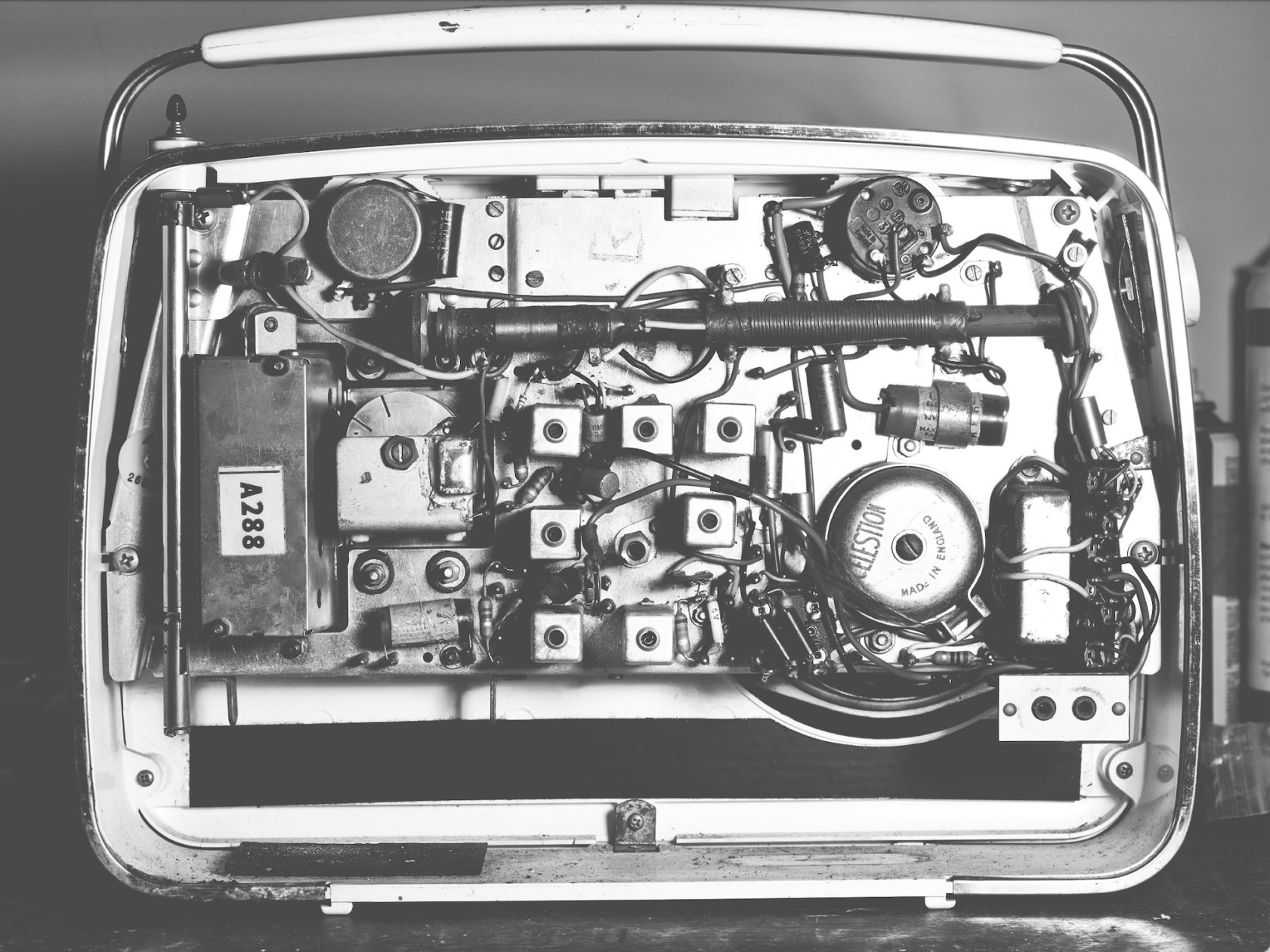
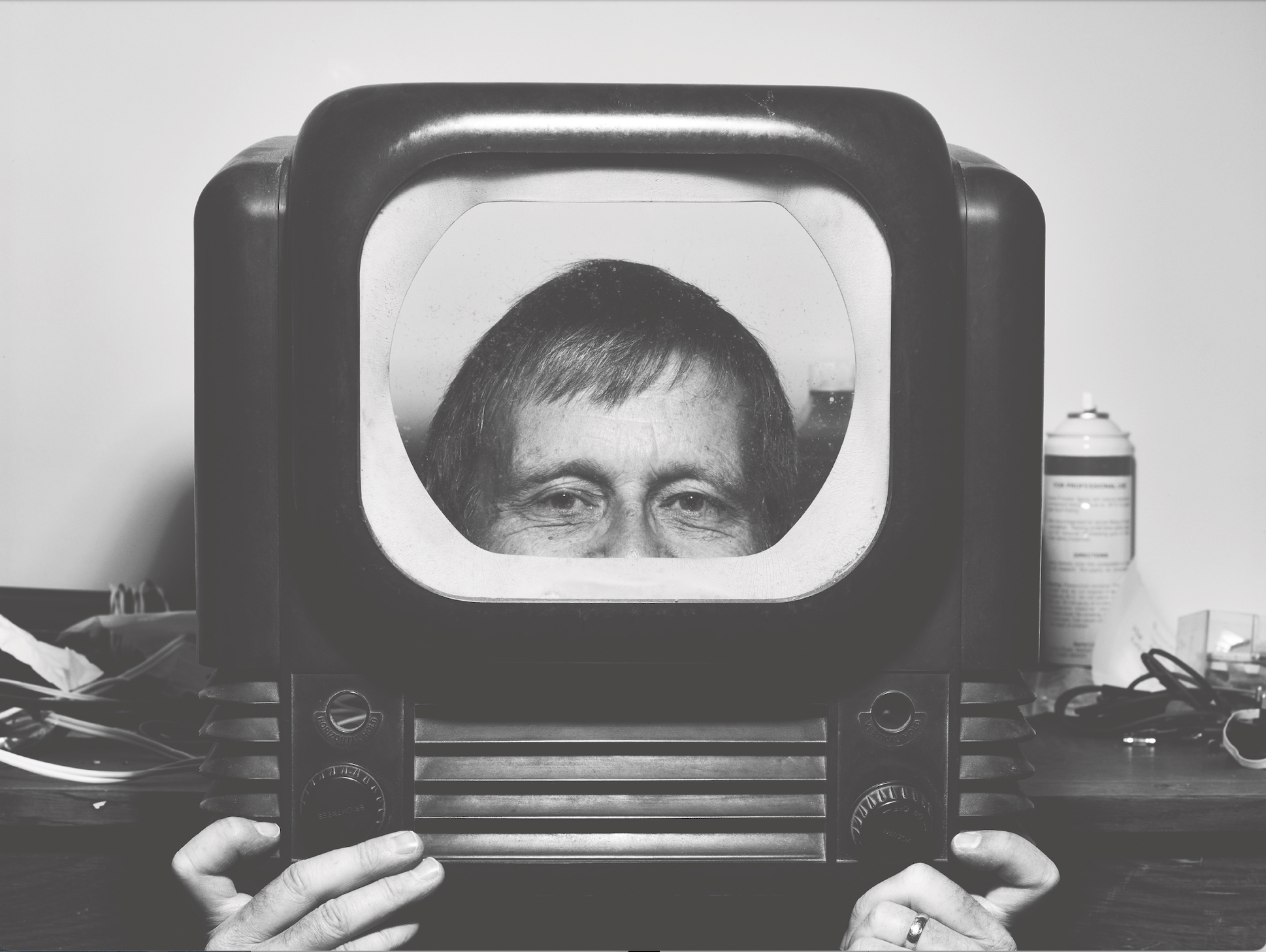
Back home in McGregor’s main work room, the light clicks on to reveal shelves stacked with ancient radios, wire recorders, cumbersome Dictaphones, small jukeboxes, Bakelite radios and a tiny television that Clive Sinclair produced before turning his attention to home computers and pint-sized cars. Small piles of equipment sit mid-service, partway through being restored and returned to their owners. In most cases, the financial cost of the repair far outstrips the nominal value of the item. ‘It usually carries some memories with it – one guy wants it doing for his dad so he can hear it again while he’s still able to. There’s always some link with the past, it seems.’

McGregor has developed something of a speciality working with Discomatics – a Swiss-made, portable jukebox made famous by John Lennon’s patronage. McGregor fires up a half-repaired machine; the line of 40 buttons along the front of the machine select which discs will make up the mechanised playlist. The single rises from its rack and a vertical cartridge slides alongside the single to play the track, before reversing its path to play the B-side. ‘It goes loud, better than you’d expect.’ Viewed up close, it’s a reminder of what an astonishing feat of engineering was required within relatively recent memory to facilitate a pleasure that we now take completely for granted.
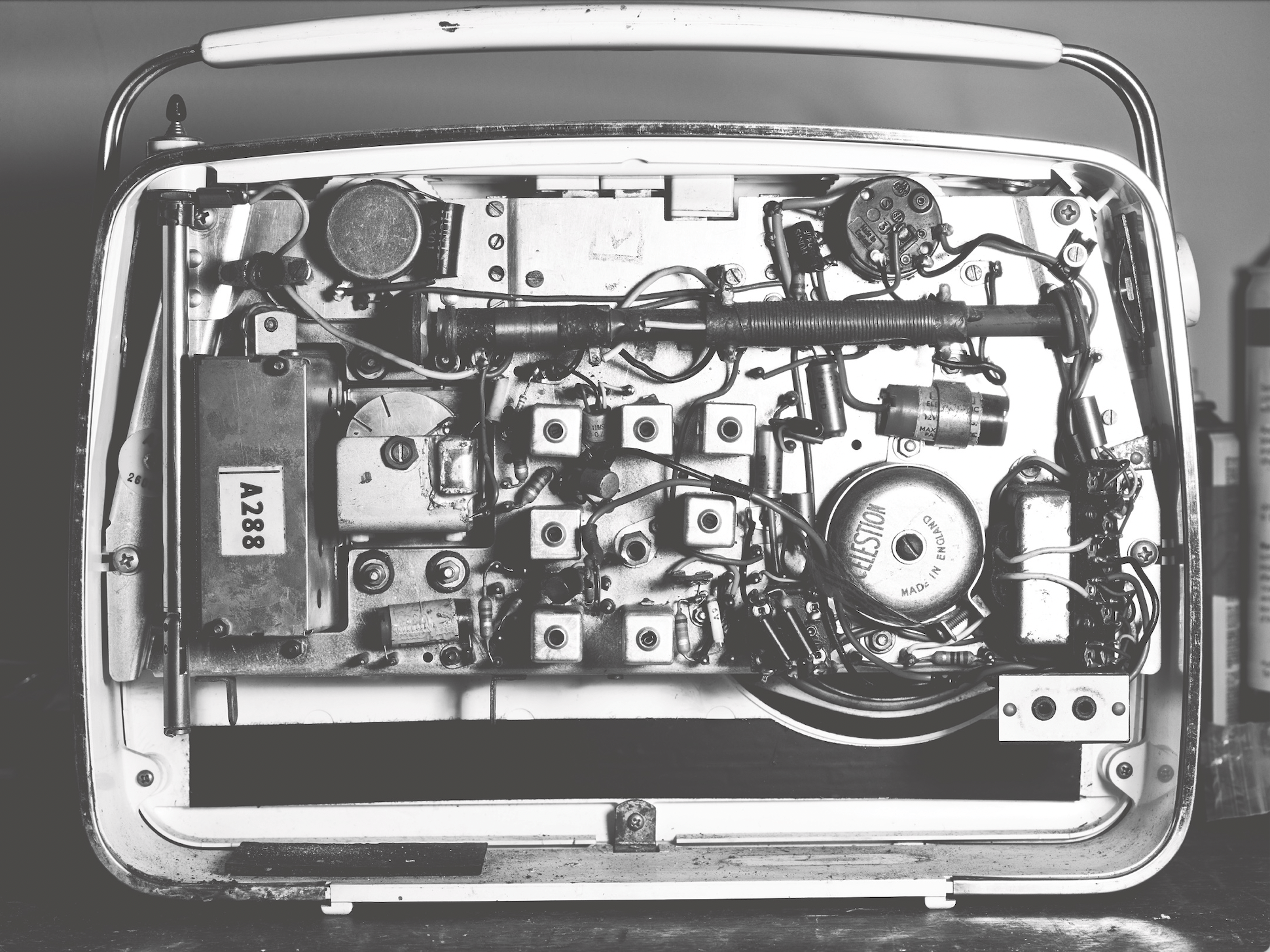
McGregor moves around the room, detailing the technological and industrial history contained within each of these obsolete pieces of machinery. The cassette-based Uehr Dictaphone – ‘that’s what you’d have been using to record me in the 1970s’; a Revox A77 reel-to-reel machine – ‘the very top end of domestic tape recording’; the Cossar and Osram radios that emerged in the wake of the valve being introduced, a step change in potential and quality for radios.
‘I have a pretty unusual talent in being able to read circuit boards,’ McGregor explains. ‘Circuits are not linear like a book – they’re complex in that they’re three-dimensional.’ As to what has drawn him to this niche corner where music, electronics and antiques collide, he seems mystified. He motions to a device on the middle shelf. ‘The first piece I ever had was that TV, in 1966. It was given to me by my art teacher. I was the envy of my mates as I had a TV in my bedroom – I remember watching the moon landings on it. Having this stuff really gave us some status.’
§
The pinnacle of lathe-cutting technology was achieved by the German company Neumann in the mid-Seventies. If you’ve attended any of the London-based Vinyl Factory’s art events in the past year – Christian Marclay at the White Cube, for example – you may have seen one of these in action. Rebuilt into a protective housing, the Factory’s cutting lathe is now fully mobile and means that when they stage an audio performance, their engineer can be on hand to record it straight to a lacquer. With the Vinyl Factory also now in possession of a completely self-contained mobile vinyl pressing plant (it’s housed in a shipping container), they can offer a one-stop, bespoke vinyl pressing service for their own events. ‘It’s exciting, recording what happens in the moment. It’s a craft business, essentially, and there are very few skilled technicians who are masters at what they do,’ says Sean Bidder, the Factory’s Creative Director. ‘It’s a niche skill, but a skill that’s essential for the process to work. So round the world there’s only a few people with that kind of experience.’
Vinyl Factory’s commitment to high-end audio culture has become increasingly art-focused (their Ryoji Ikeda and Carsten Nikolai events at Brewer Street Car Park have been some of London’s most critically acclaimed recent exhibitions). This has been crucial in pushing their take on high end audio beyond the dusty realm of Discogs-monitoring completists and drawing in collaborators and enthusiasts too young to have experienced analogue first hand. ‘They’ve obviously started on digital technology and they’re not going to give up their computers or anything, but given the option, they’re fascinated by analogue,’ says Bidder. ‘All producers are trying to forge their own sound and get a point of difference, and analogue gives you that. It’s hands-on. Outboards, synths, if you’re naturally creative that’s an exciting world to explore. You need to get into the nuts and bolts of experimenting with stuff.’
The Vinyl Factory’s next project is the building of a sound system with Funktion One that will launch in Berlin later this year. The eight-speaker, in-the-round system ‘offers something different from anything else. You can play it in stereo, or surround, or a rich three-dimensional sound field called Hafler Sound. So we can be really flexible in terms of how we’re working with people – artists can produce a bespoke sound piece to work with it. It’s a subtle process and you have to understand the system. It’s partly about creating a great sound and environment, but also about allowing producers to showcase their work to a really high level.’ Ultimately, Bidder sees all of the Vinyl Factory’s projects and services as being part of the same mission: to return sound to the status of a fully visceral listening experience. ‘On the internet, everything is slightly compressed, it’s a flattened experience. So when you get into an environment where (the same thing) is done to a high standard in a physical space it kind of blows you away.’
§
At the less esoteric end of music creation is Snap in North London, a sister business of Funky Junk, offering ‘the very best in vintage and modern equipment, along with traditional values and a unique, creative vibe.’ Now in its fifth year, Snap is overseen by engineer/manager Marco Pasquariello who is walking me through the compact space and its various features and USPs: an oak floor reclaimed from a church in Leeds (‘a really tight sound for drums’); a Bösendorfer 225 grand piano that had previously belonged to George Martin’s Air Studios; Chris Rea’s old Hammond C3 organ; a stack of Fender amplifiers with the internal speakers ‘wired into a really weird labyrinth system’ and overhauled by a man called Horse; and a specially installed balanced mains electricity system which ‘cost a bloody fortune’ but reduces the noise on the building’s power feed to almost nothing.
But it’s in the recording room where the quality of Snap’s offering is really apparent. The main feature is a Neve 5316 analogue console. ‘I think it was originally probably built to be a live recording desk,’ says Pasquariello. ‘It was in Scotland for a while in the Seventies, then somehow ended up in Paris. We didn’t have the service manual for it when we bought it, then eventually got a call from a guy we do some work with who had found our old manual with the exact serial number in a studio in New York.’
However, Snap isn’t a temple of analogue purism, and much of Pasquariello’s work in establishing the studio has been to work out how digital technology can be integrated with these vintage pieces. Individual modules have been stripped from cumbersome old consoles and re-racked so their sound can still be captured with less hardware; 1950s limiters and Stude tape machines (‘so well built it’s just insane’) are used alongside Pro Tools. ‘Sometimes bands want to use tape just because of the whole process of recording to it. It’s all about the process of using it. Bands who are into that sound romanticise it, they love working with it.’
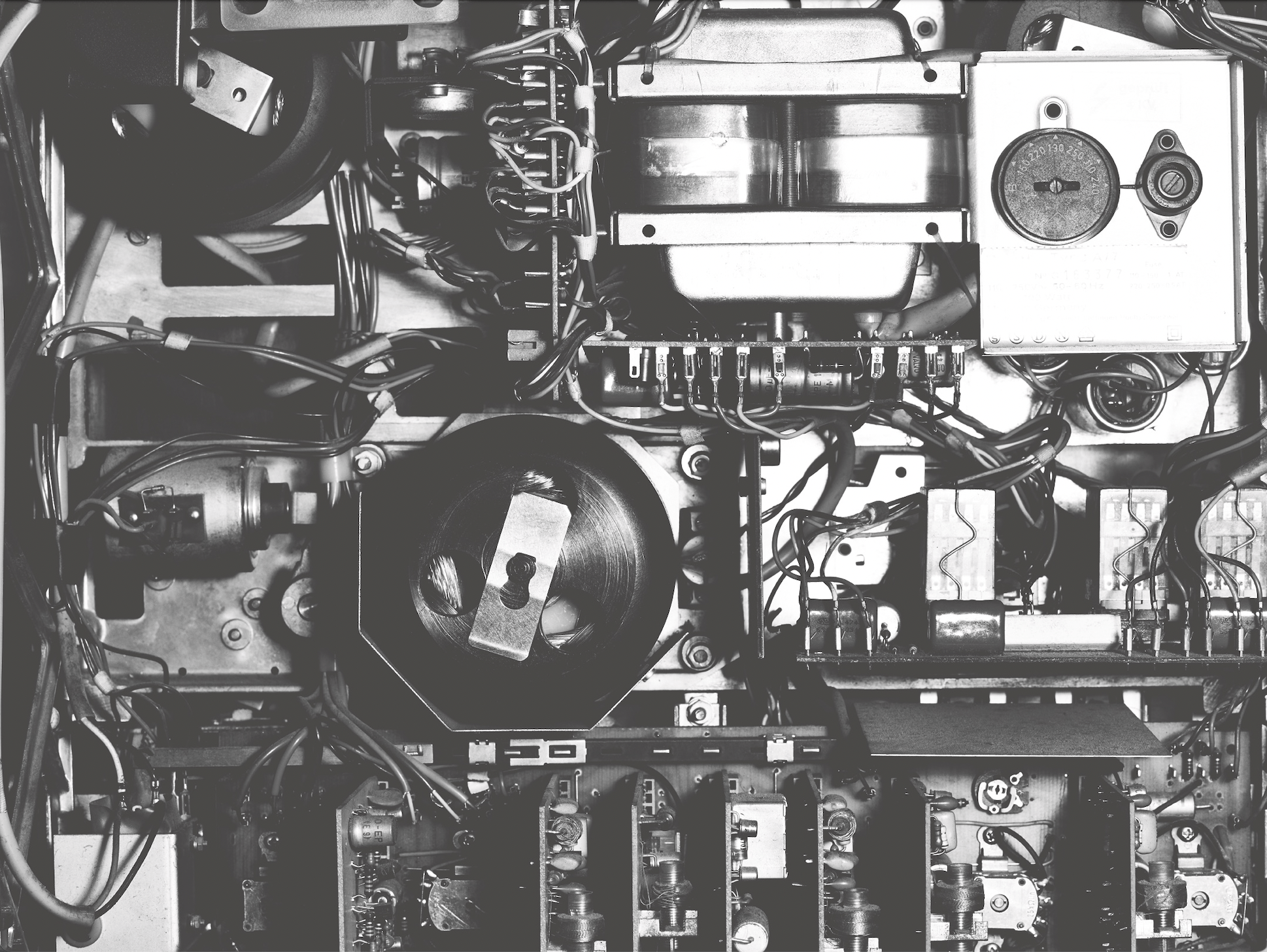
Pasquariello’s own current area of interest is particularly in synthesisers – and a side room at the studio is filled with these. The centrepiece is the Yamaha CS80, a back-breakingly heavy, temperamental, polyphonic synth released in 1976 and used extensively by everyone from Vangelis (on the Blade Runner soundtrack) to Kraftwerk. ‘It’s like the Holy Grail. It’s less like a synth and more like a proper instrument in its own right,’ he says as we lift its lid and peer into its multicoloured, hand-wired entrails. ‘In 1976, this must have been like seeing the future.’
§
The most immediate thing you notice about the sound system at Merchant’s Tavern – a bar and restaurant on the corner of Great Eastern Street in London’s Shoreditch – is its sheer size. Not just in terms of the height and breadth of the Living Voice speakers, impressive as they are. But in the generous spacing between each piece of kit – the pair of modified Technics 1210 turntables with Isonoe arms, suspension feet and power unit, the Californian-made Canary Audio amplifiers with their trays of exposed Electro-Harmonix glass valves, the Japanese-made Alpha Recording Systems mixer and the ex-BBC Studer reel-to-reel tape machine – and the comfortable, corridor-wide space for the DJ to stand in.
But then everything about the Spiritland sound system is expansive and exacting. Built by audiophile and radio producer Paul Noble after he left his previous berths at the BBC and Monocle 24, it stands as a perfectly balanced, aesthetically pleasing counterweight to a sonic culture in London that still too often defaults to ‘barman’s phone cranking out compressed MP3s.’
‘I was always into equipment,’ says Noble. ‘I’ve got piles and piles of audio gear and I was always putting it together in different ways and trying to get it to work, but it was never quite there. Then I went to Japan where they take their sound very seriously – you’d go to a little bar and there’d be a lovely pair of vintage speakers, a Garrard turntable, a valve amp, original pressings of Riverside Records stuff.’ After visiting high-end hi-fi shows, and performing a ‘ground zero’ refit of his own music system, Noble started to sketch out the idea for a new kind of public listening. ‘An approach that isn’t about club culture and keeping the dance floor going, but where you could explore any kind of music, in a very considered and heavily curated way… on a sound system of outstanding quality, in somewhere that was also an elegant space to listen to music. There’s food, drinks are bought to your table, you’re not standing at a bar. And where we could build a system and not say that it’s definitive but something that could evolve over time.’ Those who’ve eagerly played in this environment already include Andrew Weatherall, Franz Ferdinand, Elijah Wood and Jay-Z’s tour DJ Young Guru.
As the needle drops on a copy of David Cassidy’s ‘What A Day For A Daydream’, I retreat to the midpoint of the room as the sound swells out. Even playing a single track from a bog-standard pressing of a compilation LP, the sound feels tangible, like it’s a cloud of steam that you can walk through, rather than a narrow jet of water being fired at you. As the treble-rich, hammered piano comes in, it seems to sit above the main body of the song’s mix. The effect is strange – as though you are being shown a geological survey of the song’s layers – and highlights how woeful the music sounds in most venues.
Noble flags up other operations who treat their music with similar care – Lucky Cloud’s Loft parties (blessed by David Mancuso, the legendary DJ and founder of the original Loft events in New York); Leeds’ Cosmic Slop, Brilliant Corners in Dalston, London; Mr Scruff’s own personal sound system and James Murphy’s Despacio rig – suggesting a revival of interest in the bars, clubs and artists that have built music into the heart of their operation. He puts other records on – George Benson’s ‘In Flight’ sounds particularly good. The intricate network of instruments untangle and sit cleanly in their own areas of the mix, cohering into something close to how Benson himself would have heard the music on its first creation.
§
Round the corner from Spiritland is Sonos Studio London – a newly opened café and creative space and major investment from the audio streaming company. In an ambitious raising of reputational stakes, a company best known for small-scale, domestic products has converted an old industrial print-shop on a side street in London’s Shoreditch into a large space devoted to high quality listening in all its permutations. The timber floor is reclaimed from the former BBC World Service building; the original Crittal windows are screened by lines of mobile, vertical ‘louvres’ to improve the room’s sound; on the upper floor, a small side room serves as a listening space, the sound swelling and filling the air as you recline in a chair and look out over the rooftops and railway lines of Shoreditch. Most remarkably, the bar area’s ceiling is made up of a series of modular panels with interchangeable surfaces, which lower and angle depending on what sound is coming through the speakers. Essentially the entire room becomes an acoustically tunable speaker, ensuring the highest quality, whatever is being listened to.
On the staircase of the building is an original framed print of a Dennis Morris photograph, showing the Admiral Ken Sound System unloading their speakers on the exact location of the Sonos Studio in 1974. Between the Admiral’s set-up and that installed by Sonos 40 years later, there’s a stylistic and technological gulf. But the motivation is the same: to wrestle with the available hardware and science of the day, push it to its functional limits, and use it to convey music as near to its original, intended state as possible. What seems different nowadays is a realisation that the technology of the past is there to be learned from – and reincorporated – rather than discarded; and an acknowledgement that ‘perfect’ sound is a phantom. Rather than a discernable point or state to be worked towards, it’s a confluence of song, space, equipment, environment, artist and listener. And in the studios, bars, workshops and galleries of the UK, it lives on.