The 11 Learnings of c
Interview Julia Jarvis
Photographs Martin Crook
Lluís Lleó is one of the most important figures in modern Spanish art. Why? Perhaps it’s because he uses the ancient techniques of fresco in utterly new and exciting ways. Or maybe it’s because he recognises that magic can happen anywhere. Or it could be because he calls bullshit on art with a capital ‘A’.
ON WHAT IT MEANS TO BE AN ARTIST
‘I never decided to be an artist, I just wanted to be a good painter. I grew up in a family of painters; my father, grandfather, great grandfather and their friends. And nobody really talked about being an artist — the only time they talked about an ‘artist’, they’d mean an actor; Cary Grant, Sophia Loren. In the painting world, the only people I remember being called ‘artist’ was Picasso obviously, and especially Salvador Dalí. He could sing, he could dance, he could talk; he himself was like a piece of art. But the rest were people doing things for a living. So the idea of art was never present, it was more about the craftsmanship.’
ON ARCHITECTURE AND MORALITY
‘I remember when I was seven or eight years old, I did a one of these tests in school, where they told my parents that I was going to be a fantastic architect. And in 2006 I did a show called I Wanted To Be An Architect.
‘I think architecture is the real thing. A good painting is nice to live with, but architecture has a real effect on people’s life. Consciously or unconsciously, the place where you live, the door you enter, the light, the window in the bedroom — all those things have a real effect on you. I love collaborating with architects, because it gives me a different perspective, it makes you more humble. Seeing art in buildings makes you realise two things. One: that sometimes you have a
fantastic building with a horrible painting in the lobby that ruins the building. Or two: a fantastic painting that you wish could be in another building. As Mies used to say, ‘God is in the details’. I think details make a huge difference. Actually, I think art and life is about details, those little things that make it extraordinary or ordinary.’
ON LEARNING ‘THE SCRAMBLED EGG OF ART’
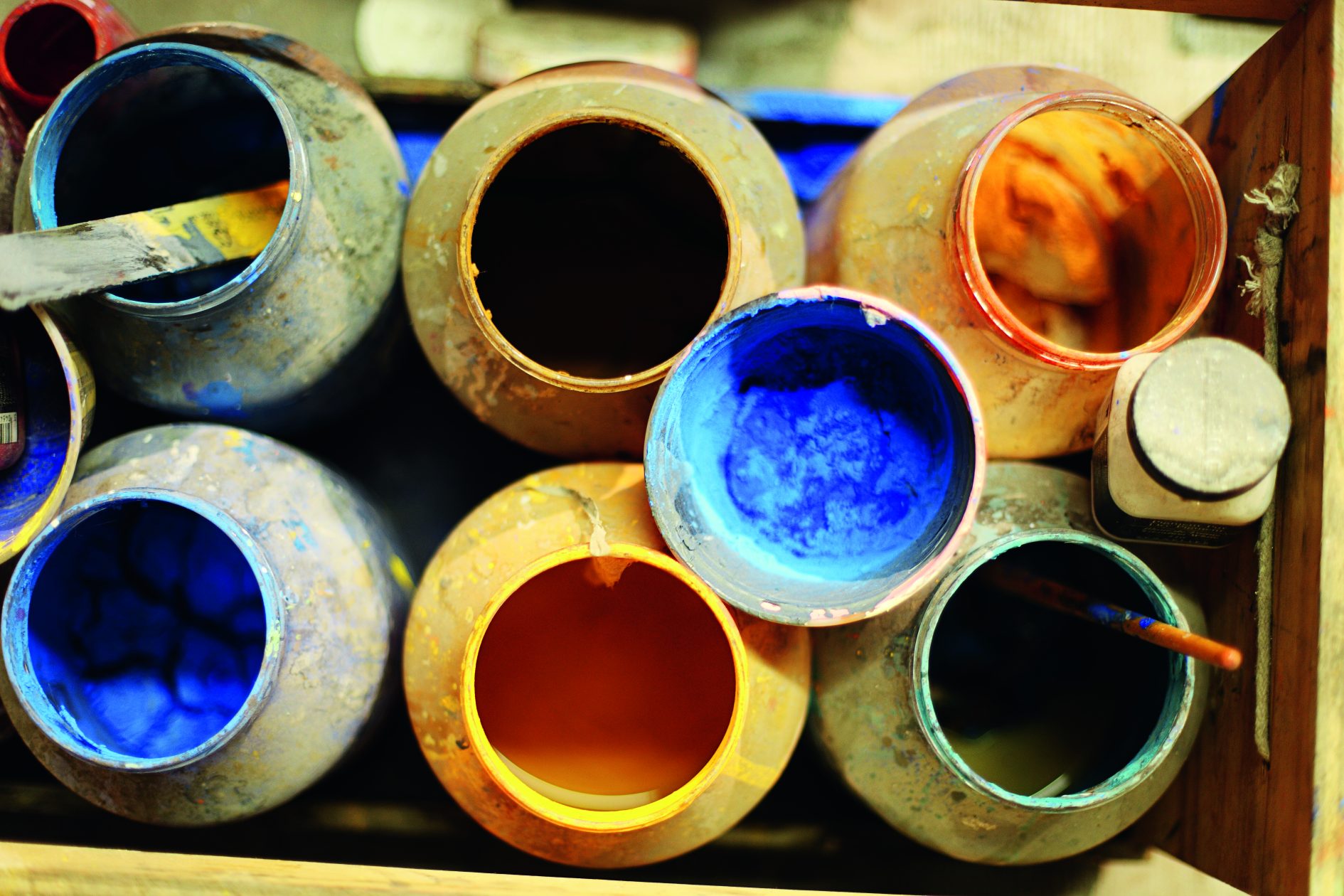
Fresco is probably the oldest technique in art. Even the caves of Lascaux – those are the beginnings of curating the space you live in. I learned how to do frescoes at an early age. I thought I need to find something I can do that not everyone can do. So I thought, what about using the oldest technique to do something new?
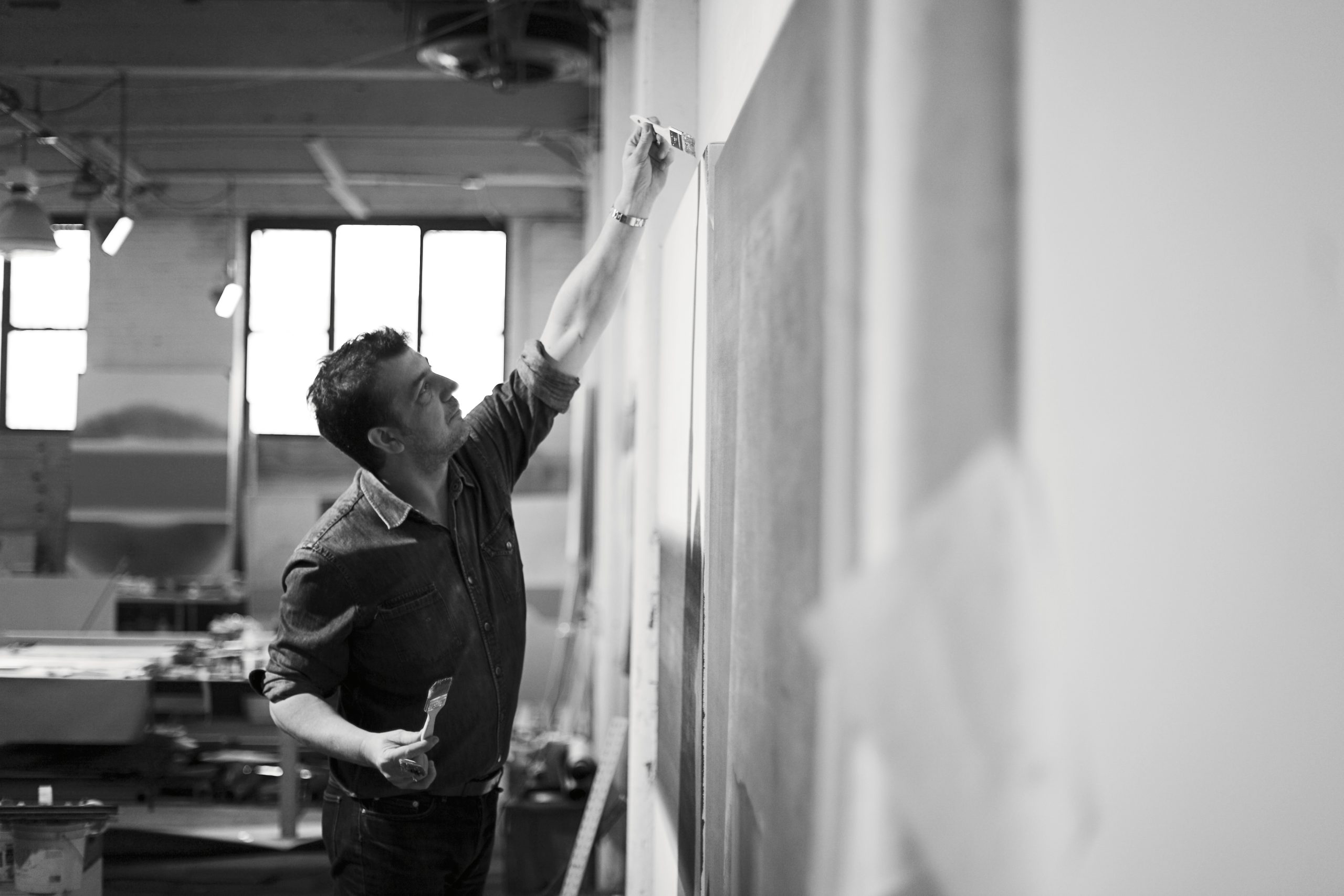
Fresco has a technical limitation. It’s like the scrambled egg of art; it’s the simplest thing, but it’s hard to do it right. It’s very simple; you just put on the fresh lime and you put pigment on top. You cannot get distracted, it’s almost impossible to erase, so there’s a moment of concentration on the fresco that for me is a very good discipline.
‘There’s a timeframe between when you can paint and when the lime starts carbonating and stops accepting water and you cannot paint anymore. It varies from one to three hours. So that’s why you have to know exactly what to do and when to do it and why. In the Renaissance, they used to make drawings directly on top of the wet lime, to know exactly what to do and where to do it. You don’t have time to speculate; you just need to know what you are doing in fresco. But also it makes me different to other artists because the result of painting in fresco is different than any other technique. And almost nobody does it because it’s a little bit complicated; it’s not a practical thing. It’s not like taking an acrylic paint and painting it, and for that reason less and less people use it.’
ON SPANISH MAGIC AND NEW YORK REALISM
‘Spain has produced some of the best artists in history. There is this idea of Spanish blood, Spanish passion, Spanish power. It’s very hard to escape that. You’re not totally European and you’re not considered Latin American, so we’re always left out of everything basically. It’s a strange place to be. But I’m proud of being a Spanish painter. I think Spain has produced extraordinary painters because it is almost impossible to be a painter in Spain. When I see Velázquez for example – the most elegant, the most delicate painter ever – that guy was living in Spain; dark, dirty, poor. Even if he was living at the palace with the king, the palace was probably filthy. And yet he is producing work that looks like it’s painted by God. There’s a word to explain that: “Duende”. It describes some magic that happens sometimes. It happens in flamenco; some musicians and composers had it, some painters had it, some writers. It’s very strange. Something magical happens.
‘I feel like, one foot is in America, one foot is in Europe and the whole ocean in between. It’s very present in my work that the European and American combine. Painting in Spain in the 1970s and
the 1980s was all about Formalism – and then when I came to New York I discovered Ellsworth Kelly and Jasper Johns. So I think my work has a combination of the two things – it’s very obvious. Between abstraction and figuration. There’s a way of control or discipline and this random thing always in my work. The two things are always there.
‘I never came to America to stay here; I said I’ll come to paint for a while in New York and then I’m going to go back to Barcelona. It’s been 24 years and I always think, well, a couple more months…
‘I like it, because I’m very independent here. Independent in the sense that if a bomb dropped in my studio now and I die, nobody cares about it. There’s no family, no hierarchy. And New Yorkers don’t particularly care if they see you dead in the street. It’s good that nobody gives a shit about you. The lack of audience is very healthy, because you end up doing what you do because you like to do it, besides everything else. Everything is fashionable for a moment and not fashionable ever again. I think it’s good that you understand that you have to do that painting to pay that electric bill. The lack of glamour is beautiful, no?’
ON DEVELOPMENT IN ART
In science, the last telephone is supposed to be the best telephone and the last vaccine is supposed to be the best. In art it’s not true, in art a painting painted 2,000 years ago is sometimes better than a painting painted a minute ago – and that’s the advantage we have; that time plays a different role in art.
ON THE FRAGILE NATURE OF ART
‘Paper lasts longer than frescoes: look at the parchment of Egypt. The reason why paper lasts longer is that it’s not rigid. It’s like bamboo – the secret of bamboo is it’s flexible and compartmentalised, and that makes it very strong. But solid things, all the Roman sculptures and the Egyptian sculptures, are all broken. Everything breaks. So I guess to endure time you need to be softer and more flexible.’
ON THE FREEDOM OF PAPER
‘People who cannot afford painting work on paper. Everything starts in paper: the sketch, the ideas are born in paper or on a napkin and then you develop it. But the energy and the magic of that piece of paper is very hard to translate to the finished work, because when you do the finished work on the big canvas, or big the fresco or the big sculpture, you’re too conscious of what you’re doing. In the drawing, unconsciously you’re more free, you’re less tied to things.’
ON THE SECRET OF SUCCESS
‘To paint when you are successful is okay. To do it when you’re not, that’s the important thing. I learned from my father, who was not a successful painter at all, to think about what you leave behind. I remember the first show I did was a sunny afternoon in Barcelona in September, and there were a lot of people who had nothing to do so they decided to go to an opening. And I sold everything that day. The next show after me, there was another artist just like me who had his first show and it was a rainy afternoon; he’s never done anything in his life. As simple as that. Sometimes when you do the best work nobody cares about it. Sometimes when you do something you would throw away people love it. And I still think you should throw it, even if people love it. For me, it’s good to be a little bit isolated from the information. I see almost no shows, I don’t look at art on the internet. I don’t look at the reviews. I go to The Metropolitan and see a painting or a Buddha and I go back to the studio. There’s not unlimited space in your brain, and when you fill it up with stupidity there’s no way to replace that. So I’m careful about it: I prefer to imagine than to see sometimes.’
ON MAINTAINING THE MYSTERY
‘I don’t like to talk about my work. In Spain, from the 1960s to the 80s, the living star was Tàpies, and he always said that there’s nothing to say. You say it with your work. You’re lost, very often, because painting takes you to another place than your idea. You want to do it red but the red is not really red, and that painting that you want to be really warm starts to get cold, and you didn’t want it to drip and it starts dripping — those things takes a little bit of seriousness out of it and puts it in perspective and shows you that nothing happened.
‘I think it’s an Arab proverb that says, you’re born with a certain amount of words you are going to say in your life, and the day you’ve said it you die. But nobody knows what’s their number. And I think the brain is a little bit the same. If you start filling your brain with bullshit then everything becomes a little bit bullshit.
‘It’s tricky to find the balance. You want to be safe, you don’t want to feel all the time like you’re walking on the cliff. At the same time, you have to be close to the cliff to feel the fear and the tension of the cliff.
‘I think the worse thing that can happen to an artist is to find a style. A style kills you totally. Because as soon as you get the recipe you start repeating, and as soon as you start repeating you’re killing your work. ’
ON THE BATHROOM APPROACH
‘I think for art, the bathroom approach – which is silence and privacy – is pretty good, no?’
ON THE IMPORTANCE OF PERSPECTIVE IN ART
‘I have a sister that is a teacher, who’s married to a teacher, who have a daughter who’s a teacher. And when I see what happens with art and the prices, I think it’s totally crazy. Teachers are extremely important. Doctors are extremely important. Economists are extremely important. And I never understood why we make the money.
‘I don’t think art has any effect on people’s lives at all. Education and medicine; these things have, but I don’t think art has. And that makes me think that I have to be quiet and do it and not bother too much. I think we are a little bit of decoration. There’s a tree, and art is like balls hanging on it; bits of decoration. The tree is the tree, we’re just things that come and go.’