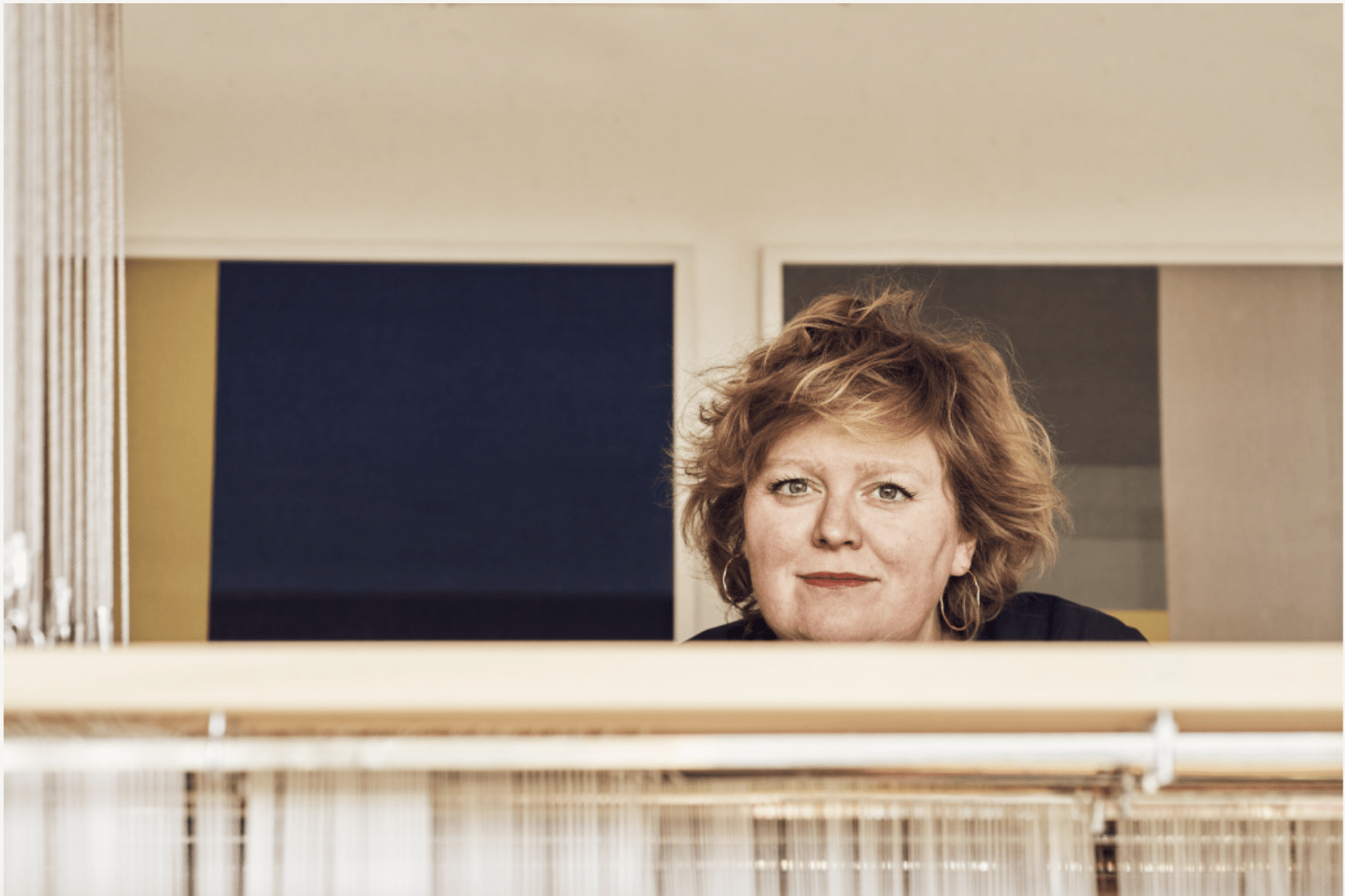
Margo Selby in Conversation with Matt Bourne of Christopher Farr
photographs sam walton
Margo Selby is a textile artist and designer, who was awarded the Turner Medal for Britain’s Greatest Colourist in 2021. She embraces both art and industry, using her artworks to inform her commercial work for interiors, fashion and domestic textiles. An alumnus of Chelsea College of Art, the Royal College of Art and atelier National d’Art in Paris, she established her eponymous weaving studio in 2012.
In 2020, Selby won the Collect Open Award with her Vexillum series, which pushed the practice of woven textiles to the limits of what is possible. The technical challenge of Vexillum I-V was to create pieces that are beyond the scale of the loom. A Vexillum work is made in 9,000-strand sections and is extraordinary to see in real life. You get lost in the optical illusion, weaving in and out of the geometry and the subtlety of the colours. No wonder that Christopher Farr, the rug company that pioneered working with fine artists, wanted to see if Vexillum could be translated into a series of rugs. They were launched, appropriately enough, during London Craft Week in March 2022. The rugs are in two editions; the Vexillum, a highly collectible hand knotted rug in pure wool, while Aquila and Signum are both hand tufted and more affordable for everyday use.
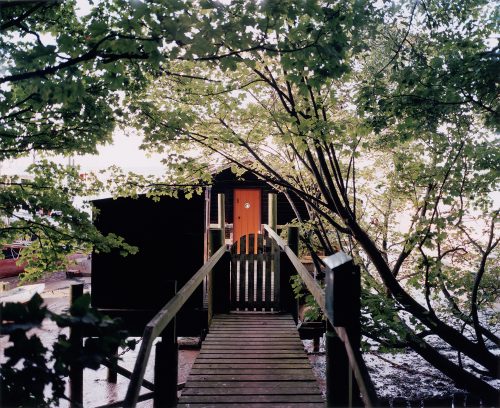
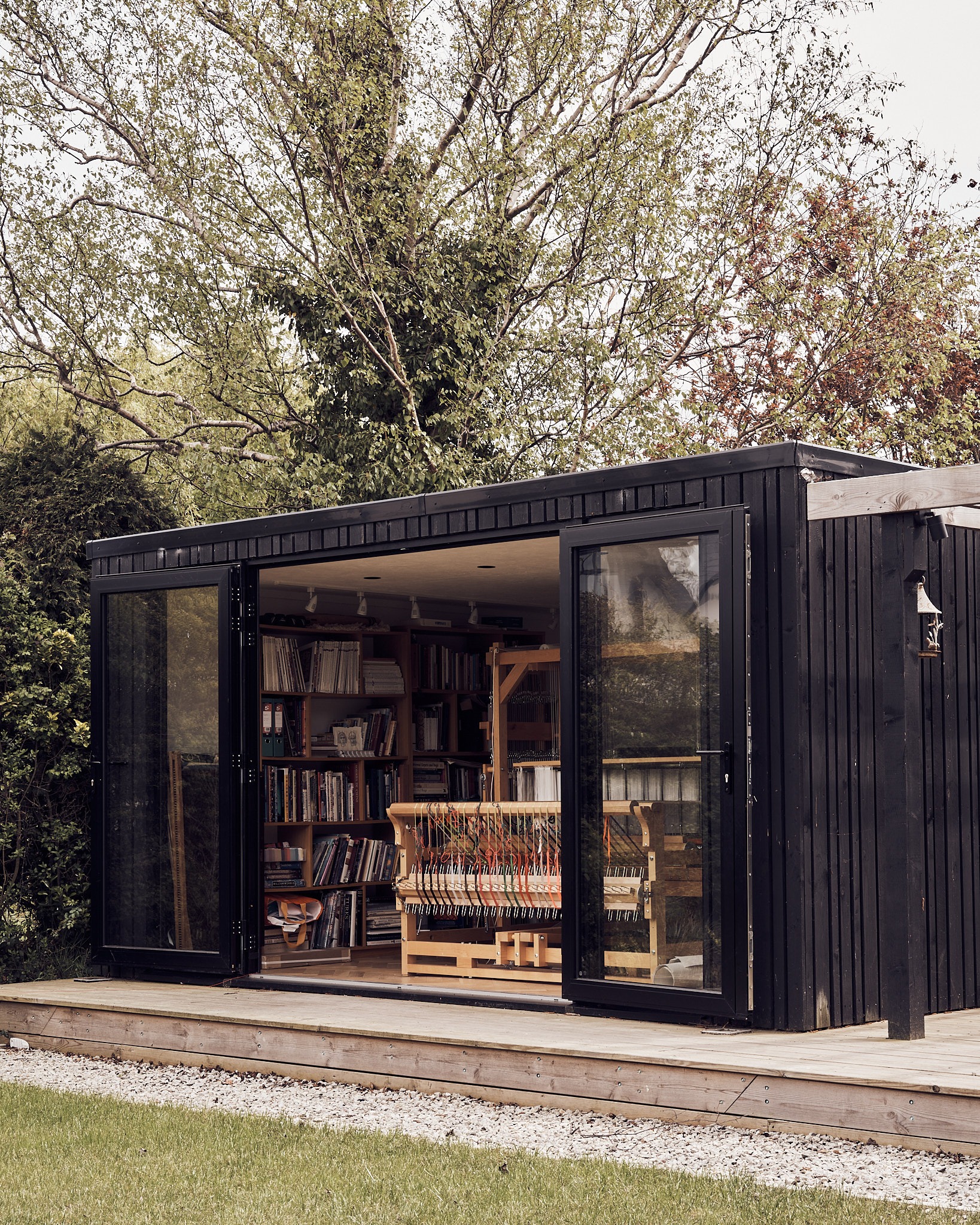
The following is snippets of a conversation between Matt Bourne of Christopher Farr and Selby. This took place on a windy day at Selby’s studio manager’s house looking out to the sea the sea over the Tankerton Slopes, after a visit to Selby’s Whiststable weaving shed at the bottom her garden.
Margo Selby: Christopher Farr has always been one of the most respected rug companies. It works with authentic, amazing artworks, translating them, always in high quality, very carefully, so it was a real honour to be invited to collaborate with the company and I’m very grateful for the opportunity. But also, I have this philosophy, which I call art into industry, which is dedicating myself to creating one-off handwoven artworks to infuse into more commercial products. Plus, it’s really nice to work on collaborations that are keeping these traditional crafts alive.
I like responding to other craftspeople. Visiting India and meeting the workshops that make these works … understanding their craft skills, that is the starting point. Where are their strengths? What is their expertise? And how can we apply my design knowledge, or my understanding of weaving, to their skills? I think that element is important, not just collaborating between two brands, but between the craftspeople.
Matt Bourne: We used to make carpets in Turkey, but it’s now very difficult so most of the weavers are in India and Nepal. There, it’s an industry that’s grown out of commerce rather than a 1,000 year-old tradition – like in Turkey or Afghanistan – so we started working with [Margo’s partner, who is a rug maker] and a particular workshop that makes these carpets, near Varanasi, where most of the weaving is in India.
Because of the activities of Western industry, weaving has become a downgraded job. When we first started working in Turkey, there were 150,000 women weaving; that number is now 15,000 and shrinking. So, we’re working with a guy who has a model workshop in central Turkey, making it an attractive job – he pays three times the going rate, and he’s over subscribed to the number of weavers he has. I want to do something similar in India. Unless we do, in 20 to 30 years you won’t be able to make this [hand knotted rug], it’ll be gone.
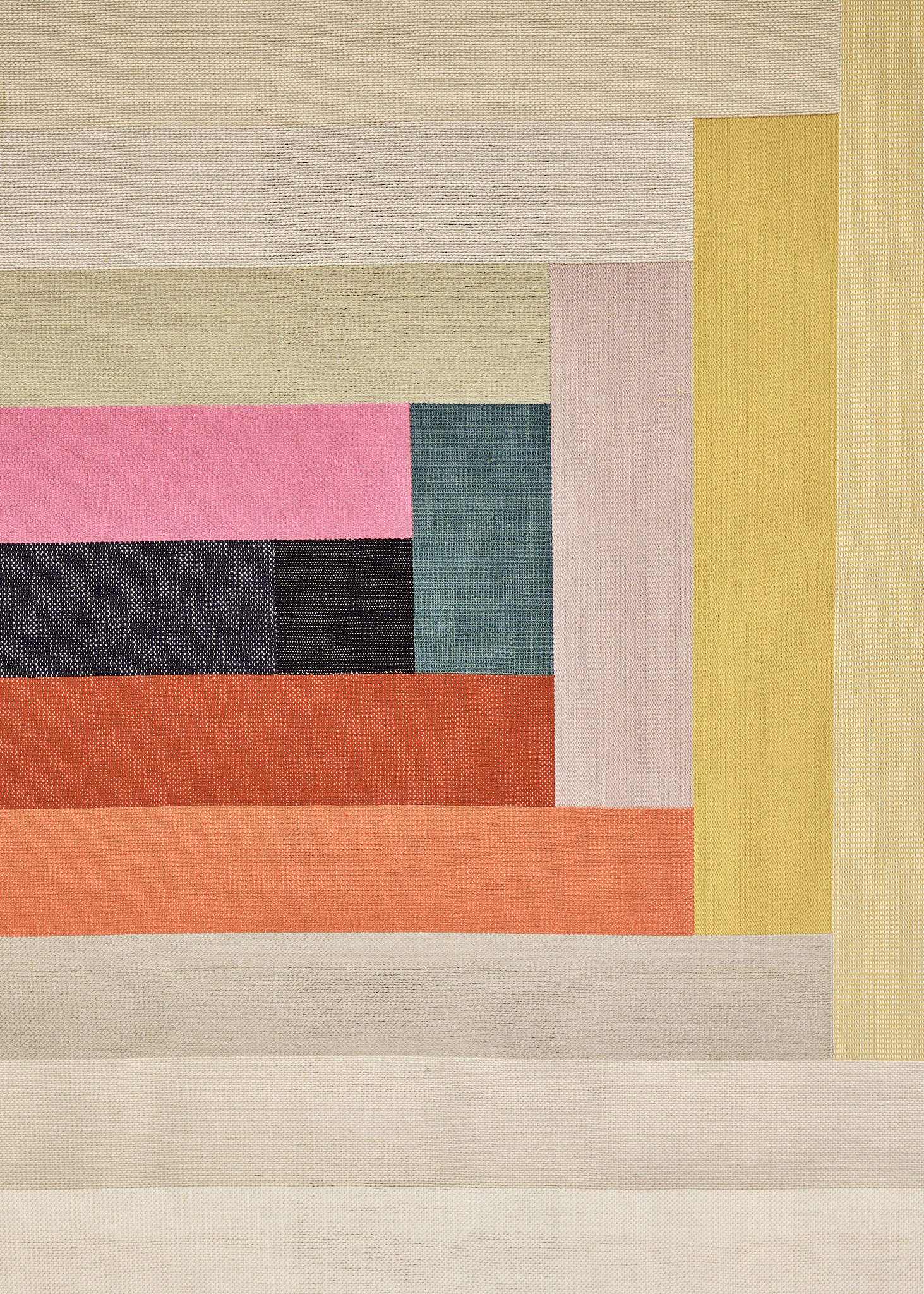

Margo: A lot of what I do is exploring the relationship between mathematics and colour. There’s something about the order that you can find in maths that lends itself beautifully to aesthetics and form. I often experiment with number patterns, and then translate those into colours. So you’ll see graduating lines, which might be the number of knots. I’ve been working with this kind of stepped boundary for quite some time, just exploring what you can do with colour, what you can do with light and dark, and how you can take colours on a journey within that form.
Colour is instinctive for me. I remember being very young, colouring in a colouring book and thinking, this really needs yellow. I remember having those feelings, there is a sort of a note that you get when two colours are put together, which uplifts you, and I have a very physical experience and response to that. A lot of it is instinctive exploration, but I also want to try to use colour to create texture. This is a flat rug, but there is a lot of texture happening. And that’s to do with trying to create contrast. It might be contrast between light and dark, contrast between bright colours and softer colours. And the contrast between warm and cold… it is just as many different contrasts as you can get to create the textural effect – that is actually an optical effect – that creates surface and dimension. When I’m weaving, when you suddenly bring in a colour that changes it, that’s exciting – that almost sweet shop experience of maximum colour combinations. I think of it as sudoku in colour because everything has to be in the right place at the right time.