In the Studio with… Roger Herman
Interview Meena Sears
There is something delightedly refreshing about Roger Herman’s approach to art; when I ask what it is that links the pieces in his new exhibition From California with Love, he jokingly replies, ‘I made them all. That’s what connects them.’ This light-hearted response, I later find out, stems from Herman’s unconventional journey to his practice.
Born in Germany, Herman moved to Los Angeles in 1977, becoming an integral figure within the city’s growing artistic community. Alongside teaching at UCLA, Herman made a name for himself as the West Coast equivalent to the neo-Expressionist movement and was positioned by the Gagosian as the California counterpart to David Salle and Jean-Michel Basquiat. It was in 2000, after taking lessons from one of his students, that Herman first tried his hand at ceramics. Widely dismissed as ‘non-art’ at the time, ceramics gave Herman the freedom to create something that was not burdened by the same expectations and demands he felt his paintings were.
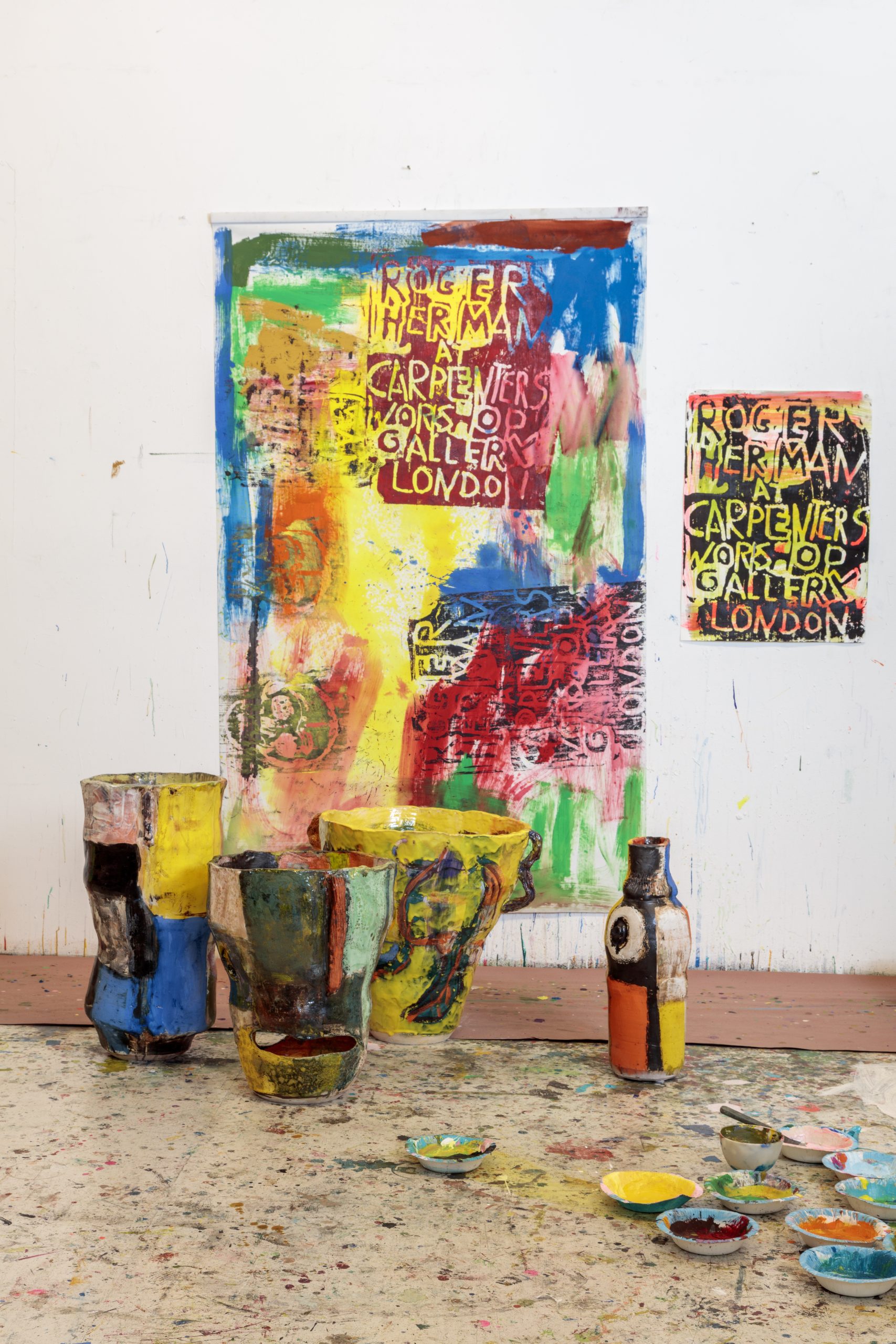
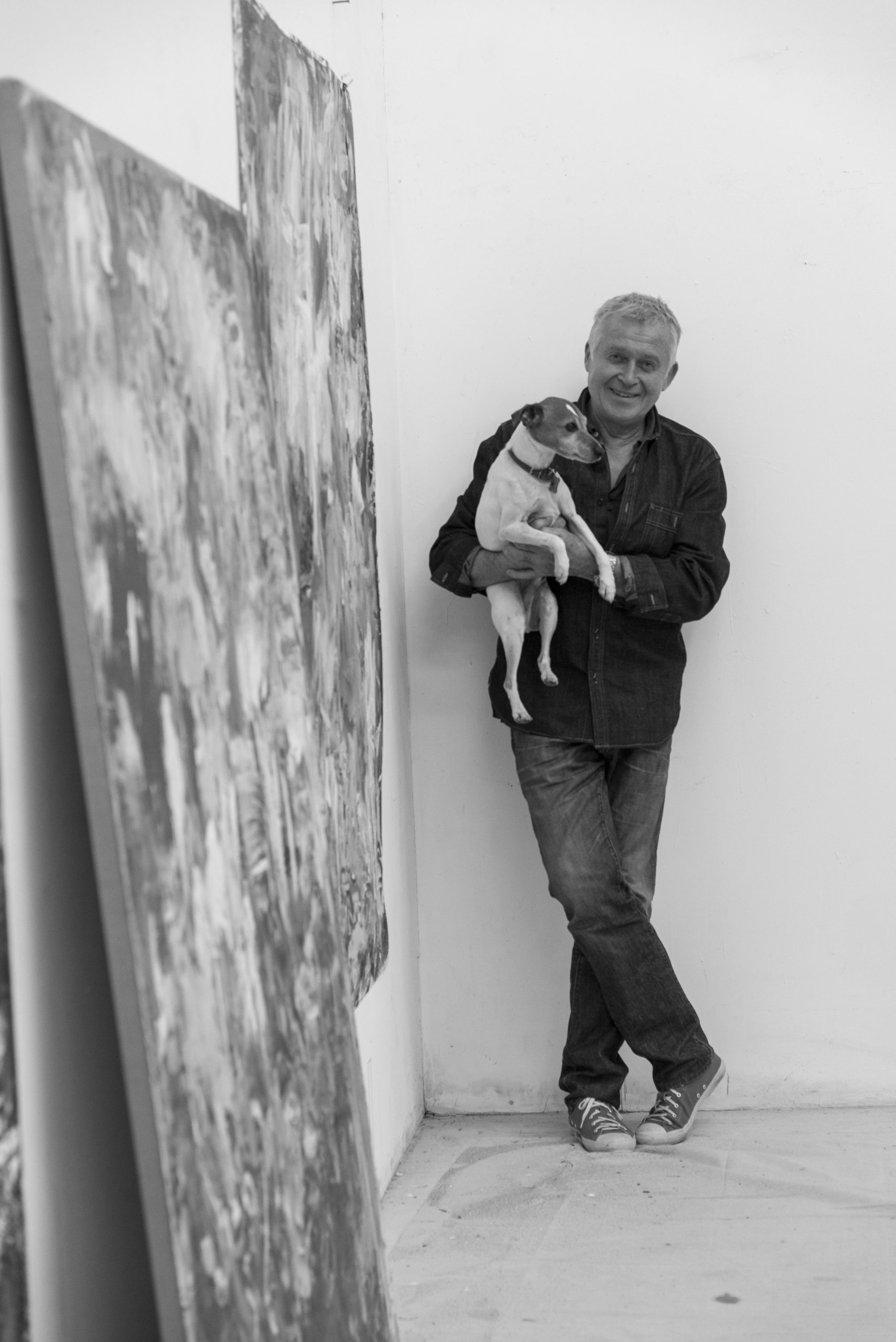
Roger Herman work and portrait. Photographs Joshua White
‘It was a hobby when I started, like an old lady who starts knitting. I felt I could do things in my ceramics that I wouldn’t dare in my paintings, like copying other people’s work or taking inspiration from Japanese erotica and cartoons. I never allowed myself to go in that direction in painting because I took it too seriously. But ceramics was my little secret.’ Herman tells me from across the table at Pollini, the restaurant in the Carpenters Workshop Gallery where he is currently exhibiting.
Perhaps it is this almost serendipitous encounter with ceramics that gives Herman’s craft its distinctive character. Embracing the innately unpredictable nature of ceramics, Herman relinquishes control to the pot, allowing the process to dictate the outcome. His large, free-form ceramic sculptures appear to take shape on their own accord, veering unequally from one side to the other in a highly experimental manner. Likewise, Herman’s exploration of colour is rooted in experimentation, as he relishes in the unexpected results that appear when glazes come out of the kiln a completely different colour to their original, unfired appearance. ‘Most ceramicists have a colour chart, but I try to avoid that. I do my best work when there is that element of surprise.’
Now the artist moves between the two mediums, applying sweeping brushstrokes and unusual colour combinations to ceramics as well as canvas. Working from his stylish home studio in Los Angeles, Herman forms, perhaps inadvertently, a conversation between his respective disciplines, where his training as a painter informs his ceramic practice and his uninhibited approach to ceramics influences his painting.
Fascinated by Herman’s approach to his craft, I was intrigued to find out more about how the multi-disciplinary artist works and delve into studio life in Los Angeles.
What is it exactly that you like about the unpredictability of ceramics?
When I draw or paint on paper, I’m very uptight; there’s this kind of self-consciousness. But with the ceramics, you have less control both in the initial shaping of the piece and, when I put them in the kiln, I don’t know how the glaze is going to turn out. In other aspects of my life, I’m very controlled – I don’t know whether it’s because I’m German or whatever – but ceramics allows me this incredible freedom. That sounds a little contrived but it’s true, you should try it!
Do you have any idea of what a piece is going to look like before you start making it?
None at all. I go by luck. Sometimes I throw a pot and it happens to go this way, and sometimes it happens to go the other.
And the holes?
Most of the holes are consciously placed so that I can carry the pieces – like handles on a basket.
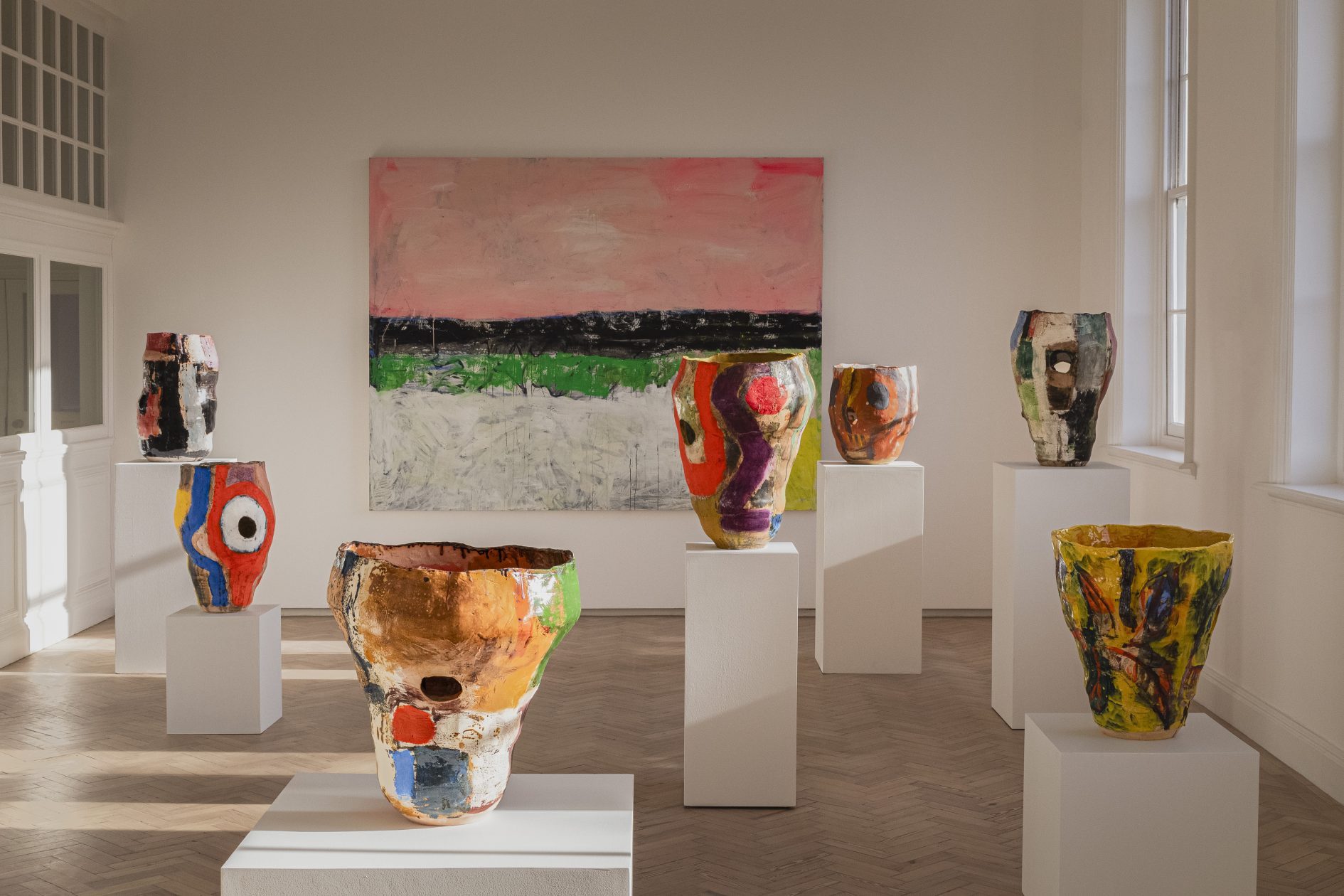
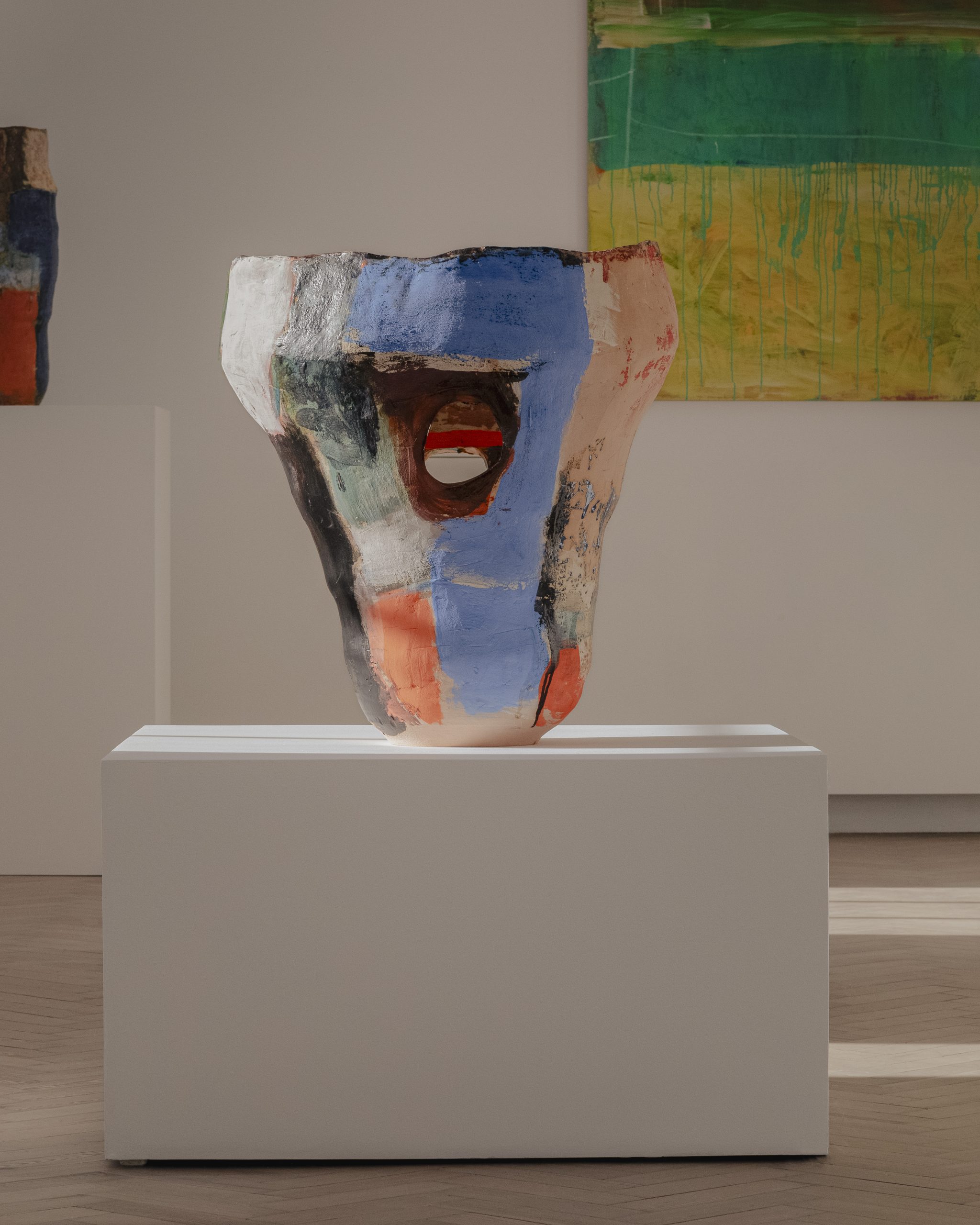 Above and hero image: installation views of From California with Love at the Carpenters Workshop Gallery. Photographs Benjamin Baccarani
How has your ceramics practice influenced your painting practice?
Since starting ceramics, I have enjoyed painting more than ever, perhaps I have enjoyed it for the first time ever. I used to take painting so seriously. I taught at UCLA for such a long time so my head was full of information about artists I am indebted to: Frank Boling, Richard Diebenkorn, Howard Hodgkin, they’re all in my head. And I always carried that burden that I didn’t like what I made.
But now, I am less intimated by all that information and I just do it. Some of the paintings in this exhibition are even painted over other paintings I did, which I never would have done before.
Tell us about your studio…
My studio is at my house – actually, it’s more accurate to say that my house is at my studio – which is in Solano Canyon, close to downtown LA. It’s kind of separated from the city and we have our own church, school and grocery stores, but if the hill wasn’t there you would see the high-rise buildings. It’s really special in that way.
My house and studio was designed by the architect Frederick Fisher; it has 16-foot ceilings and the outside is clad in raw red plywood. I live upstairs and my studio is downstairs. Before I had even found the land, I had already bought these old steel windows and doors that I wanted to use, so it was like making a collage.
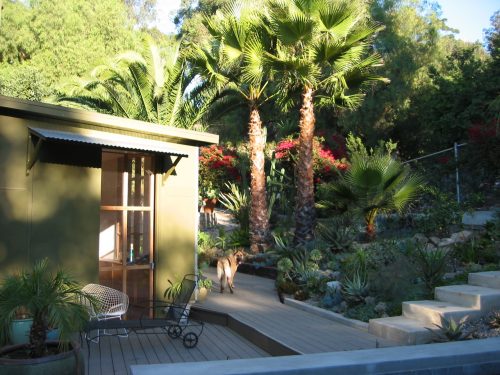
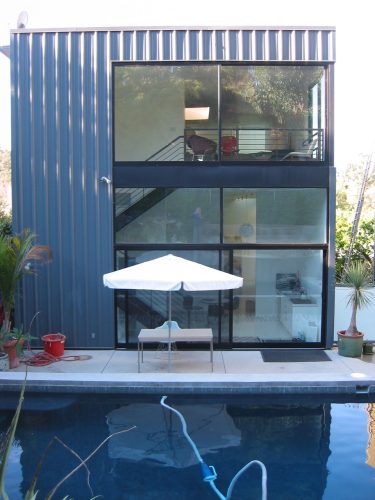
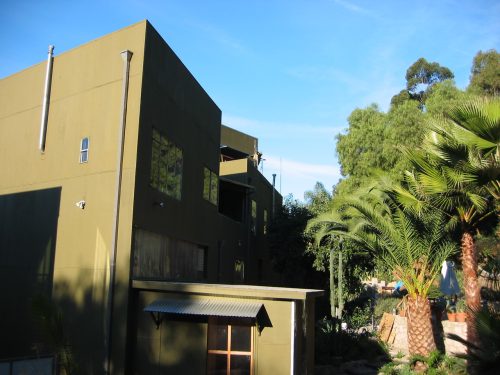
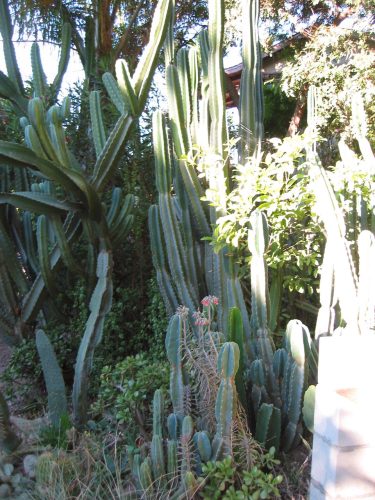
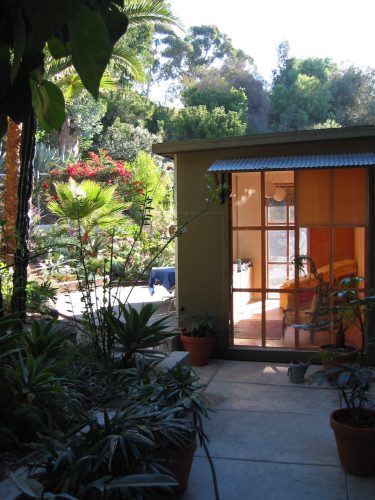
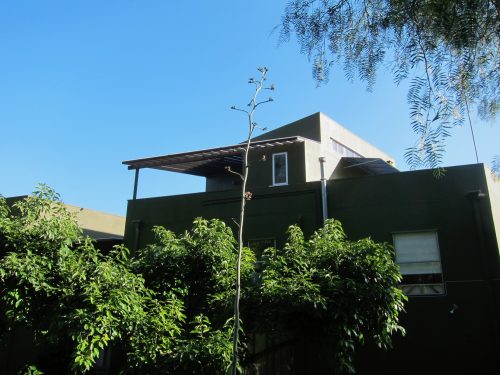
Roger Herman’s house and studio in Los Angeles. Photographs courtesy Roger Herman
What does a day in the studio look like for you?
Since I stopped teaching, I have less structure to my day because I have so much time, so I tend to work in short bursts. I might paint for an hour and then go upstairs to read and then go back downstairs to do more painting or go outside.
But I am constantly working. There’s a manic-ness to it. I have to be careful that I don’t burn out because if I make too much work, I risk repeating myself. I always want to be making something new. You have to fight your own clichés or you become too comfortable.
Do you think there’s anything within your environment and your surroundings that affects the outcome of your work?
No, I could do it anywhere. I mean, I have this beautiful garden with all these crazy cacti – it’s really wild – and my neighbour, the artist Urs Fischer, makes fun of me because I never paint any of it.
Do you feel like you get into a zone when you’re working?
Yes, I have to. But I don’t mean that in an existential way. I used to do martial arts – aikido – and it’s a similar thing. You have to be somewhat unconscious but still you are conducting a skill. It takes training and then you just automatically move like that. It’s kind of against my nature because I have a hard time switching off. But, when I make the pots, I can get into that state.
Do you think of ceramics as an art now?
Well yes, but I think it’s been a good practice to start making something in that way, by not thinking of it as an art.