Folk like us... The Museum of British Folklore
Words Katie Baron
Photographs Luke Stephenson
The godfather of set design and storytelling, Simon Costin has enough eccentric folk art and ephemera to start a museum. Which is funny, because that’s exactly what he’s done. Welcome to The Museum of British Folklore…
While Britain’s cultural habits and regional peculiarities are often cherished, if somewhat self-deprecatingly, as a source of national pride (from Little Britain to Hot Fuzz no one does regional eccentricity quite like the British) no one has attempted to pool the stories of our weird but wonderful traditions into one central home – until now.
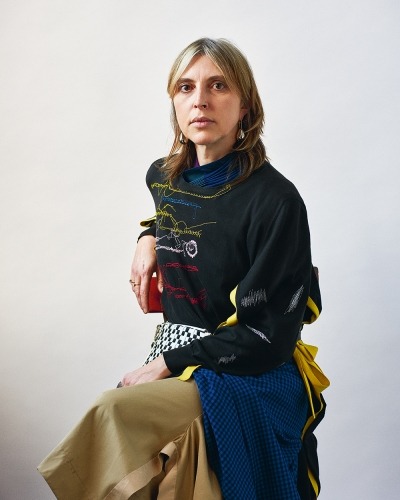
Boldly taking up that meaty mantle – a task involving pulling together hundreds of traditional local festivals, rites and rituals – is Simon Costin. A former jewellery designer (Costin has two pieces – Incubus and Memento Mori – on display in the Metropolitan Museum of Art, New York) turned prodigious set designer, Costin’s lifelong fascination with both museums and folklore, combined with his exemplary professional status as a supreme storyteller, make him the ideal man for the job. We meet late in the summer, just before fashion folk return to their posts proper in readiness for the new season. I’ve been tipped off– by mutual friends – that going to the designer’s house means journeying into somewhere special; I’m not disappointed.

Simon Costin
Visiting Costin’s extraordinary Hackney home (he’s a seventh generation Londoner) entails crossing over into an exotic netherworld where talismanic mementoes from projects past, present and still-on-the-cards line the walls, tables and pretty much everywhere else with a flat surface. Considering he’s currently creative director for avant-garde fashion designer Gareth Pugh; formerly a long-time cohort of the late, great and magically macabre Alexander McQueen; and regular collaborator with photographer Tim Walker – arguably the fashion industry’s premier set-fetishist – it’s a wildly engrossing haul.
Taking tea in the basement, at a table littered with recalibrated circus ephemera, curio-filled cloches (one of which houses a miniature horned head) and a life-sized waxwork of a man who looks like he died in battle seems just about the perfect place to delve into a world of parallel histories and almost-mythic traditions. The idea was originally born in 2008 as a result of his frustration that there was nowhere to go to explore Britain’s indigenous traditions in full.
‘I was slightly angry that we’re brilliant at championing other peoples’ cultures but not our own,’ says Costin. ‘The legacy of colonialism is that we’ve tried to draw a line under it by simply not talking about it – effectively making it un-PC to celebrate the idea of Britishness. Thanks to that and idiots like the BNP who have done a massive disservice to indigenous culture, Britishness has almost become a dirty word; it’s been hi-jacked by the Far Right. We need to re-appropriate it.’

Among the ephemera on Costin’s kitchen table is a wax likeness ofLouis de Rochefort, rescued from the now closed Brading: The Experience waxworks museum; the cupboard doors behind are panels from a 1940s fairground tombola stand
Re-tracing the theme of social dissolution, he cites as influences the work of English documentary-makers Humphrey Jennings and Basil Wright, whose respective short World War II propaganda films, Listen to Britain and Night Mail, were essentially ‘about re-evaluating what people were fighting for, what it was about Britain that they truly valued’. Paul Kingsnorth’s Real England: The Battle Against the Bland – an examination of Britons fighting to reclaim their sense of national identity in the face of global homogenisation – also chimed strongly.
Costin’s response was to take his mission out on the road, quite literally, in a caravan that he bought on eBay and renovated in his own inimitable style – the innards were replaced with glass display cases and the exterior emblazoned with fairground-style paintwork. Gareth Pugh made him an outfit ‘to provide intrigue’; Stephen Jones constructed a hat incorporating a microscopic museum. Costs were covered, in suitably theatrical style, by a lavish event at the English Folk Dance and Song Society in London, graced by heavyweight fans including Comme des Garcons’ Rei Kawakubo, Tim Burton and Helena Bonham-Carter.
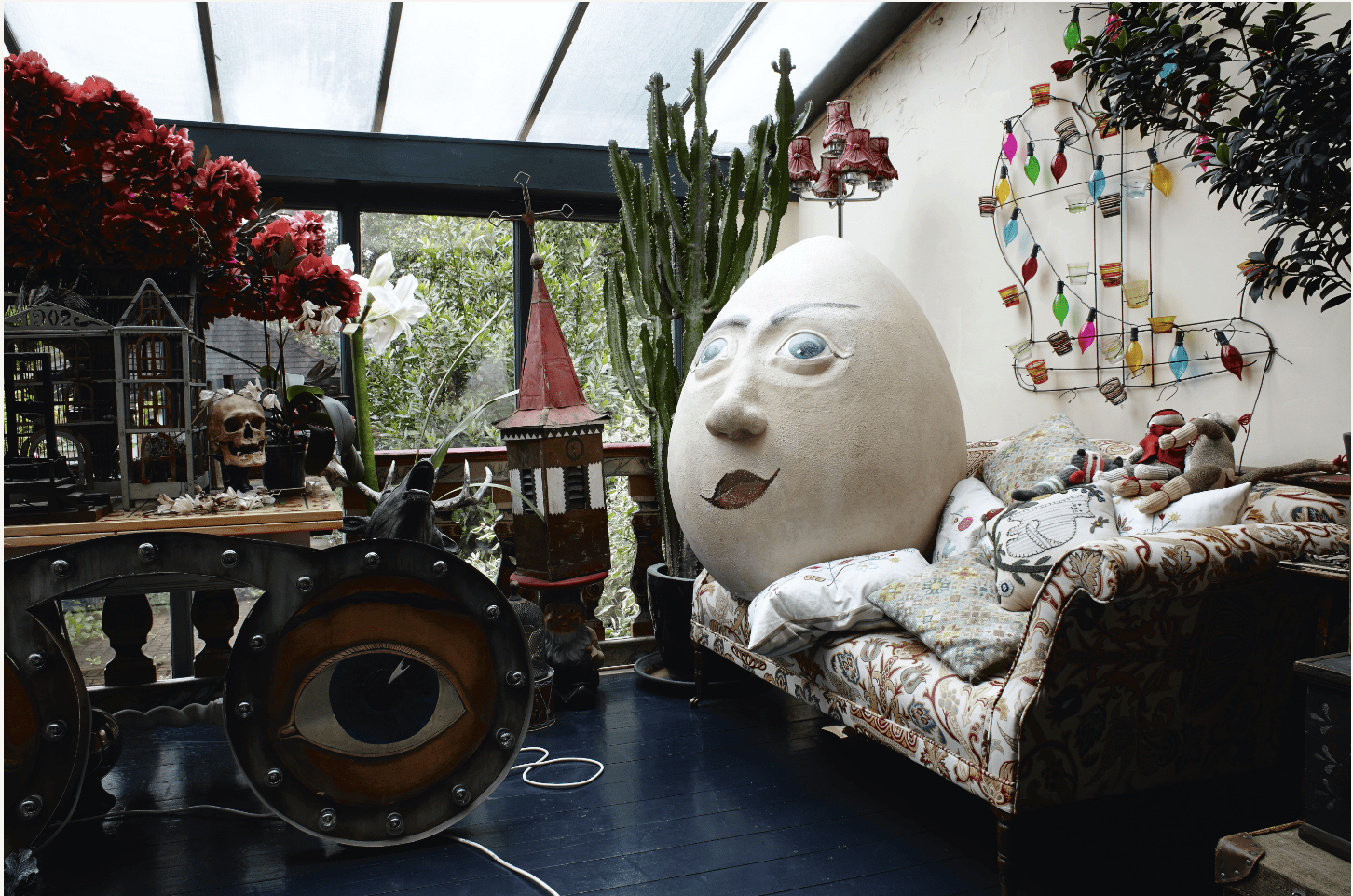
Humpty Dumpty was a prop for a shoot with British fashion photographer and ‘set fetishist’ Tim Walker; Costin designed the optician’s sign fora collaborative exhibition, Curating Popular Art: Black Eyes & Lemonade, at the Whitechapel Gallery, and the church steeple came from a Paris flea market
With money raised and folklore propelled, at least temporarily, into the headlines, Costin was en route. For six months he toured the country like a folkloric Louis Theroux, sampling happenings – and not just as a voyeur but, whenever invited, as a fully paid-up participant. ‘Folklore comes from the ground up, as a kind of intangible heritage,’ he explains. ‘I wanted to see what these dyed-in-the-wool folkloric people made of it.’
The response was overwhelmingly positive, which led to a tremendous sense of enquiry about what form the museum should take (‘a virtual entity? A series of satellite outposts?’), and the decision to develop an exhibition programme – orchestrated in tandem with Mellany Robinson, who is now the museum’s project manager. The first static exhibition, of Cornish folklore, was staged at the Gatehouse in Port Eliot, Cornwall, kicking off a roster of events and exhibitions that’s been rolling ever since.
‘Britishness has almost become a dirty word. We need to re-appropriate it’
He describes the festivals as each having a unique atmosphere, the vast majority invoking some kind of spiritual sensibility. Some, like the ritual of burning tar barrels in Ottery St Mary, Devon, are based on a more feral sense of chaos, a primal need for release: ‘It has that raw-in-tooth-and-claw feeling of being alive, which we all need,’ says Costin. ‘Experiencing that, all the senses were fired up, the smell of the burning tar, the feel of the crowd thundering past. It’s very dangerous but, because of that, it’s also incredibly life affirming.’ Others, such as the reverie of the Horn Dance at Abbots Bromley, Staffordshire – a rite that involves two teams, one of light and one dark, both carrying antlers (no one knows why) – are more ethereal in their magic.
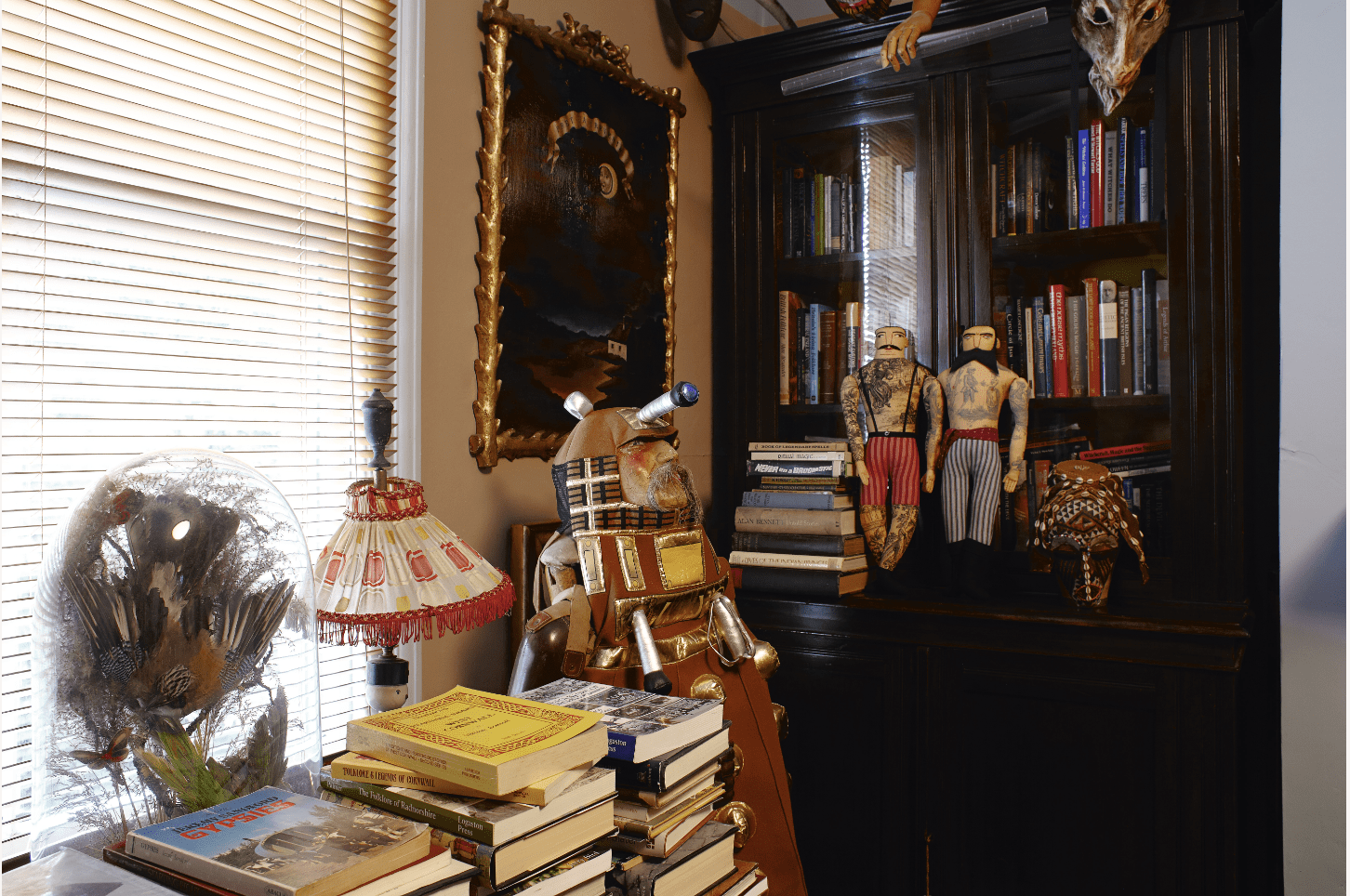
In the library, a shop-front dummy wears a Dalek playsuit and a pair of tattooed sailors by Boston-based artist-doll maker Mimi Kirchner stand on the bookcase
One of Costin’s favourites, which he attends annually, is Jack in the Green festival in Hastings, Sussex – an urban tradition based on the days when chimney sweeps were out of work during the summer months and, dressed up in huge garlands of foliage, would parade through the streets as a form of legalised begging. The one he marks as being the most moving is The Boys Ploughing Match and the Festival of the Horse, in the Orkney Isles, Scotland, in which children dress with tails and young boys participate in a ploughing match in which they painstakingly draw a series of dead-straight furrows in the sand. ‘It was so touching to see the commitment the community has to the event, I actually cried,’ he recalls.
‘It’s time to draw up new lines about where museum practice comes from’
While seasonal change and regional identity are two of the key factors in these traditions, the notion of local community is their ultimate bedrock. Having been an integral figure within the groundbreaking counter-cultural creative movement incubated in the clubs of London’s hedonistic 1980s party scene, Costin is no stranger to the potent power of community as a portal for transcending the ordinary: ‘From the massive scale of the Notting Hill Carnival in London to the intimate event that is the Horn Dance, it’s essentially about honouring a sense of place, reflecting those things that community sees as being of interest and value.’
The opportunity for escapism encapsulated within a group bonding experience has, he says, never been more relevant. ‘The sense of otherness, of escaping from the mundane, is very important. When a community is able to step outside its normal life and become something else, but bond together, that’s very powerful. With these traditions, for just one day a year that community is able to express something entirely unique and personal to them.’
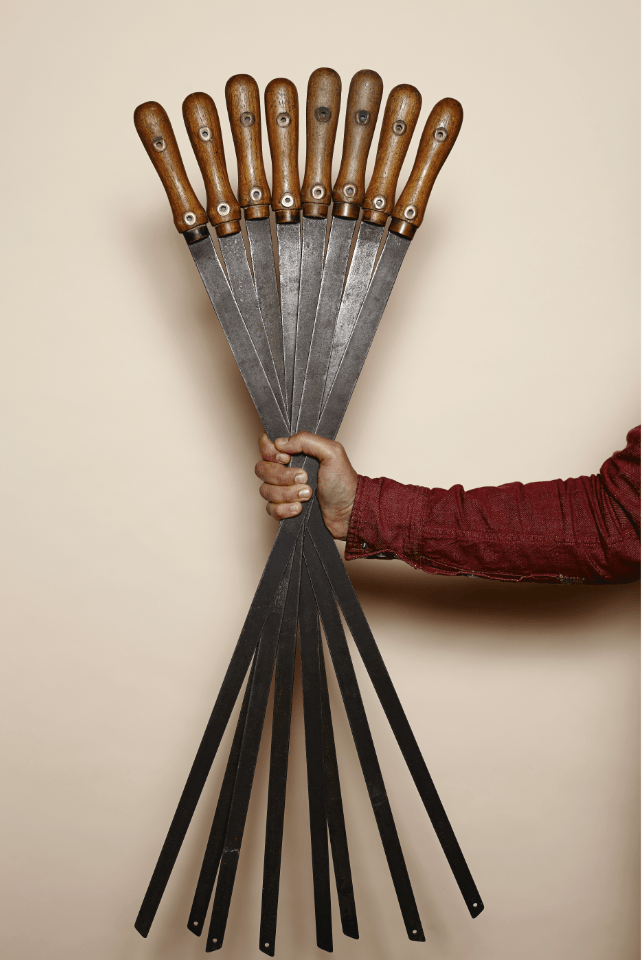
The museum collection includes the swords that belonged to legendary Yorkshire long-sword dancer Trevor Stone
The evolution of communal rituals will be key to the museum’s future programme – a reflection of Costin’s desire that folklore be understood as far more than dressing up in garb from yesteryear. ‘The way that some houses are decorated every Christmas with thousands of lights – that’s contemporary folklore in many ways. Nail art is a great example of contemporary folkloric practice because the stories told through those designs, many of which have regional or community relevance, is all part of the visually-expressed social culture that shapes our lives.’
Most emphatically, according to Costin, what’s grown out of the travelling and subsequent groundswell of interest that’s followed the initiative (including a growing stash of donations) is the realisation that the museum needs a permanent space to anchor the concept. When the building is located (for ease of access from London it’s likely to be in Sussex, which was, incidentally, the last county in Britain to convert from paganism to Christianity) it will serve as a physical homage to all the people, places and ephemeral happenings on which folklore feeds.
Steering the museum is a role that Costin plans to embrace alongside the frenetic pace of the fashion industry; this month alone he has an advertising campaign in London, a project for Swarovski in Vienna and a film for W magazine with Tim Walker beckoning – all of which underscores why no one should expect a traditional museum. ‘I’ve always been obsessed with the idea of museums; the visual language they use, the placement of objects and the stories they tell,’ says Costin. ‘But the hierarchal structure of many museums means they risk appearing patronising; it’s time to draw up new lines about where museum practice comes from. Plus there are lots of academic books on folklore, I wanted to drive something more emotional; essentially it’s the people keeping these stories alive.’