Seeing the light with Piet Mondrian and Hilma Af Klint
Words Tamsin Blanchard
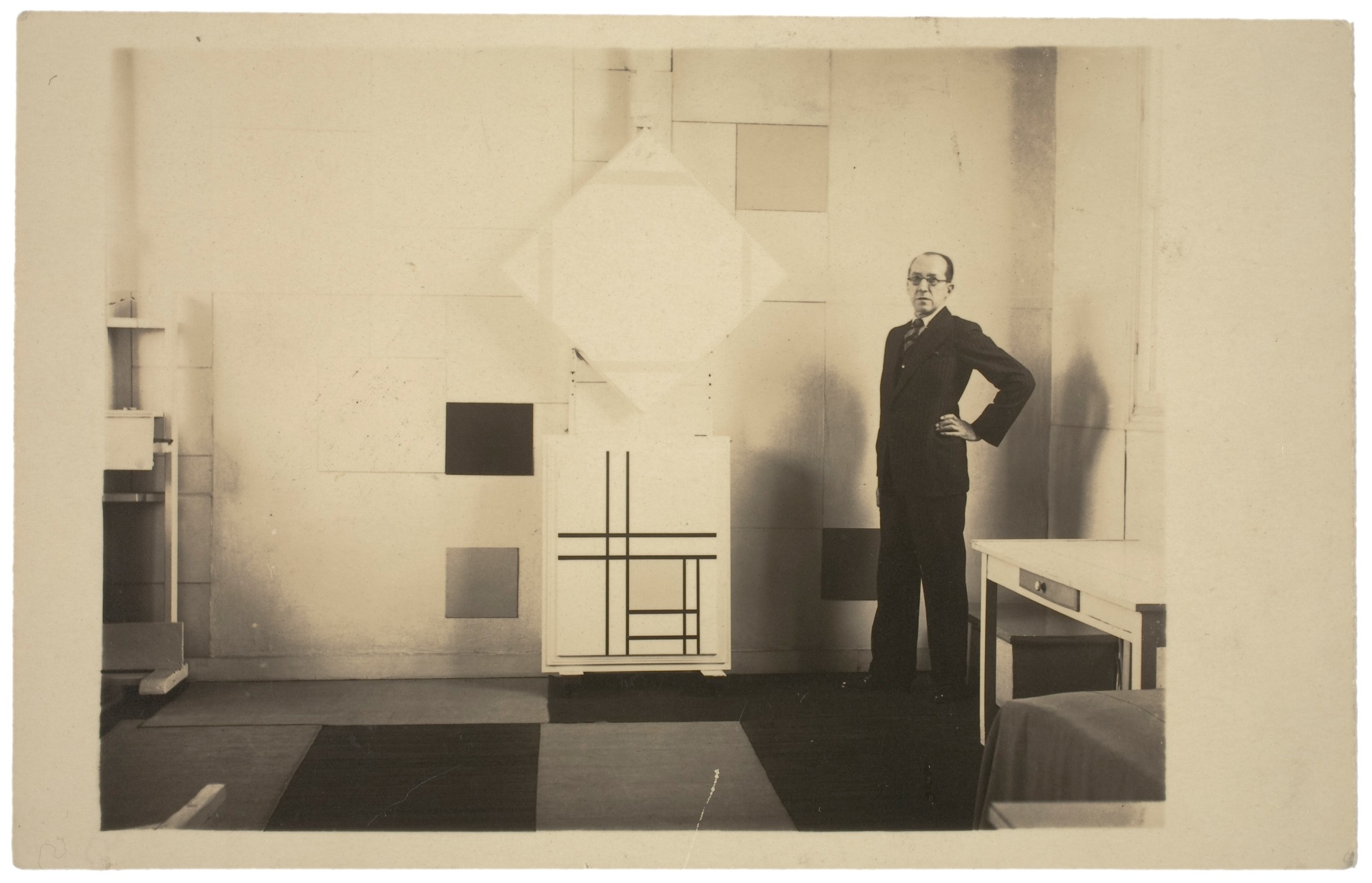
ABOVE Charles Karsten, Piet Mondrian in his studio with Lozenge Composition with Four Yellow Lines, 1933 (top) and Composition with Double Lines and Yellow, 1934 (bottom), Paris, October 1933. Collection Nieuwe Instituut Rotterdam/ KARS, e3.238
In the basement depot of the impressive Art Deco Kunstmuseum in The Hague, the Netherlands, there are racks upon racks of artworks. The stores and archives of galleries and museums are extraordinary places, the gritty engine rooms of the polished, minimal spaces we usually associate with seeing art. Here, among the empty frames and the metal grids used to store hundreds of paintings cheek by jowl, there is something quite thrilling about coming face to face with a painting like Piet Mondrian’s Red Amaryllis with Blue Background, painted in 1907 as one in a series of single flower portraits (around 200 of them still exist) he was to make over his lifetime.

Grupp IV, nr 7. De tio största,
Mannaåldern, 1907, courtesy of Stiftelsen Hilma af Klints Verk
On a stormy day in March, I was here in the industrial depths of the museum, to view some of the extensive collection of Mondrians (the largest collection in the world), and particularly those about to be packed up and shipped to the Tate Modern in London for Hilma af Klint & Piet Mondrian: Forms of Life, the exhibition that has just opened. Both artists were influenced by Theosophy, which according to curator Laura Stamps in her essay ‘A New Health A New Era’ published in the exhibition catalogue, promoted the idea that ‘all forms of life are one, as they come from the same unknowable supernatural force’.
The show aims not to compare and contrast the work of Mondrian, the Dutch abstract modernist and Af Klint, the Swedish artist and mystic, but to place them in the context of the first decade of the 20th century and the interest in the worlds of botany, science, and ecology as well as a fascination with spiritualism, which was the guiding light of Af Klint’s art. Amrita Dhallu, assistant curator, International Art, Tate explained: ‘Both of them were very much interested in the forces that lay behind life. So this is also a scientific interest in a way. It was the beginning of 20th century, in which a lot was happening … there was the discovery of the X-ray, the discovery of the atom, the electron.’
According to its director Benno Tempel, Kunstmuseum Den Haag has long had a focus on the spiritual aspect of art, to the extent that the building itself was designed to be lit by daylight so that ‘the divine light should be everywhere’. In 1987, the gallery hosted a seminal exhibition originally shown at Los Angeles County Museum of Art called The Spiritual in Art: Abstract Painting 1890-1985, an exhibition showing the relationship between symbolism and spirituality and art with many works by Mondrian alongside Jan Toorop and other symbolists and Theosophists including Af Klint, whose work at the time was largely unknown. After her death, she left a note in her will to say her work was to be kept secret for 20 years.

Hilma Af Klint and Piet Mondrian Installation View at Tate Modern 2023, photograph Jai Monaghan
Af Klint and Mondrian never actually met, though they both visited The Hague, and had similar interests and inspirations. ‘It’s far more about their shared cultural context, and also about the fact that they were inspired by the same kind of spiritual forces,’ said Dhallu. It’s not surprising that in 1927, Af Klint stayed at the Pomona Restaurant Hotel in The Hague, an anti-establishment, vegetarian proto-hippie place run by women. As a woman travelling alone, a hotel run by women would be a safe place to stay. The founder of Pomona was affiliated to the National Office of Women’s Work. Mondrian himself frequented the restaurant a decade or so earlier, and referred to it as ‘the Vegetarians’.
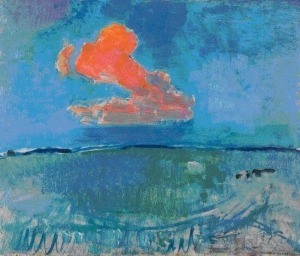
Piet Mondrian The-Red Cloud, 1907
Mondrian, it seems, was very keen to try out anything new and progressive, whether that was rebelling against his strict Calvinist upbringing to explore eastern religions, submit himself to the practice of phrenology (where the bumps and shape of a person’s head is said to show the person’s character or personality traits) or listening to the latest swing and jazz music, particularly when he moved to Paris in 1912. If you are interested in understanding the early life of Mondrian, Mondriaanhuis in Amersfoort is well worth a visit. There you can see the schoolroom Mondrian’s father taught in, and get a feel for the smallness and simplicity – and the miserable dampness of his childhood. You can also follow the artist’s evolution, step into a replica of his Paris studio and hear some of the music he loved to play on his beloved gramophone.
He was an enthusiastic dancer, though he would dance to his own beat. Caro Verbeek, curator at Kunstmuseum Den Haag and assistant professor sensory history, Vrije University, was part of the team of curators who have been working in collaboration for the Tate exhibition, talking us through the pieces in the depot. ‘I’ve collected about 30 eyewitness reports of the way he danced,’ she said. ‘Straight, his upper body was always very straight in angular shape. It was still fashionable to dance in pairs, but he would dance with a large distance in between and he would look upwards. I think he was projecting compositions while he was dancing.’

Hilma Af Klint and Piet Mondrian Installation View at Tate Modern 2023, photograph Jai Monaghan
As a specialist in sensory history, Verbeek, who was dressed, when we met, in electric blue boots and Mondrian-inspired nail colours, has created an installation at the museum where she’s commissioned a fragrance house to produce the smell of each of his studios in Amsterdam, Paris and New York – the kashmir scarf and woodiness of Amsterdam for example.
‘He was a very wild guy,’ she said. ‘We have this picture where he has this beard and this wooden necklace. He’s kind of a hippie there.’ The photograph is part of a new book, Mondrian and Photography edited by Wietse Coppes and was taken by Alfred von Waldenburg, a renowned phrenologist or ‘skull measurer’, in 1909. The Vogue-ish pose was thought to reveal things about a person’s character. Von Waldenburg himself lived in a cabin and slept on a bed made of books (how Hole & Corner is that?)
The exhibition highlights what Dhallu describes as the ‘ethereal worldview’ that both these artists shared, including aspects of symbolism, spiritualism, eastern religions, and even astrology. These influences are clear to see with Hilma af Klint’s work, the Swedish artist.
But Mondrian, who you might have always imagined to be the most rational of artists with his restricted, bold colour palette and straight lines, was influenced by astrology – after he had his birth chart read in 1912, he moved to Paris to further explore the avant-garde and immerse himself at the centre of the modernist art movement.
We are shown extraordinary paintings from Mondrian’s earlier years, including his expansive, lonely dune landscapes on the coast of the Dumburg near to the Westkapelle lighthouse, which he painted and drew six times between 1908-10. The lighthouse was originally built as a church tower in the 15th century and each time Mondrian painted it using a different range of techniques. It’s a slightly sinister-looking building, which you can still visit today if you happen to be following in the artist’s footsteps. We are also allowed to see close up, propped up in all of their luminous glory, the Evolution triptych, also ready to be packed and shipped – three portraits of a nude woman with elements of symbolism, the flowers, the triangular and square-shaped nipples, pointing up or down, the shimmery quality to the painting. According to the curator, Laura Stamps, this is Mondrian’s most symbolist work and ‘hard for a lot of Monondrian specialists to fit in his oeuvre’. But she said, ‘It’s a very interesting painting to understand. From the 1970s onwards, people were saying that this is all about the Theosophist idea of a spiritual phase of evolution development…Of course, this was not where Mondrian was heading.’
There were several flower portraits that had been brought out of storage to show us, including soft stems of chrysanthemums, in different stages of their decay. These flower studies will be used to show the two artists’ shared rootedness in nature. Mondrian’s paintings are more decorative and expressive when compared with Af Klint’s academic botanical drawings, which document the wild flowers and flora and fauna of Sweden. ‘One of the really exciting connections that really comes through when we bring both of these artists together is this ecological connection,’ said Dhallu.
Now installed at the Tate, opposite the Mondrian flower portraits, there’s a wall of Af Klint’s botanical illustrations of wildflowers, native to Sweden, nasturtium, the poppy, the juniper… ‘They both paid attention to the micro and macro life forces,” said Dhallu. “And this kind of push and pull between the macro and micro life forces really carries through throughout the show.’
Hilma Af Klint and Piet Mondrian runs until September 3 2023 at Tate Modern and then will tour to Kunstmuseum Den Haag from October 7 – February 25 2024
To find out more about MondrianHuis and Mondrian in the Netherlands, go to www.holland.com