Martina Spetlova
Photographs Philip Sinden
Martina Spetlova | Designer
Describe your new collection of bags and how they have evolved from your previous work?
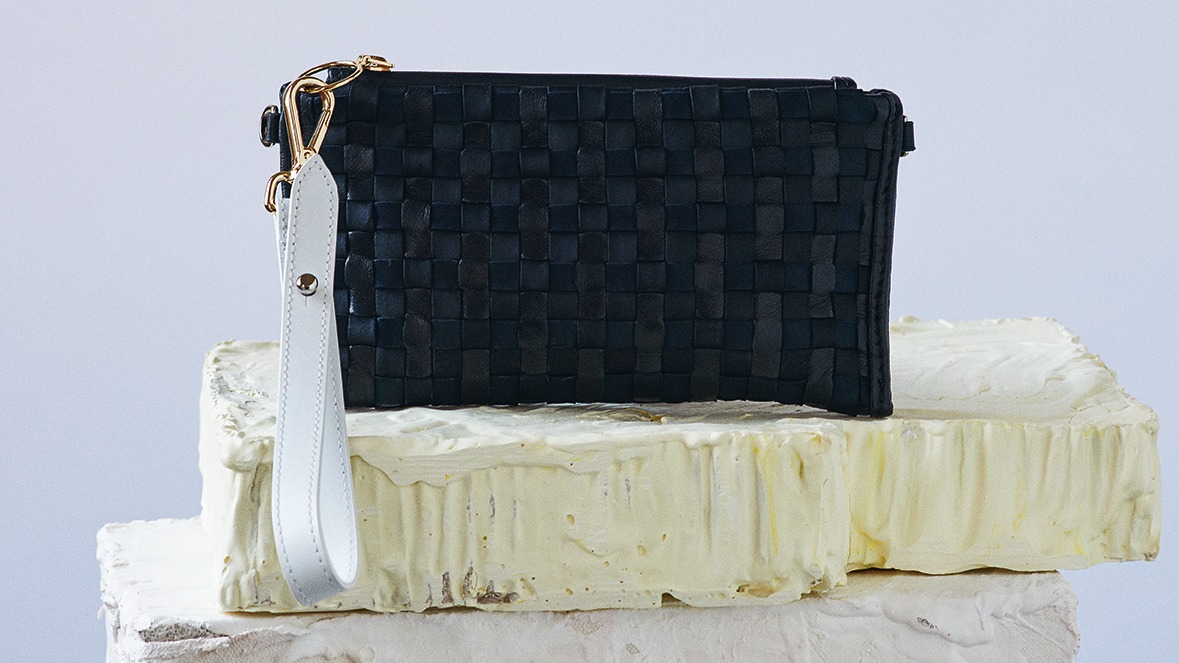
My background is in textile for fashion design, but last year I stopped producing full fashion collections to concentrate on bespoke bags and jackets using the handwoven leather technique I’ve been developing over the past few years.
The accessory collections I have just launched reflect my ethical values in form and function through design and customisation – so with the bags there are different ways of hanging and holding each style. But this is just a small part of a larger transition of my business. I spent last year building a brand that is innovative, responsible, and transparent in its practice, and cares about the communities involved.
This year began with us winning the Leathersellers’ Award 2019, and I’m now concentrating on developing my woven leather technique, exploring new surface treatments to add richness to the textile itself by overprinting, weaving and overlaying patchwork and textured pieces.

Photographer’s assistant Chris Bromley | Props Amanda Benson | Stylists Tamara Fulton, Daisy Gray
How and why you did you make the transition from science to fashion?
I studied chemistry in the Czech Republic before moving to London to study fashion textiles. I have always been interested in fashion – and in textiles in particular. I love experimenting with challenging materials – in some ways it is similar to working in the lab. After I’d been living in London for a few years I applied to Central Saint Martins where I did my BA and Masters in Textiles for Fashion before setting up my own brand.
What does the craft of weaving allow you to do in terms of sustainability – both for materials and your makers?
I only work with European tanneries using hides that are a by-product from the meat industry and would end up in landfill otherwise. All my suppliers have very strict ethical and environmental policies in terms of water usage, emissions, dying processes and animal welfare. The pre-cut leather panels are handwoven by women artisan refugees – who have all fled Syria for a better life in Turkey – and then assembled in the UK.
Last year I partnered with a tech company called Provenance, so that each piece of my work now comes with a scannable chip that details its materials, sourcing and processes. Each product has a narrative; not only from conception to design, but how it has been made, where it has travelled and how it ends up with the consumer, so with this technology, I can easily gather these stories, and embed them online to be viewed.
I’m currently looking for a vegan alternative to leather but I have not found anything that’s not plastic coated. Right now I’m fascinated by the work of Modern Meadow – a company that’s experimenting with bio-based leather grown in a lab from collagen. I’d love to get my hands on that.
How do you ensure quality control for each of the pieces?
At the moment it is not too difficult as I only work with a small number of people and companies. I still travel to Istanbul to oversee the production of the textiles but the women I work with are very involved in the project and take pride in what they do, so eventually, they will become self-sufficient and responsible for the quality control.
What sort of quantities do you make in?
At the moment the quantities are small, and we offer bespoke services to our private clients. That is something I would love to introduce via my e-store as well in the future. Everything is made to order as I don’t hold stock; that is also a part of the sustainability initiative.
How important is detail, colour and texture in your work?
For me it is all about colour and texture – that has always been the most important part of my work.