Inside Sfera: the lifestyle brand re-imagining traditional Japanese craftsmanship
Words Julian Brenna
Photographs Alan Clarke
It takes a singular vision and a certain drive to draw on the Kyoto’s vast heritage of traditional crafts to form a lifestyle brand and concept with a chic, contemporary territory. That is exactly what Shigeo Mashiro has done with Sfera.
Here, he spells out his vision…
Sfera, (Italian for sphere) is indeed an all-encompassing world, where time-honoured traditional Japanese craftsmanship is re-imagined through a prism of European contemporary aesthetics, balancing Zen principles with a discerning sense of style and comfort. The company’s elegant premises are located along a leafy, dipped pathway between the ancient Miyagwa-cho (famous for its geisha tea houses) and the city’s much-loved Kamogawa River. Its secluded location is redolent of Kyoto’s often secretive, hidden world of culture – a world whose compartmentalised nature often makes it difficult for innovative thinkers and designers such as Shigeo Mashiro to break new ground in.
On entering, one instantly feels a sense of harmony and space – a distinct feeling of leaving the hectic world behind for a more rarefied, cleaner sophistication.
Shigeo Mashiro offers an affably natural welcome as he cuddles his French bulldog in his arms. Casually dressed in a faded T-shirt, he is clearly the hands-on type who likes to oversee every step of the operation…

Can you explain the ethos of Sera?
Basically what we see around us in Japan is a huge untapped wealth of craftsmanship and design, often following centuries-old traditions. We feel that in the current climate we can tap into that, coupling it with fresh design sensibilities, thus bringing new potential out of these craftspeople and artists, to then offer it to the wider world. We aim to give these traditional makers new opportunities; maintaining their high standards of craftsmanship but at the same time offering more contemporary interpretations of aesthetics and functionality. We want to champion this talent to the heights it deserves within the context of modern living. Although this movement may appear to be a passing trend, I think it represents a kind of universality that will become a new standard for the future.
Can you expand on the concept of ‘crafting the future’?
We want to widen the notion of crafts and design to one that incorporates modern lifestyles as a whole. Not only are we interested in pottery and furniture, but interior accessories and product design. Any aspect of the way we live our daily lives can be enhanced by such aesthetics. The way we want to go forward is by also looking back to the wealth of knowhow and how it makes use of the natural materials available. The timeless appeal of such quality workmanship has long-lasting potential. However, traditionally in Japan, the various disciplines within arts and crafts have remained pigeonholed into strictly self-limiting worlds and there has been little inter-communication between these realms. Nor has there been much forward-thinking change. With Sfera, I don’t want the idea of crafting the future to be limited, but always open and moving with the times.
Sfera is essentially aiming to create objects that will become antiques of the future. It is humbling to be in a position where we have a responsibility to act as ambassadors to represent these craftspeople and the traditions of their culture. Globally, such crafts are in danger of extinction – one of the major reasons for this is that they simply cannot keep up with rapid lifestyle changes and the huge shift in market demand. It is therefore not only important to come up with new designs and products, but to convey the stories and histories behind these traditional techniques and put that across to the market too; a sharing and appreciation of traditional values of craftsmanship with a forward-looking perspective.
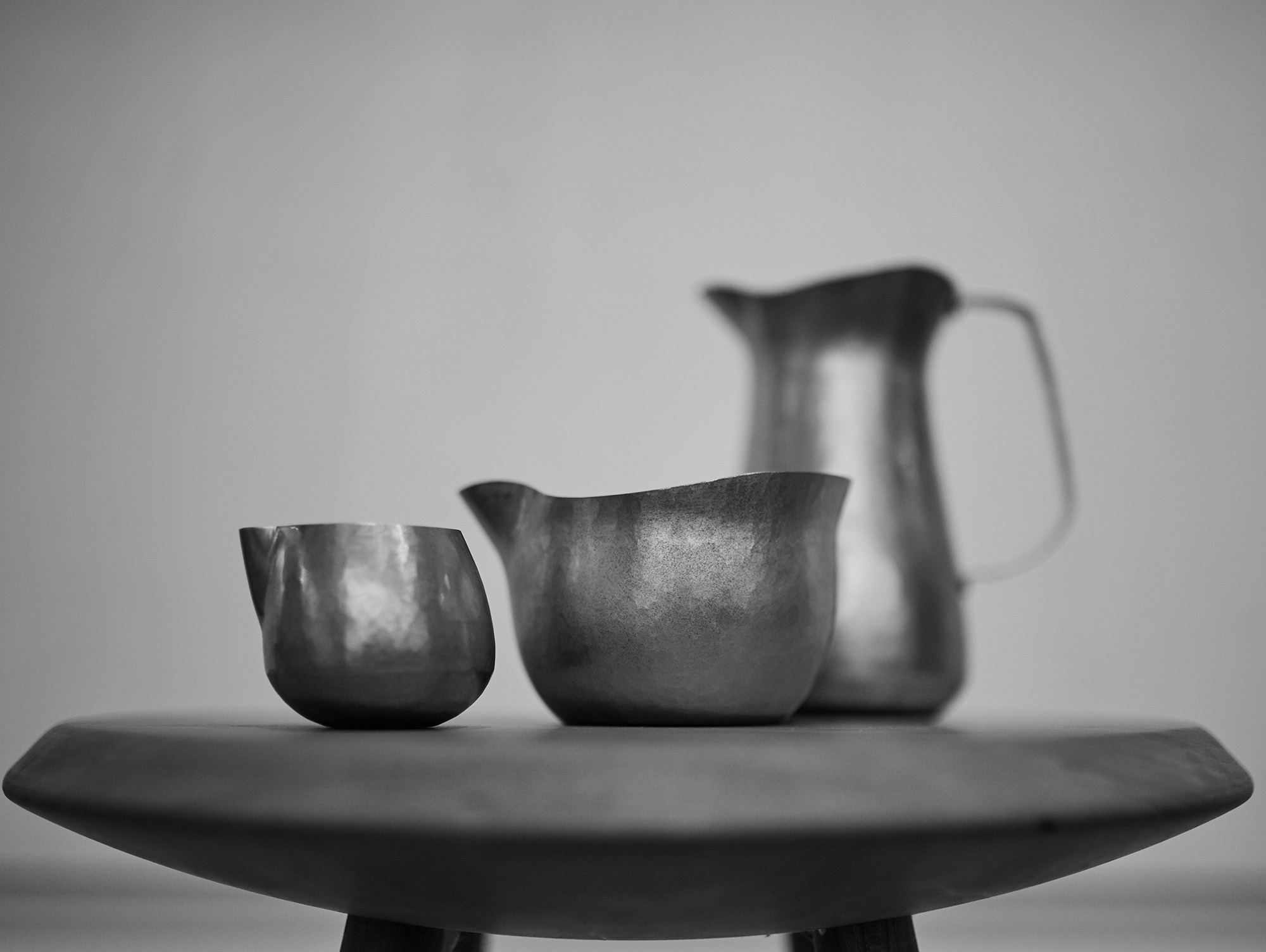
How important to you is the idea of wabi-sabi – the acceptance of transience and imperfection in the making process?
While wabi-sabi is a notion with its roots in Zen, it is one idea among many, and it is often seen in Japanese art work and craft. Japanese art and cuisine has always preferred to stay close to nature and seasonality and as such these ideas of impermanence and transience are in a sense a reflection of that – and somehow truer than the idea of a perfectly finished or symmetrical product. Imperfection or ‘aged beauty’ can be seen in many of these artefacts around us today, so while the notion isn’t always in the forefront of my mind, I am clearly influenced by it, as are the craftspeople I work with. How conscious we are of that is not always apparent. There is a tendency when working with natural materials to allow some of these organic features to remain; to give them some life of their own.

How difficult have you found it to win the trust of traditional craftspeople and to explain your vision to them?
Admittedly, with great experience, comes a kind of stubbornness – an unwillingness to accept newer ideas can be borne out of the tried and tested way of doing things, often over decades. This, I feel, is only natural and is a kind of reassurance for me of their skill and ability – which I have no doubt that they possess in enormous quantities. Showing respect for this is clearly important, along with taking a keen interest in the people I’m working with and their own history and background. It also helps to have at least a fundamental understanding of materials, the skills and ideas involved, and if I can keep within my own territory of design without stepping on their toes so to speak, then a successful collaboration can be fostered. I need to be sincere in my intentions – and if I can communicate things well then there isn’t usually a problem. For example, Shoichi Ishida, who specialises in bamboo crafting, is an old-fashioned artisan in the truest sense. So, rather than approach him with a new aesthetic vision or talk about market trends, we would sooner arrive at an idea for a product that brings out his technique, but also feels rewarding and challenging for him. The final work is a result of our considered exchanges and opinions; a mutually happy agreement.
Do you feel that there is a revival of interest in craftsmanship in contemporary design both in Japan and globally?
Without doubt. There is an ever-growing number of people who are re-connecting to something that was lost. The humanity that can be found through acquainting themselves with these authentic and untainted processes of crafting is really resonating with people again. I think in these very digital times we genuinely want to escape from seeing the world distorted through these media and to get back to true values in all kinds of products, from music to food. The more digital we become, it seems the more we want to enjoy products that resonate with our humanity. We are seeking out authenticity more and more.

Do you worry that this may be seen as a passing fashion trend by some consumers and brands rather than a long-term commitment?
I firmly believe that this is set to continue as the new standard rather than a temporary trend. In my view this isn’t some fad for nostalgia, it’s a genuine pursuit of quality and formulas that have stood the test of time and which themselves have taken time and care to make, with a touch. It is necessary sometimes to go back to basics when it feels like we are losing our way. People have always liked well-crafted products and interior accessories, but there are times when we have temporarily departed from this notion. We will always return to it however, hence the timeless appeal of such items. The digital world we live in isn’t going to go away soon, so neither is our love for the authentic or the analogue as an antidote to that. I envisage a world where the two can co-exist. It is perhaps ironic that this wave of discernment for authenticity is indirectly a result of the digital revolution. The flower arrangements in the wooden sculpted bowls you can see around you in this room for example, I insist on doing myself. These days, even the flower arrangements that you see are sometimes made of plastic or displayed digitally. The clients and customers who come to Sfera are equally insistent on having real things around them, elements of nature, and they always have been. Those clients won’t suddenly change their tastes overnight – it’s a lifelong pursuit of quality.
What aspect of your job do you enjoy the most?
In general terms, it is simply a great pleasure to be working in an environment where there is natural inspiration in seemingly constant flow. More recently, I have been channelling this into the design of one-off pieces. Initially our focus was more on everyday interior accessories, but the design of these objéts has really allowed me to indulge my inspiration from nature too, to go where ideas take me. There’s an added satisfaction in knowing that each work is unique in that respect.

What have you most enjoyed about working with these craftspeople?
First of all I enjoy the process of communicating an idea with them, but not only that: when the piece of work finally comes to fruition, however well we have conceived of the idea and thought it through, the finished work is invariably beyond my expectations, in ways I could never have imagined.
That feeling of validation, that the collaboration has been well-executed, is pretty special. Obviously, I have a general interest in their lives and work and, as our friendships have grown, it has become one of life’s little pleasures to simply shoot the breeze with them. They have given me so much insight into their crafts, and how they work their materials. As I go about my own work, I am constantly aware of the skills base we have at our disposal and how we can make the most of it for the next ideas we generate – and the ones after that. My mind is constantly on the go with this kind of creative contemplation. That’s not to say that there aren’t moments where the freshness fades or we hit a dry spot. I think those lulls are a natural part of the process, and they are often a reminder to keep things simple, go back to basics and not to lose sight of what you have.
What is the most important lesson you have learnt?
By working with age-old traditions of craft making in the world of the tea ceremony and especially when designing religious artefacts for use in Buddhist practices, I have found myself having to do some serious soul searching. Should I really be meddling with these hitherto unchanged traditions? Am I pushing too far? Rocking the boat too much?. There are even times when I have to ask myself whether my motivations are true, or whether I am pursuing something simply for self-gratification. I find this level of contemplation highly instructive. It helps me to ensure that I am communicating honestly from the point of view of design only. My designs can be an expression of the changes that they embody, they can tell the story of that very struggle. Through engaging with craft making and techniques, we are acquainting with another aspect of human nature on a deeper level. The philosophies of the craftspeople – and how they approach their work – reflect strongly. This process of grappling with ideas through dialogue is a hugely important contributor to the design process itself.